In the animal kingdom, the cheetah is legendary. It is the fastest land animal on Earth, capable of accelerating from 0 to 60 mph in just three seconds. When we think of apex predators, the cheetah’s sleek, aerodynamic form often comes to mind.
But there is a harsh reality in the wild: speed does not equal invincibility.
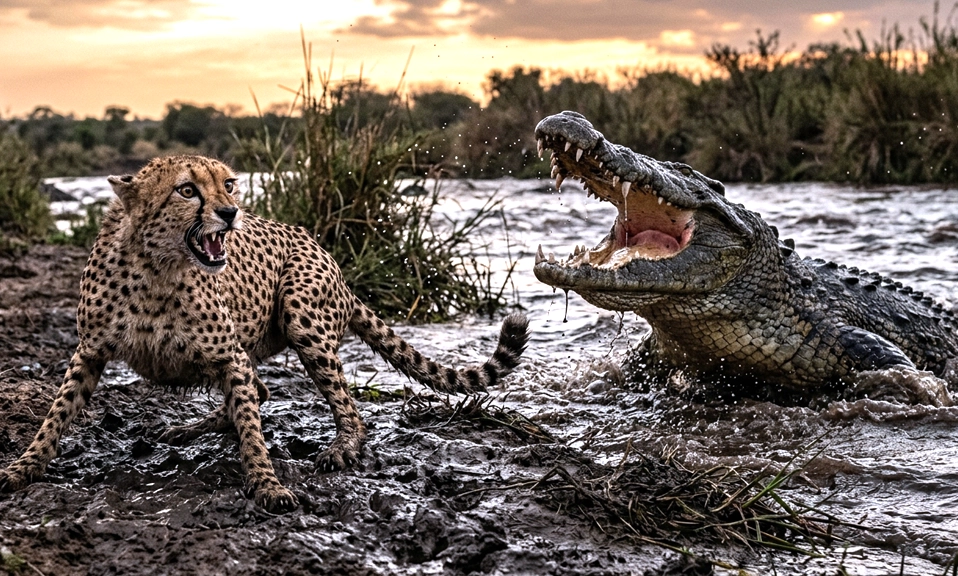
If a cheetah were to encounter a Nile crocodile at the edge of a river, the cheetah would not attack. In fact, it would do everything in its power to avoid the water entirely. This isn’t cowardice; it’s millions of years of evolutionary survival instinct.
Here is the fascinating biological and ecological breakdown of why a cheetah would never dare to attack a crocodile.
🏃♂️ 1. Built for Speed, Not Combat (The “Glass Cannon” Effect)
The cheetah’s entire anatomy is a masterclass in aerodynamic engineering, but it comes at a severe cost: fragility.
- Lightweight Frame: To achieve blistering speeds, cheetahs have lightweight bones, small heads, and slender bodies. They simply do not have the mass to wrestle a heavy opponent.
- Weak Bite Force: Compared to other big cats, a cheetah’s jaw is relatively weak. It is designed to suffocate small to medium-sized prey (like gazelles), not to crush thick, armored hides.
- Non-Retractable Claws: A cheetah’s claws act like the cleats on a sprinter’s shoes, providing traction for running. They are not the sharp, retractable grappling hooks of a lion or leopard, making them useless as weapons in a fight.
In a physical confrontation, a cheetah is essentially a “glass cannon”—incredibly fast, but highly vulnerable to damage.
🐊 2. The Crocodile’s Ultimate Arsenal
On the other side of this matchup is the Nile crocodile, one of nature’s most perfect ambush predators.
- Living Armor: A crocodile’s back is covered in osteoderms (bony deposits) that act like a natural suit of chainmail. A cheetah’s weak claws and bite would do absolutely nothing to penetrate this armor.
- Crushing Bite Force: A large Nile crocodile has a bite force of nearly 5,000 pounds per square inch (PSI). One snap is enough to shatter bone.
- The Death Roll: If a crocodile gets a grip on any part of a cheetah, it will drag it into the water and perform a “death roll,” a maneuver designed to dismember prey or drown it instantly.
⚠️ 3. The “Injury = Death” Rule
This is perhaps the most critical reason cheetahs avoid conflict.
For a lion or a leopard, a minor injury from a fight is a setback. For a cheetah, any injury is a potential death sentence.
Because cheetahs rely entirely on their speed and agility to catch prey, a sprained ankle, a torn muscle, or a deep bite wound means they can no longer hunt. In the wild, a cheetah that cannot hunt will starve to death within days. Therefore, cheetahs are incredibly risk-averse. They will abandon a fresh kill to a lion or a hyena rather than risk injury fighting for it. Attacking a crocodile is a risk with a 100% chance of severe injury or death, and zero chance of a reward.
🌊 4. The Environmental Disadvantage
Cheetahs are strictly terrestrial animals. They are built for the open savanna, not aquatic environments.
Crocodiles, however, are masters of their domain. In the water, or even in the shallow, muddy banks of a river, a crocodile has total control. A cheetah entering the water loses its greatest advantage (speed and agility) and becomes slow, clumsy, and highly vulnerable. Evolution has hardwired cheetahs to view large bodies of water as danger zones, not hunting grounds.
🔄 The Reality: It’s Usually the Other Way Around
In the wild, the dynamic is almost never a cheetah attacking a crocodile. Instead, crocodiles are a known predator of cheetahs.
During the Great Migration in the Serengeti and Masai Mara, cheetahs are sometimes forced to cross the Mara River to follow their prey. These river crossings are treacherous. Crocodiles lurking beneath the surface are known to ambush and drown cheetahs (especially mothers with cubs) as they attempt to swim across.
In this scenario, the cheetah’s only defense is to assess the risk, wait for a safe moment, and sprint across as fast as possible. Fighting is never an option.
Survival Over Ego
In human terms, we might call it “fear.” But in biological terms, it is optimal risk assessment.
The cheetah’s evolutionary success is not based on dominance or brute strength; it is based on efficiency, speed, and avoiding unnecessary danger. Attacking a crocodile offers no nutritional reward, guarantees severe injury, and violates every survival rule the cheetah has evolved to follow.
Nature is not a movie. There are no heroic last stands. There is only the cold, calculated logic of survival. And in the wild, the smartest predators know exactly when to walk away.
Did you know that cheetahs are so fragile they will abandon a kill rather than fight for it? What’s your favorite fact about cheetahs or crocodiles? 🐆🐊🌿