Why Only 30–50 May Remain
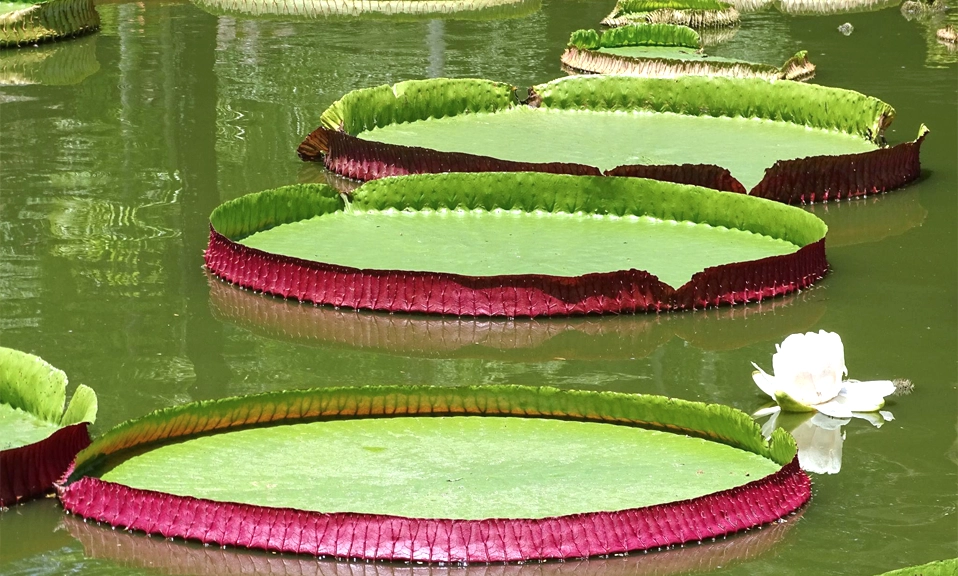
It can be seen from space. Its leaves can grow up to three metres wide and carry the weight of a small child. It is one of the oldest flowering plants on Earth, a living relic from before the continents split apart. And until this week, science didn’t even know it existed.
The Colombian giant water lily — Victoria colombiana — has just been confirmed as a new species, published in the journal Phytotaxa. It is the first new giant water lily to be found in the Americas in over a century, and the fifth known species in the genus Victoria. But it comes with a devastating caveat: there are estimated to be only 30 to 50 individual plants left in the wild, making it critically endangered.
The story of how it was found — and why it may already be too late — is as extraordinary as the plant itself.
A Selfie That Changed Botany
The discovery began with an Instagram post.
In 2021, Jeremiah Harris, an American who runs a carnivorous plant nursery, posted photos of himself swimming among giant water lilies in Colombia’s Inírida River. He had labelled the plant Victoria amazonica — the common giant water lily of the Amazon basin. But when Carlos Magdalena, a world-renowned waterlily expert at the Royal Botanic Gardens, Kew, saw the photo, he immediately suspected something was wrong.
The natural range of Victoria amazonica does not extend to the Inírida River. The region is part of the Orinoco Basin, which had been geographically separated from the Amazon for millions of years. No known giant water lily had ever been reported there.
“I realised it was remarkable,” Magdalena later said.
He messaged Harris to track down the exact location. Then he spent several years analysing satellite imagery, securing permits, and assembling a team. The satellite images confirmed telltale green dots — giant lily pads floating in the flooded rainforest.
The Five-Day Expedition
In 2024, Magdalena led a five-day expedition deep into the Inírida region, working alongside researchers from the Jardín Botánico in Bogotá and members of local Indigenous reserves — the Río Atabapo, Caranacoa-Yurí-Laguna Morocoto, and Puinave-Piapoco el Paujil communities.
For days, they found nothing. They located two plants, but neither was flowering — and the flower is essential for identifying a new species. With only 10 hours left before their return flight, the expedition seemed to have failed.
Then, at 11 p.m. on the final night, one of their guides — Gustavo Melo, from the Indigenous Tucano community — said he knew where more plants were growing.
The team set off by boat in total darkness. They navigated a flooded forest with no GPS and no mobile signal, relying entirely on the guides’ knowledge of the landscape. Just before sunrise, they found five giant water lilies in a small lake, including one in full flower.
“It was so emotional I shed a tear,” Magdalena said. “It was one of those moments that will remain with me for life”.
What Makes Victoria colombiana Different
The new species differs from Victoria amazonica in several key ways. Its spines — a defence against manatees and plant-eating fish — are oriented differently beneath the leaves. The shape of its flowers and fruits is also distinct.
But its most striking feature is its sheer size. The leaves can reach two metres across, and the plant is large enough to be visible from space. Giant water lilies are among the oldest flowering plants still alive today, existing before the continents split apart. They appear throughout human culture, from the Egyptians to Monet.
Why Only 30–50 Remain
The researchers estimate there are between 30 and 50 individual Victoria colombiana plants left in the wild. The reasons are the same pressures facing countless species across the region:
Habitat loss and degradation. The Inírida region’s flooded rainforests are under threat from deforestation, agricultural expansion, and changing water patterns.
Extreme rarity and isolation. Even before its formal discovery, the plant was “incredibly rare and grows in places that are not often visited by people, let alone science,” Magdalena explained. Its small populations are vulnerable to any disturbance.
Limited reproductive output. With so few individuals, the species faces the risk of genetic bottlenecks and reduced resilience to environmental change.
The Race to Save It
The team is not waiting for the species to disappear. They are already working to collect seeds and propagate the plant, both in botanic gardens and in collaboration with local Indigenous communities near its natural habitat.
There are also hopes to cultivate Victoria colombiana at Kew Gardens in London, alongside its relatives.
Magdalena has been careful to credit the role of Indigenous knowledge in the discovery. “Their knowledge of the area is incredible,” he said. “They had legendary navigation skills in a rather thick flooded forest where GPS knowledge or mobile connectivity was simply not there. To say that this research would not have been possible without their support and help is an understatement”.
He described the discovery as “one of those extraordinary stories where indigenous and horticultural knowledge with the help of social media and technology came together to uncover a truly extraordinary botanical achievement”.
The Bigger Picture: A Plant That Shouldn’t Have Been Lost
What makes Victoria colombiana so striking is not just its size or its rarity. It’s the fact that a plant this large — visible from space, capable of supporting a child’s weight — could remain unknown to science for so long.
“New species are found all the time, but few are as large, spectacular and emblematic as this one,” said Maarten Christenhusz, the plant taxonomist who analysed the sample. “This new giant waterlily can even be seen from space, which is a striking reminder of how much we still don’t know about life on our planet”.
The discovery also nearly doubled the number of known giant water lily species. For decades, science recognised only two: Victoria amazonica and Victoria cruziana. In 2022, Victoria boliviana was confirmed. Now Victoria colombiana brings the total to four — with a fifth, Victoria mattogrossensis, expected to be described soon.
The Colombian giant
water lily is a survivor. It has existed since before the continents split. It has hidden in flooded rainforests that few people ever visit. It has, against the odds, escaped detection by science for centuries.
But it may not survive the next century.
With only 30 to 50 plants left in the wild, Victoria colombiana is balanced on a knife’s edge. The discovery is a triumph of technology, Indigenous knowledge, and botanical persistence. The conservation challenge is just beginning.
“We believe we know everything but the reality is we don’t,” Magdalena said. “There’s lots of things still to be discovered and protected”.
The giant water lily of the Inírida is one of those things. And now that we know it exists, the responsibility is ours.
The study, “Victoria colombiana (Nymphaeaceae), a new species from the Colombian Orinoco Basin,” was published in Phytotaxa on October 9, 2026.