The petrol station ritual—five minutes at the pump, a swift exit—has been the benchmark the electric vehicle industry has been chasing for over a decade. In 2026, that benchmark has finally been met, and in some cases, beaten. Flash charging is no longer a laboratory curiosity or a concept car promise. It is arriving on European roads, in Chinese showrooms, and in the specifications of the next generation of electric vehicles. The question is no longer whether an electric car can charge in under ten minutes. It is what it will take to make that experience the norm rather than the exception.
The technology is real. BYD has begun installing its 1,500 kW Flash Charging network in Europe, with a hundred stations planned by the end of 2026, capable of taking compatible vehicles from 10% to 70% in five minutes and 10% to 97% in nine. Geely has demonstrated a system that can charge from 10% to 70% in 4.5 minutes and 10% to 97% in 8 minutes and 40 seconds. Tesla has confirmed that its new Roadster, equipped with its most advanced 4680 battery pack, will charge from 15% to 85% in about ten minutes. And solid-state batteries from companies like ProLogium and Donut Lab are entering mass production with charging times that promise to make the ten-minute barrier a conservative estimate.
But the headline numbers only tell part of the story. The reality of flash charging—who can use it, where, and under what conditions—is far more complicated than a single lap time. The technology is here. The infrastructure, the standards, and the economics are still catching up.
The Technology: How Flash Charging Actually Works
Flash charging is not simply a matter of pumping more electricity into a battery. It is a system-level engineering challenge that requires three things to work in concert: a battery that can accept enormous charge rates without degrading, a charging station that can deliver those rates, and a thermal management system that can keep the whole process from turning into a fire hazard.
The Battery: Beyond Conventional Lithium-Ion
The first enabler is the battery itself. BYD’s second-generation Blade Battery 2.0 uses a lithium manganese iron phosphate (LMFP) cathode and a silicon-carbon composite anode, along with an electrolyte designed to improve ion mobility. The result is a battery that can accept 1,500 kW of charging power while increasing energy density by 5% compared to the first-generation Blade. BYD says the battery can go from 10% to 97% in nine minutes at room temperature, and even at -30°C, a 20% to 97% charge takes just 12 minutes.
Solid-state batteries offer a different path to the same goal. ProLogium’s Lithium Ceramic Battery, now in mass production at its Taoyuan facility with backing from Mercedes-Benz, promises 5% to 80% charging in under ten minutes and an energy density of 381 Wh/kg—roughly 30% better than conventional NMC cells. Donut Lab’s solid-state battery, already in production for Verge Motorcycles, claims a full charge in five to ten minutes.
The Charger: Megawatt-Class Power
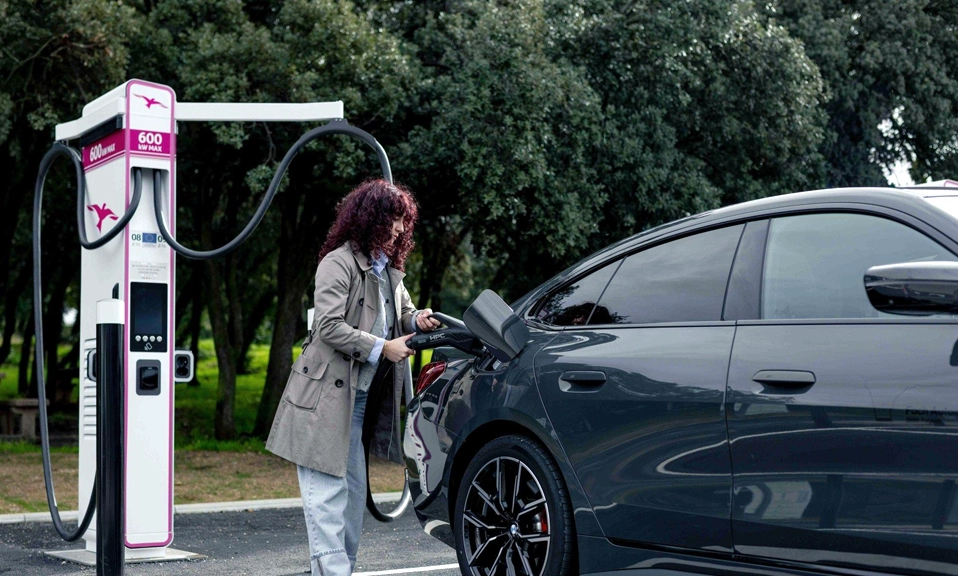
The second enabler is the charger. BYD’s Flash Charging stations deliver up to 1,500 kW per port. Geely’s system is even more powerful, with a peak output of 2.25 megawatts (MW) from a single gun. These are not the 50 kW or 150 kW chargers that have defined public EV infrastructure for the past decade. They are megawatt-class machines that require their own grid connections, their own cooling systems, and their own safety protocols.
To avoid overwhelming local grids, BYD’s Flash Charging sites use on-site battery energy storage systems (BESS) with a capacity of 370 kWh. The BESS draws power from the grid at a modest 100 kW to 560 kW between vehicle recharges, then delivers the full 1,500 kW burst when a compatible car plugs in. This removes the need for costly local grid upgrades—a critical factor in making the stations deployable at scale.
The Thermal Challenge: Keeping It Cool
The third enabler is thermal management. Pushing megawatt-level currents into a lithium-ion battery generates enormous heat, and heat is the enemy of both safety and longevity. Geely’s solution is a full-loop “five-end” liquid cooling network that circulates fluid through the charging station’s storage batteries, the liquid-cooled cables, and the vehicle’s charging port. The company also uses AI-powered deep-learning algorithms running on the vehicle to anticipate temperature rises 30 seconds in advance and adjust the charging current accordingly, keeping the average cell temperature below 55°C and preventing it from exceeding 65°C.
The Reality Check: What Flash Charging Cannot Do (Yet)
The technology works. But the experience of using it is not yet universal, and the gap between the best-case demonstration and the average driver’s reality is where the flash charging story becomes more complicated.
The Vehicle Compatibility Problem
Flash charging requires a compatible vehicle. BYD’s 1,500 kW stations can only deliver their full power to cars equipped with the second-generation Blade Battery. In Europe, that currently means the Denza Z9 GT—and very little else. The BYD Atto 8, a seven-seat SUV with a 115 kWh battery and 653 km of WLTP range, will not arrive until the first quarter of 2027. Other compatible models are expected to follow, but the rollout of vehicles is lagging behind the rollout of chargers.
This is a familiar pattern in EV infrastructure: the hardware arrives before the cars that can use it. For most drivers, the flash charging experience will not be available until they buy a car that supports it—and for now, that means buying a very specific, very new model from a limited number of brands.
The Infrastructure Gap: Europe Is Behind China
BYD’s European rollout is ambitious but modest in scale. The company plans 100 Flash Charging stations in Europe by the end of 2026, with a longer-term goal of 3,000 stations by the end of 2027. In China, by contrast, BYD already has 12,165 stations in operation and aims for 20,000 by the end of 2026. The European network will be concentrated in Germany, the UK, and a handful of other markets, leaving large parts of the continent without access to the technology.
Geely’s ultra-fast charging system is currently being developed and tested only in China. The company has not yet announced plans to bring its smart charging technology to other markets. Tesla’s ten-minute Roadster charging is a feature of a low-volume, high-priced halo car, not a mass-market proposition.
The Grid and Cost Challenge
Even with on-site battery storage, megawatt-class charging stations place significant demands on the electricity grid. A single 1,500 kW charger drawing power at full rate is equivalent to the demand of hundreds of homes. The BESS buffer helps, but it does not eliminate the need for a robust grid connection. As one review of fast-charging infrastructure notes, “without strategically deployed charging stations, EV adoption faces significant barriers, including range anxiety, limited accessibility, and uneven grid utilization”. Uncoordinated megawatt-level charging hubs can introduce “localized transformer thermal overloading, voltage unbalance, and severe harmonic distortion” into distribution networks.
The cost of deploying these stations is also substantial. The high-power hardware, the on-site batteries, the liquid cooling, and the grid upgrades all add up. BYD’s partnership with Sinopec, the Chinese oil giant, to install chargers at existing service stations is a pragmatic way to share the infrastructure cost—but it is a model that may not translate easily to markets where oil companies are less willing to invest in EV charging.
The Battery Degradation Question
Fast charging has long been associated with accelerated battery degradation. The concern is real: pushing high currents into a battery generates heat and mechanical stress that can shorten its lifespan. The industry’s response has been a combination of better battery chemistry, smarter thermal management, and software that monitors and adjusts charging rates in real time.
BYD claims its Blade Battery 2.0 has been designed for longevity, and Geely’s AI-driven thermal control is explicitly intended to “reduce the impact of fast charging on battery life”. But the long-term data on how these batteries perform after years of frequent flash charging is not yet available. The first generation of flash-charging vehicles will be the test case, and the results will not be known for several years.
The Competitive Landscape: A Chinese-Led Revolution
The flash charging revolution is being driven overwhelmingly by Chinese automakers. BYD, Geely, and Li Auto are competing fiercely to outdo each other on charging speed, and the result is a pace of innovation that Western legacy automakers have struggled to match.
Li Auto’s flagship EVs use CATL’s 5C Kirin battery, which can add 500 km of range in 12 minutes. Sunwoda has joined the race with a battery system promising 10% to 97% in nine minutes. For context, a standard 10% to 80% charge on a Tesla Supercharger typically takes 15 to 25 minutes, and Mercedes-Benz offers fast charging from 10% to 80% in as little as 22 minutes. The Chinese systems are roughly twice as fast as the Western benchmarks.
This lead is not accidental. It reflects a strategic bet by Chinese manufacturers that charging speed—not just range—is the key to winning mainstream consumers. As one Reuters analysis put it, “no longer satisfied with 30-minute top-ups, automakers such as Geely, BYD, and Li Auto are now racing to deliver charging speeds that mimic the 5-minute gasoline stop”. The goal is to eliminate the last remaining friction point in the EV ownership experience, and to do it before Western rivals can catch up.
Flash Charging Is Here, But the Revolution Is Uneven
Flash charging is no longer a promise. It is a product, and it is on sale. BYD’s stations are being installed in Europe. Geely’s technology has been demonstrated on real vehicles. Solid-state batteries with ten-minute charging times are entering mass production. The ten-minute barrier has been broken, and the five-minute barrier is within reach.
But the experience of flash charging is not yet universal, and it will not be for several years. The vehicles that can use it are few and expensive. The stations are concentrated in specific markets and specific locations. The grid, the cost, and the long-term battery degradation questions remain unresolved. For most drivers, the ten-minute charge is still a future prospect, not a daily reality.
The significance of the flash charging revolution is not that it has solved the EV charging problem overnight. It is that it has proven the problem is solvable. The technology exists. The engineering challenges are being met. The infrastructure is being built. The question is no longer whether electric cars will one day charge as fast as petrol cars. The question is how quickly that day will arrive—and who will be first to deliver it at scale.
The answer, for now, is China. The challenge, for everyone else, is to catch up.