If you had told a dermatologist ten years ago that a clear, watery liquid used to clean burn wounds and sanitize veterinary clinics would one day be a must-have beauty staple sitting next to designer serums, they would have laughed.
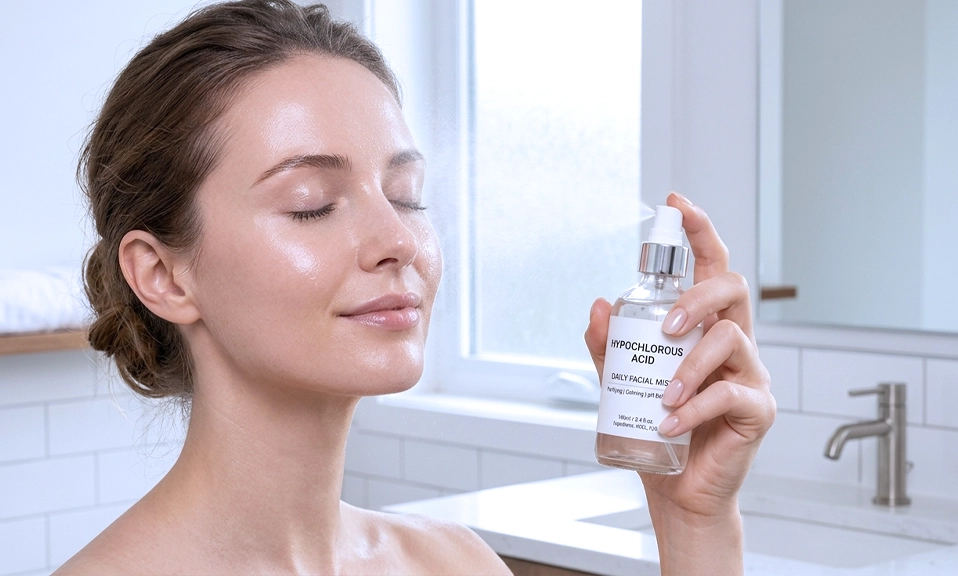
But today, Hypochlorous Acid (HOCl) spray is everywhere. It’s in the bathrooms of beauty influencers, recommended by makeup artists to set their clients’ faces, and flying off the shelves of drugstores and Sephora alike.
How did a literal medical-grade antimicrobial agent become the “It” girl of the skincare world?
The journey of HOCl from the hospital ward to the vanity table is a fascinating look at how consumer skincare trends are shifting—and why the best beauty hacks are often the ones backed by hard science.
🏥 Phase 1: The Clinical Secret Weapon
To understand the hype, you have to look at where HOCl started. For decades, Hypochlorous Acid has been a quiet hero in the medical field.
Because it is the exact same molecule produced by human white blood cells to fight infection, it is incredibly effective at killing bacteria, viruses, and fungi, yet completely non-toxic to human tissue.
- In burn units: It’s used to clean severe wounds without damaging fragile, regenerating skin.
- In veterinary clinics: It’s used to treat animal bites and infections.
- In eye care: It’s used in sterile saline solutions for contact lens wearers.
It was the ultimate “behind-the-scenes” medical tool. It wasn’t marketed to consumers, it didn’t have a catchy name, and it certainly wasn’t considered “glamorous.” It was just highly effective medicine.
🩺 Phase 2: The Dermatologist Crossover
The first bridge between the hospital and the beauty world was built by dermatologists and aesthetic nurses.
As in-office procedures like microneedling, laser resurfacing, and deep chemical peels became wildly popular, practitioners needed a way to help patients heal. Traditional toners and astringents were too harsh for compromised skin.
Dermatologists started telling their patients: “Go to the medical supply store and buy a wound-care spray.”
Patients who used HOCl post-procedure noticed something incredible: their skin healed faster, redness subsided almost immediately, and they didn’t break out. Word of mouth spread. The “secret” was out. The medical community had accidentally created the ultimate post-treatment skincare hack.
📱 Phase 3: The TikTok Boom and “Barrier Repair”
If dermatologists lit the spark, social media poured gasoline on it.
Around 2021 and 2022, the skincare community experienced a massive cultural shift. For years, the trend had been “more is more”—layering harsh retinoids, 30% AHA peels, and strong benzoyl peroxides to get that “glass skin” look. But the result? A generation of consumers with severely damaged skin barriers, chronic redness, and cystic acne.
Enter the “Barrier Repair” trend. Consumers desperately wanted to heal their skin, not strip it.
TikTok creators and skincare chemists began highlighting Hypochlorous Acid as the ultimate barrier-rescuer. It didn’t exfoliate. It didn’t cause purging. It just healed.
Videos of people spraying it on their faces to instantly calm rosacea flare-ups, soothe sunburns, or clear up “maskne” went viral. It was the perfect antidote to “skincare fatigue.”
💄 Phase 4: The Beauty Industry Pounces
Once a medical ingredient goes viral on TikTok, the beauty industry moves at lightning speed.
Brands realized that HOCl wasn’t just a niche medical product; it was a highly marketable, multi-tasking beauty staple.
- Tower 28 Beauty launched their SOS Daily Rescue Facial Spray, packaging the medical ingredient in a chic, minimalist bottle and marketing it specifically for sensitive, eczema-prone skin. It became a cult classic.
- Briotech and SkinSmart, originally medical brands, suddenly found themselves competing for shelf space in Ulta and Sephora.
- Makeup Artists adopted it as a holy grail tool to hydrate skin and kill bacteria on set without messing up foundation.
Suddenly, HOCl wasn’t just for healing laser burns; it was for refreshing your face after a sweaty gym session, soothing a toddler’s diaper rash, and setting your makeup before a night out.
🧪 Why It Actually Stuck (It’s Not Just a Fad)
Many viral skincare trends (like slugging or using toothpaste on pimples) fade away once the novelty wears off. But HOCl has staying power because it solves a fundamental problem in modern skincare.
We live in an era of highly active, highly potent skincare. We are using stronger retinoids and more potent acids than ever before. Our skin is constantly under assault from environmental stressors, pollution, and our own routines.
HOCl is the perfect counterbalance. It is the “off switch” for inflammation. It allows us to use active ingredients while providing a safety net that keeps the skin’s microbiome balanced and the barrier intact.
Furthermore, it’s incredibly affordable compared to a $150 luxury serum, and it actually does what it claims: it kills 99.9% of bacteria without irritating the skin.
Science is the New Luxury
The rise of Hypochlorous Acid spray represents a massive shift in the beauty industry. Consumers are no longer just buying into fancy marketing, beautiful packaging, and rare botanical extracts.
They are looking for clinical efficacy. They want ingredients that have a proven track record in medicine, repackaged for their daily lives.
HOCl’s journey from the burn ward to the beauty blender proves that the most revolutionary skincare products aren’t always the ones with the most complex ingredient lists. Sometimes, the best thing you can put on your face is the exact same molecule your own body uses to heal itself.