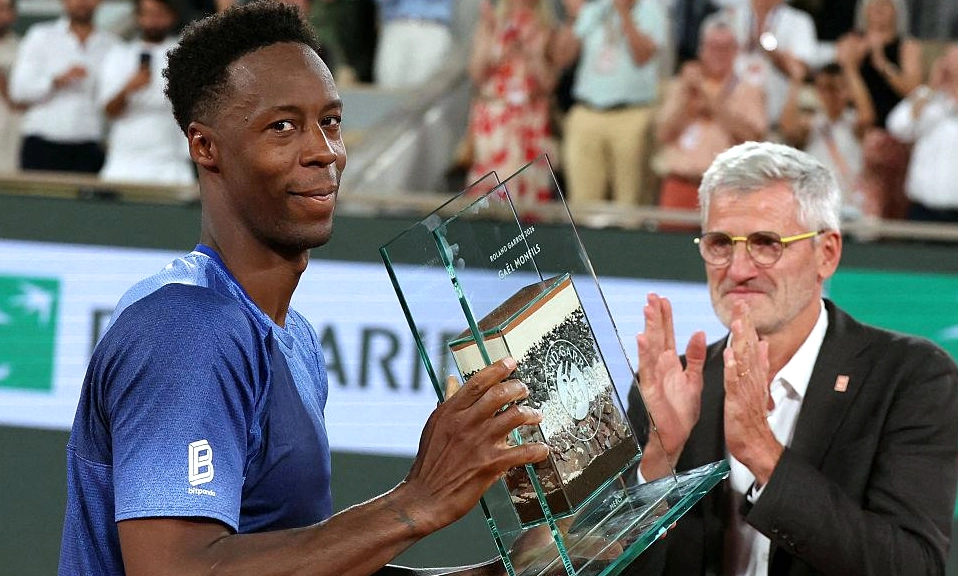
PARIS — The Centre Court at the Plenitude Arena in Nanterre has witnessed countless moments of tennis brilliance, but on the night of November 3, 2026, it hosted something rarer: a farewell that felt less like a retirement and more like a celebration of joy itself. Gaël Monfils, the 40-year-old Frenchman who spent 22 years turning tennis into theatre, said goodbye to the sport that made him a showman, an entertainer, and one of the most beloved figures of his generation.
The ceremony was everything Monfils deserved: a packed stadium, a giant banner reading “Merci Gaël,” and a lineup of French tennis royalty—Jo-Wilfried Tsonga, Gilles Simon, Richard Gasquet, and Benoit Paire—joining him on court for a final bow. But the path to that moment was not the one he had planned. Monfils had intended to end his career with one last match at the Paris Masters, in front of the home crowd that had carried him for two decades. Instead, he quietly retired in October, his name appearing on the International Tennis Integrity Agency’s inactive list amid the breakdown of his marriage to Ukrainian player Elina Svitolina. The send-off was a celebration, but it carried a bittersweet undercurrent—a farewell that came earlier and more privately than anyone expected.
The Showman Who Redefined Entertainment
Monfils’ legacy cannot be measured in titles alone. He won 13 ATP Tour singles titles, reached a career-high No. 6 in the world, and made two Grand Slam semi-finals—at Roland Garros in 2008 and the US Open in 2016. He won 588 tour-level matches across a career that began in 2004 and ended at this year’s US Open, where he lost to Learner Tien in the second round. Those numbers are respectable. They are not, however, what made Monfils unforgettable.
What made Monfils unforgettable was the way he played. He was “La Monf”—a nickname that captured the theatricality of his movement, the audacity of his shot-making, and the sheer joy he brought to a sport that can often feel mechanical. He slid across hard courts like a dancer, dove for balls that had no business being returned, and turned lost causes into winners that defied belief. He was, as the ATP Tour put it, “one of tennis’ greatest showmen”—a natural athlete with extraordinary talent whose ability to electrify a crowd was unmatched.
Learner Tien, the 20-year-old American who played Monfils in his final professional match, put it best. “I didn’t like tennis very much and with the way he played, how exciting he was, that attracted me to watching him,” Tien said. “He was one of the few players that I watched growing up”. That is Monfils’ true legacy: he made people love tennis who might otherwise have looked away.
The Moments That Defined a Career
Monfils’ career was punctuated by moments of impossible drama. In 2009, he came from behind to force Novak Djokovic to a deciding set in the Paris Masters final, electrifying the Bercy crowd. A year later, he saved five match points against Roger Federer in the same tournament’s semi-final and beat him for the first time—a victory that remains one of the most astonishing upsets of his generation.
He reached three Masters 1000 finals. He won ATP 500 titles in Washington (2016) and Rotterdam (2019 and 2020). His last title came in Auckland in January 2025, at the age of 38—a testament to his longevity and his enduring competitive fire. And in September 2026, on his 40th birthday, he won a match at the US Open, becoming the oldest man to win a main-draw match at the tournament since Jimmy Connors in 1992. It was a fitting final flourish for a player who never stopped defying expectations.
The Farewell: “I Did the Maximum”
When Monfils finally spoke on Tuesday night, his voice carried the weight of a career that had given him everything and demanded everything in return.
“I’m not going to hide that, this is a very difficult moment to say goodbye,” he told the crowd. “The most beautiful thing that this world has given me is you, the wonderful crowd. It’s not easy at all”.
He thanked his parents, his team, and the friends who had helped him through a “more complicated period personally”. He spoke of his pride in what he had achieved, and of the peace he had found in reflecting on it. “I did the maximum,” he said. “I’m very happy and at peace with what I achieved. I told myself, ‘What a journey, what luck'”.
And then, the most personal moment of all. He addressed his four-year-old daughter, Skai. “Skai, your father was a tennis player,” he said. “He loved tennis. He grew up in Paris, where he had a magnificent crowd behind him. I hope, from the bottom of my heart, that you will become a great champion in everything you do and that, one day, you will play here in Paris”.
The Legacy: More Than a Showman
Monfils retires as the last of the French “Musketeers”—the generation of Tsonga, Simon, Gasquet, and Monfils that carried French tennis through the post-Yannick Noah era. He never won a Grand Slam. He never reached No. 1. But he won something harder to quantify: the affection of fans around the world, and the respect of the rivals he entertained alongside.
Tennis will remember his slides, his dives, his smiles, and his willingness to risk everything for a shot that might not work. It will remember the way he turned a solitary sport into a shared spectacle. And it will remember the grace with which he said goodbye—not with bitterness, but with gratitude.
The showman has left the court. But the show, in every young player who watched him and thought I want to do that, will go on.