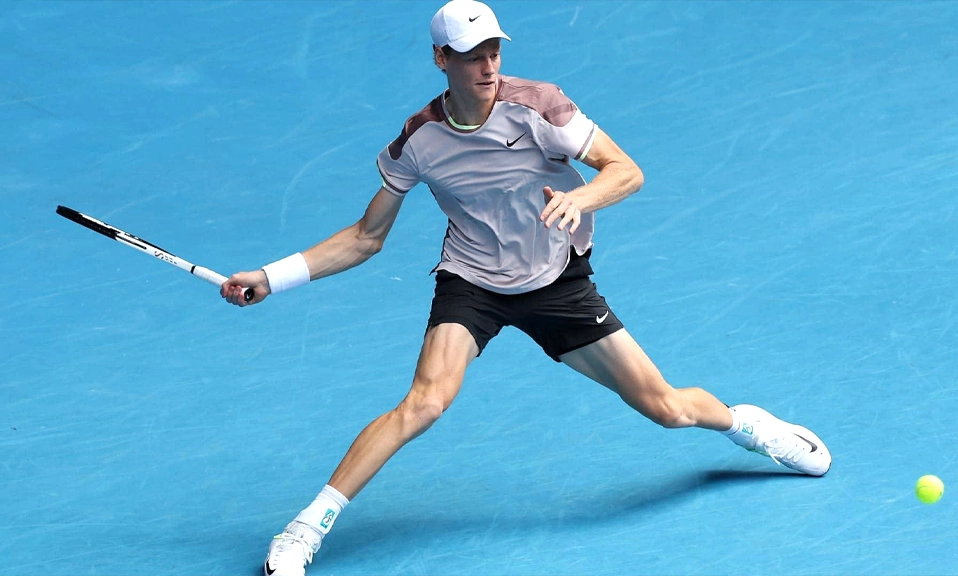
Jannik Sinner has not played a competitive match since lifting the Wimbledon trophy in July, but the Italian is already plotting his return to the biggest stage of all. On November 10, 2026, Sinner confirmed that his target is the Australian Open in January 2027, and that he will not rush a knee injury that has kept him sidelined for the second half of the season. The question is not whether Sinner can return. It is whether, after the most dominant stretch of tennis in recent memory, he can pick up where he left off—and whether Carlos Alcaraz will be waiting for him when he does.
The answer, on both counts, is more complicated than it looks. Sinner’s 2026 season was a masterclass in sustained excellence, but it ended in injury and uncertainty. Alcaraz’s season was a triumph, but it was also interrupted by his own physical struggles. The rivalry that defined 2025, and that was supposed to define 2026, was reduced to a single meeting. The 2027 Australian Open is the stage on which both men will attempt to reclaim their momentum—and the sport will be watching to see which version of each player emerges.
The Return Timeline: Patience Over Urgency
Sinner’s path back to competition is being mapped with deliberate caution. The 25-year-old has been out since July, when he won his fifth Grand Slam title at Wimbledon, due to a right knee issue that has been identified as iliotibial band syndrome. He pulled out of the US Open, the Asian swing, and the ATP Finals. In October, he announced that he would not compete again in 2026, choosing a conservative treatment approach over surgery.
The plan for his comeback is built around a single principle: respect the protocols, do not rush. “The goal is to go to Australia,” Sinner said in Milan. “The aim is also maybe to do a couple of tournaments first. But I have to respect the protocols at the moment because if we rush things we could have more serious problems”. He admitted that his team initially had an “impossible goal” in mind, and that they have since chosen a different path.
The first stop on that path is likely to be the Six Kings Slam exhibition in Riyadh, rescheduled for December 27–30, where he is expected to feature alongside Alcaraz, Novak Djokovic, Alexander Zverev, and others. It is not a competitive ATP event, but it would give Sinner the match reps he needs before Melbourne. “If we want to prepare for Australia and I’m not playing since Wimbledon, some matches before might be very helpful,” he said.
Sinner has also been candid about the psychological challenge of the layoff. “I miss playing tennis,” he said. “But looking after my body comes first, because I want to keep playing for another 10 to 15 years”. It is a mature perspective from a player who has already achieved more than most do in a career, and it suggests that his return will be built for longevity, not just for one tournament.
The 2026 Season: A Body of Work That Defies Belief
To understand why Sinner’s return matters so much, you have to understand what he did before the injury.
His 2026 season was, by any measure, extraordinary. He compiled a 44-3 record, won six tour-level titles, and claimed his second Wimbledon crown by defeating Zverev in the final. But the defining achievement of his year was at the Masters 1000 level. Sinner won the first five Masters 1000 events of the season—Indian Wells, Miami, Monte-Carlo, Madrid, and Rome—becoming the first player in history to do so. In Rome, he completed the Career Golden Masters, becoming only the second man, after Djokovic, to win all nine Masters 1000 titles.
The numbers are almost absurd. He set a record for consecutive sets won at Masters 1000 level, taking 37 in a row from the second round in Paris in 2025 through the third round in Monte-Carlo in 2026. He is currently riding a 34-match winning streak at Masters 1000 events, the longest in history. And in his only meeting with Alcaraz in 2026, he won—a 7-6(5), 6-3 victory in the Monte-Carlo final that reclaimed the world No. 1 ranking.
When Sinner is healthy, he is not just the best player in the world. He is one of the most dominant players the sport has seen in the modern era. The question is whether the knee injury has changed that.
The Rivalry: Alcaraz’s Edge, Sinner’s Momentum
The Alcaraz-Sinner rivalry is the most compelling in men’s tennis, and it is also the most finely balanced.
Alcaraz leads the head-to-head 10-7. Both men have spent 66 weeks at world No. 1, and both have won 26 tour-level titles. They have split the last several Grand Slams between them, and their contrasting styles—Alcaraz’s explosive creativity against Sinner’s relentless precision—have made every meeting an event.
But the momentum shifted in 2026. Sinner won their only encounter, on clay in Monte-Carlo, and he did it by outlasting Alcaraz in the decisive moments. He reclaimed the No. 1 ranking with that victory, and he held it until his injury forced him to surrender it. Alcaraz, meanwhile, won the Australian Open to complete his career Grand Slam, but his season was disrupted by a wrist injury that kept him out of Roland Garros and Wimbledon.
The 2027 Australian Open will be the first time both men are fully fit and competing at a major since their 2025 US Open final. It is also the first time Sinner will enter a Grand Slam as the hunter rather than the hunted—the player returning from injury, the one with something to prove. Alcaraz, the defending champion in Melbourne, will be the one with a target on his back.
The Challenges: What Sinner Must Overcome
Sinner’s talent is not in question. His body is. The knee injury that ended his 2026 season is the kind of problem that can linger, particularly for a player whose game is built on explosive movement, deep court coverage, and the ability to change direction at full speed.
The first challenge is match fitness. Sinner has not played a competitive match in nearly six months. The Six Kings Slam exhibition will help, but it is not the same as a best-of-five-set Grand Slam. He may need a few tournaments before Melbourne to find his rhythm, and he has acknowledged that “some matches before might be very helpful”.
The second challenge is the draw. The Australian Open is a two-week grind, and Sinner will likely be seeded No. 2 behind Alcaraz, assuming he holds his ranking. That means a potential semifinal or final against Alcaraz, on a hard court that suits both players. It is the kind of matchup that could define the tournament—and the season.
The third challenge is the mental hurdle. Coming back from a long injury layoff is as much a psychological test as a physical one. Sinner has spoken about trusting his medical team and respecting the process, but the moment he steps onto Rod Laver Arena, he will have to trust his knee as well.
The Rivalry Is Back, and So Is the Uncertainty
Jannik Sinner is targeting the Australian Open, and if he makes it to Melbourne, he will be one of the two favourites. His 2026 season proved that he is capable of sustained dominance at the highest level. His victory over Alcaraz in Monte-Carlo proved that he can beat his greatest rival in a final. And his decision to prioritise long-term health over short-term gain suggests that he is building for more than one comeback.
But the Australian Open is not a guaranteed coronation. Alcaraz is the defending champion, the head-to-head leader, and a player who has also used injury setbacks to fuel his own resurgence. The rivalry is back, but the balance of power is uncertain. Sinner has the momentum from 2026. Alcaraz has the title to defend. And the sport has the showdown it has been waiting for.
The 2027 Australian Open will not decide who is the greater player. It will simply tell us which one is ready to write the next chapter.
Do you think Sinner can return at his 2026 level and reclaim the No. 1 ranking, or will Alcaraz use the Australian Open to assert his dominance?