What These Cosmic Collisions Reveal About How Worlds Are Born
NASA’s James Webb Space Telescope has not filmed two planets crashing together in real time. The evidence is subtler—and scientifically more useful.
Webb has examined a rare class of young star systems surrounded by unusually large amounts of warm dust. The dust appears to be the aftermath of violent impacts between planetary building blocks. By studying the minerals glowing in infrared light, astronomers can estimate whether those collisions were gentle grazes between Moon-sized bodies or high-energy impacts between objects closer to the size of Mars.
The observations offer a new way to study a stage of planet formation that is almost impossible to watch directly. The worlds involved are too small and too distant to resolve. Their debris, however, leaves a chemical fingerprint.
Webb studied 21 extreme debris disks
Stars are born inside gas- and dust-rich disks. Over time, the material in those disks can assemble into planets, moons, asteroids and other bodies. Once much of the original gas has dispersed, a system may enter a debris-disk phase in which collisions grind down leftover material.
The systems examined in the new study belong to an unusually dusty subgroup called extreme debris disks. They contain large amounts of warm dust close to their stars, in regions broadly comparable to where rocky planets orbit in our Solar System.
Using Webb and observations from NASA’s retired Spitzer Space Telescope, the research team assembled a sample of 21 extreme debris disks. Webb supplied observations of 16 systems, including 12 newly observed disks, while five came from Spitzer’s archive.
The disks share three unusual properties: their dust grains are smaller than those in typical planet-forming or debris disks, they contain a high concentration of warm dust, and their infrared brightness changes irregularly.
Those features suggest that the disks are not quiet leftovers. They are active environments in which fresh impact debris may be moving through new orbits, colliding again and changing rapidly.
The minerals tell the story of the impact
The key advance came from spectroscopy. Webb’s Mid-Infrared Instrument, or MIRI, can separate infrared light into a spectrum. Different minerals absorb and emit light at distinctive wavelengths, allowing astronomers to infer what the dust is made of.
The team found that the disks could be divided into silica-rich and silica-poor groups. Silica-rich dust includes materials comparable to volcanic glass on Earth. Silica-poor dust includes minerals such as forsterite, which is also found in some terrestrial sands.
The mineral difference matters because the energy of an impact changes what happens to rock.
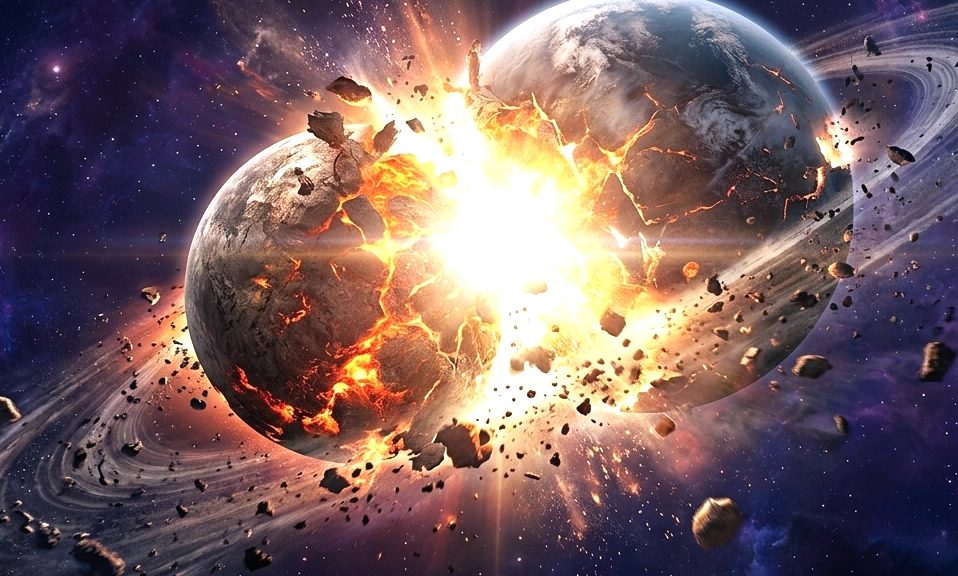
According to the researchers’ interpretation, silica-rich disks are consistent with high-energy collisions involving Mars-sized planetary bodies. The impacts may vaporize a substantial fraction of the rock, which later cools and condenses into fine silica-rich debris.
Silica-poor disks are consistent with less energetic, grazing encounters between smaller bodies roughly comparable to the Moon. These collisions may produce a different mixture of fragments without vaporizing as much of the original material.
In the sample, about one-third of the disks were silica-rich and about two-thirds were silica-poor. The split is not a direct census of all planetary collisions. It describes the particular extreme debris disks observed so far and the interpretation of their infrared spectra.
The collisions may mark different stages of planet formation
The ages of the stars add another clue. The silica-rich disks were found only around stars younger than 300 million years. Silica-poor disks appeared around stars spanning a broader range of ages.
That pattern fits a picture in which the most energetic rocky-planet collisions occur early, while planets are still assembling and their orbits remain unsettled. Over time, some systems may become calmer. Others may experience later gravitational disruptions that send smaller bodies back into unstable paths.
The brightness variations of the silica-poor disks may reflect that continuing instability. Fresh debris can spread through the system, change orbit and undergo additional impacts. The result is a fluctuating infrared glow rather than a stable, uniform disk.
The scientists describe this as a working interpretation, not a final explanation. Only three disks in the sample fit the older age range used to test the absence of silica-rich systems, so more observations are needed before the proposed age pattern can be treated as secure.
This may be what planet formation looks like up close
The popular image of planet formation is a quiet process in which dust gradually gathers into larger and larger objects. That process does begin with accumulation, but gravity eventually makes the system more competitive.
As bodies grow, their gravitational interactions alter their paths. Some collide at relatively low speeds and merge. Others strike at high speeds, breaking apart, melting or vaporizing material. The same collisions that destroy worlds can also create new ones by combining their remains.
This is why planetary formation and planetary destruction are not separate stories. Impacts can remove a planet, reshape a planet, create a moon or redistribute the material from which another world forms.
Earth’s own history likely includes an example. The leading model for the Moon’s formation proposes that a Mars-sized body, often called Theia, collided with the young Earth. Debris from the impact entered orbit and eventually gathered into the Moon. Webb is not observing Theia or the birth of our Moon, but the extreme debris disks provide distant examples of the kind of high-energy environment in which such an event could occur.
Could our Solar System have gone through dusty phases?
The observations may also connect to the later history of our Solar System.
One possibility is that the young Sun experienced an early extreme-debris-disk phase while the rocky planets were forming. Simulations place terrestrial-planet formation within the first few hundred million years of a system’s history, broadly matching the ages of the silica-rich disks in the Webb sample.
A second dusty phase may have occurred later if the giant planets changed their orbits. In the Late Heavy Bombardment hypothesis, gravitational shifts involving the giant planets disturbed smaller bodies and sent them into collision courses. If older silica-poor disks are produced by this kind of orbital instability, their changing infrared brightness could be consistent with a later period of renewed impacts.
This connection remains tentative. The Webb observations do not prove that the Solar System experienced exactly the same sequence of events. They give astronomers a set of external systems to compare with models of our own past.
Why astronomers cannot simply watch the planets collide
Even nearby exoplanets are difficult to image directly. A planet is faint compared with its star, and the planetary embryos involved in these collisions are much smaller than mature worlds.
Astronomers therefore study indirect evidence. Warm dust emits infrared radiation. Its grain size, mineral composition, temperature and changing brightness reveal the physical conditions that produced it.
This is similar to how a geologist reconstructs an ancient eruption from rocks rather than watching the eruption happen. The evidence is not a video of the event. It is a physical record of what the event left behind.
Webb’s advantage is its sensitivity to infrared light and its ability to identify chemical signatures in that light. The telescope cannot resolve the individual planetary embryos in these distant systems, but it can analyze the debris that those embryos produce.
The headline is dramatic, but the science is even better
“Planets destroying each other” is a vivid description of the result, but it should not be taken literally as a direct observation of two finished planets crashing together.
What Webb actually found was a population of rare, warm, dusty disks whose mineral signatures are consistent with large-scale collisions. Some may represent Mars-sized bodies vaporizing rock. Others may record lower-energy grazing impacts between Moon-sized objects.
That distinction does not make the discovery less exciting. It makes it more revealing. The observations show how astronomers can reconstruct invisible planetary events from dust, mineral chemistry and the evolution of infrared light.
Worlds are born in the same environments where other worlds are broken apart. Webb’s crash course in planetary collisions is therefore also a lesson in how Solar Systems grow: not smoothly, but through a long sequence of assembly, disruption, impact and renewal.