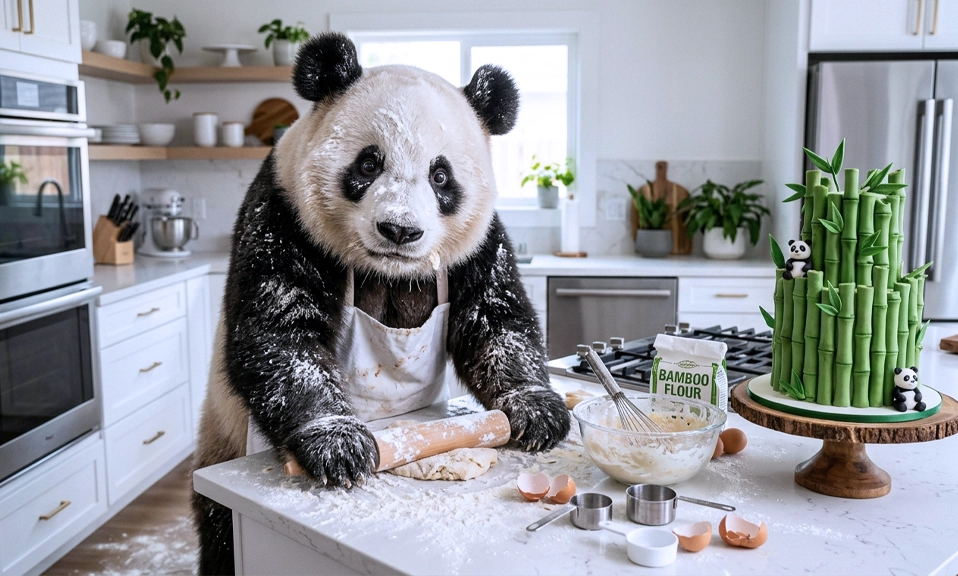
If you’ve ever watched a giant panda clumsily tumble down a hill while chewing on a stalk of bamboo, you’ve probably asked yourself a very valid question: Is that actually a bear?
It looks like a bear. It waddles like a bear. It’s even got “bear” in its name. But it eats like a cow and has the energy levels of a sleepy teenager.
So, what’s the real difference between a panda and a “regular” bear (like a grizzly or a black bear)?
The short answer: Yes, the giant panda is absolutely a true bear. But it is the weirdest, most wonderfully bizarre member of the bear family.
Let’s break down the fascinating differences between the giant panda and its carnivorous cousins.
🧬 1. The Family Tree: They Are Officially Bears
For decades, scientists argued over whether the giant panda was more closely related to bears or raccoons (thanks to the confusingly named “red panda”).
But thanks to modern DNA testing in the early 2000s, the debate was officially settled: The giant panda belongs to the family Ursidae.
However, they are on their own unique, ancient branch of the family tree (the subfamily Ailuropodinae). They split from the rest of the bear family (which includes brown bears, black bears, and polar bears) about 19 million years ago. So, while they are bears, they are the eccentric, distant cousins of the group.
🎋 2. The Diet Dilemma: Bamboo vs. Everything Else
This is the biggest difference.
- Regular Bears: Are opportunistic omnivores (or carnivores, in the case of polar bears). A grizzly bear will eat fish, berries, roots, small mammals, and insects. They adapt their diet to whatever is available.
- Giant Pandas: Are herbivores that eat almost exclusively bamboo (about 99% of their diet).
Despite having the digestive system, teeth, and gut flora of a carnivore, pandas evolved to survive on one of the least nutritious plants on the planet.
🖐️ 3. The “False Thumb” Adaptation
Regular bears have large, powerful paws designed for digging, catching fish, and swiping at prey.
Pandas, however, needed a way to grip slippery bamboo stalks. Evolution gave them a brilliant workaround: a “pseudo-thumb.” This isn’t a real finger, but an enlarged wrist bone (the radial sesamoid) that functions exactly like a thumb, allowing the panda to grasp and strip bamboo with incredible dexterity. No other bear has this.
🚽 4. The Digestive Quirk: Eating Constantly
Because a panda’s digestive tract is still built for meat, it is terribly inefficient at breaking down tough plant cellulose. A panda only absorbs about 17% of the nutrients from the bamboo it eats.
To survive on such a low-energy diet, pandas have to eat constantly.
- A giant panda will spend 12 to 16 hours a day eating.
- They can consume up to 40 pounds (18 kg) of bamboo in a single day.
- As a result, they poop up to 40 times a day. (It’s not glamorous, but it’s a biological necessity!)
Regular bears, by contrast, eat large, calorie-dense meals and can go days without eating if necessary.
🛌 5. No Hibernation for the Panda
When winter hits, brown and black bears pack on pounds of fat and hibernate for months to survive the cold and lack of food.
Giant pandas do not hibernate. Why? Because bamboo contains almost no fat. A panda simply cannot build up the fat reserves required to sleep through the winter. Instead, they cope with the cold by growing a thick, woolly winter coat and migrating to lower, warmer elevations in their mountain habitats.
🦝 The Plot Twist: What About the Red Panda?
It’s impossible to talk about pandas without addressing the elephant (or rather, the raccoon) in the room: the Red Panda.
Despite the name, the red panda is NOT a bear.
Red pandas belong to their own unique family, Ailuridae. They are more closely related to raccoons, weasels, and skunks than they are to giant pandas or brown bears. The only reason they share the name “panda” is because the giant panda was named after the red panda, which was discovered and named first!
The Ultimate Bear Weirdo
The giant panda is a biological paradox. It is a carnivore that chose to become a vegetarian, a bear that doesn’t hibernate, and a clumsy-looking animal with a highly specialized, dexterous grip.
Millions of years ago, when other bears were evolving to become apex predators, the panda’s ancestors took a different path. They found a niche with no competition (nobody else wanted to eat tough, fibrous bamboo) and adapted to it perfectly.
So, the next time you see a panda lazily chewing on a stalk of bamboo, remember: you aren’t just looking at a cute, fluffy animal. You’re looking at a highly specialized, 19-million-year-old evolutionary masterpiece.
Did you know that pandas are true bears but don’t hibernate? Are you Team Giant Panda or Team Red Panda? 🐼🐻🎋