Imagine you run a factory.
You have 500 robots, 2,000 sensors, 50 self-driving forklifts, and 200 workers with AR glasses. All of them need to talk to each other, in real time, with zero delay.
You connect them to public 5G. At 3pm, everyone in the city next door starts watching TikTok. Your robots freeze. A forklift stops in the middle of the aisle. A production line loses $50,000 in 10 minutes.
That is why businesses are building their own mobile networks.
It is called Private 5G. And in 2026, it has gone from a pilot project to a $5 billion industry, growing faster than almost any other part of telecom.
What Is Private 5G?
Private 5G refers to a dedicated cellular network deployed to serve the communication requirements of a specific enterprise, industrial facility, campus, or organization.
A private 5G network is a dedicated, enterprise-owned mobile network designed for environments such as factories, ports, campuses, and smart cities, delivering secure, high-performance connectivity for real-time operations.
Private 5G is a 5G cellular network built for one organisation’s site, such as a factory, port, mine, airport or campus, rather than shared with the public.
Think of it like this:
Public 5G is a public highway. You share it with everyone. At rush hour, it is slow.
Wi-Fi is your office hallway. It is free, it is fast indoors, but it does not go far, and it gets congested when everyone is in the hallway.
Private 5G is your own private highway, built just for your factory. Only your cars are allowed. No traffic jams. No strangers. You control the speed limit, the lanes, and who gets in.
That gives the operator control over coverage, capacity, latency and security in a way public mobile networks and unlicensed Wi-Fi do not.
How Big Is This Really?
It is not a niche anymore.
According to MarketsandMarkets, the global private 5G market is projected to grow from USD 5.35 billion in 2026 to USD 24.84 billion by 2032, registering a compound annual growth rate (CAGR) of 29.1% during the forecast period.
The private 5G market is projected to grow from $3.86 billion in 2025 to $17.55 billion by 2030, at a CAGR of 35.4%, according to MarketsandMarkets.
Analysts now put the private networking market on track to top $22 billion by 2030. The deployments backing that forecast aren’t pilots anymore. Instead, they’re operational networks running ports, factories, and utilities.
The global private mobile network market has crossed a major milestone, with more than 2,000 organizations worldwide now operating dedicated LTE or 5G networks as enterprises increasingly seek secure, high-performance wireless infrastructure.
According to new data released by the Global mobile Suppliers Association (GSA), 2,003 organizations across 88 countries had deployed one or more private mobile networks by the end of the first quarter of 2026.
The demand for private 5G networks is increasing due to the deployment of mission-critical enterprise applications and dedicated digital infrastructure. This demand is spread across industries such as manufacturing, transportation & logistics, energy, and healthcare.
The manufacturing/factories segment dominated the market in 2025.
China remains the most mature national market supported by state-funded directives aimed at accelerating the adoption of 5G connectivity in industrial settings such as factories, warehouses, mines, power plants, substations, oil and gas facilities and ports.
In other words, the companies that make your stuff are already on private 5G. You just cannot see it.
Why Not Just Use Public 5G Or Wi-Fi?
This is the question every CEO asks. Here is the honest answer.
Private 5G networks, dedicated, enterprise-operated 5G infrastructure, are transforming industrial IoT deployments in factories, ports, warehouses, and mining sites. Unlike Wi-Fi or shared 4G/LTE, private 5G delivers the combination of ultra-low latency, massive device density, deterministic performance, and security isolation that demanding industrial applications require.
1. Latency That You Can Guarantee
Public networks deliver statistically low latency. Private networks deliver structurally enforced latency.
On public 5G, latency is usually 20ms. Sometimes it is 100ms. Sometimes it spikes to 500ms when the network is busy.
On private 5G, latency is always 10ms, because no one else is on the network.
That matters when a robot arm is moving at 2 meters per second. A 100ms delay means the arm moves 20cm too far. That is a broken product, or a hurt worker.
Latency typical for private 5G: 1 to 5ms for URLLC, 10 to 20ms for eMBB.
Wi-Fi hops through shared airwaves, so latency can spike when the neighbors binge video. Private 5G keeps latency low and steady, because the signal is yours alone.
2. Coverage That Actually Works Outdoors
Wi-Fi covers 30 to 50 meters indoors. Private 5G covers 1 to 3 km outdoors from one tower.
Coverage per node: 30 to 50 m indoor for Wi-Fi, 1 to 3 km outdoor for private LTE/5G, mmWave short, sub-6 ∼1 km.
Mid-band 5G (sub-6 GHz): several-mile radius, low-gigabit speed, perfect for a factory complex, stadium district, or logistics park.
If you have a port that is 2 kilometers long, you would need 200 Wi-Fi access points and miles of cable to cover it. With private 5G, you need 3 towers.
Wi-Fi 7 wins indoors for dense, high-throughput, device-rich spaces; private 5G wins for large outdoor footprints, deterministic mobility, and hostile RF where running cable is impractical.
Lead with private 5G: ports, mines, rail, utilities, large outdoor yards, multi-acre campuses, anywhere cabling every radio is the dominant cost.
Lead with Wi-Fi 7: warehouses, hospitals, offices, dense production lines, and any indoor space where per-zone capacity matters more than reach.
3. Mobility That Does Not Drop
Wi-Fi was designed for devices that stay still. Laptops on desks.
Private 5G was designed for devices that move at 80 km/h. Forklifts, trucks, cranes, drones.
When a forklift moves from one Wi-Fi access point to another, it drops for 200ms. That is enough to lose connection.
When it moves from one private 5G cell to another, it hands over seamlessly, like your phone does on the highway. No drop.
Mining yard, port, or rail depot with moving vehicles: Private LTE/5G wins for kilometer-scale coverage and clean handoff.
4. Security: Your Data Never Leaves Your Site
In terms of security and capacity, Wi-Fi also comes up short when compared to a private 5G network.
On public 5G, your factory data goes to the carrier’s core network, possibly in another city, then back to your factory. That is a security risk.
On private 5G, you can keep the core network inside your factory. Your robot data never leaves the building. No internet needed. No carrier can see it.
Healthcare clinics and hospitals that keep track of sensitive data and require seamless mobility to connect hundreds to thousands of wireless endpoints need this. Patient data cannot go over public Wi-Fi.
5. You Control The Slices
With private 5G, you can create network slices: a slice for robots that gets ultra-low latency, a slice for cameras that gets high bandwidth, a slice for sensors that gets low power.
On public 5G, you have to beg your carrier for a slice. On private 5G, you just configure it.
Where Is Private 5G Actually Being Used?
1. Smart Factories
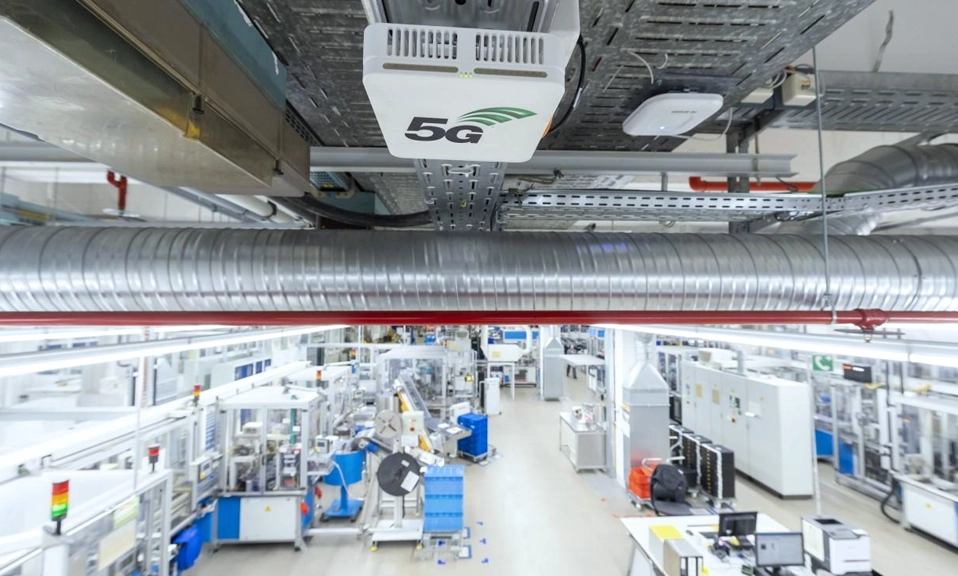
Smart factories represent the perfect application environment for Private 5G, where thousands of connected devices, robots, sensors, and systems must operate in harmony.
Factories can use dedicated networks to connect robots, programmable equipment, production machines, and sensors.
Private 5G networks allow organizations to deploy dedicated wireless infrastructure tailored specifically to their operational environments.
Manufacturing: Smart factories powered by robotics and connected sensors.
Example: A BMW or Toyota factory uses private 5G to connect autonomous mobile robots that carry parts across the factory. The robots need 10ms latency, or they will crash into each other. Wi-Fi cannot guarantee that.
Augmented reality applications for worker guidance benefit from Private 5G’s low latency and high bandwidth, while digital twin implementations leverage the network’s capacity to transfer massive amounts of realtime operational data.
A worker wears AR glasses. The glasses show them exactly where to put a screw on an engine. That video has to be real-time. If it lags, the worker makes a mistake.
2. Ports
Associated British Ports is building the “port of the future” with rented private 5G so cranes, sensors, and safety cams share one speedy lane; no more dropped containers or data.
The same dynamics also apply for seaports, manufacturing facilities, campus environments, and mining operations.
A port crane lifts a 40-ton container. It is controlled remotely by an operator sitting in an office, watching 8 cameras. If the video lags by 200ms, the crane drops the container. Private 5G gives the crane a dedicated, guaranteed lane.
3. Mines
Mines are the perfect private 5G use case. They are in the middle of nowhere, no public 5G, no Wi-Fi, and they have autonomous trucks that drive 200 km a day.
With private 5G, the mine can control trucks remotely, with no driver in the truck. That is safer, and it works 24/7.
4. Hospitals
Hospitals need seamless mobility. A doctor walks from the ER to the ICU to the operating room, with a tablet that has patient data. Wi-Fi drops in elevators. Private 5G does not.
And because private 5G can keep data on-site, it is easier to comply with health privacy laws.
5. Airports, Stadiums, And Campuses
Airports use private 5G for baggage handling, security cameras, and ground crew. Stadiums use it for broadcast cameras that move around the field. Universities use it to connect an entire campus with one network, instead of 500 Wi-Fi routers.
Industrial plants, manufacturing plants and warehouses are rife with interferences that require reliability and complete indoor and outdoor coverage.
Private 5G vs Public 5G vs Wi-Fi 6/7
Feature | Private 5G | Public 5G | Wi-Fi 6 / 7 |
|---|---|---|---|
Who owns it? | You | Carrier | You |
Who uses it? | Only your devices | Everyone | Anyone with password |
Latency | 1 to 10ms, guaranteed | 20 to 50ms, varies | 5 to 20ms, spikes when busy |
Coverage | 1 to 3 km per tower, outdoors | Whole country | 30 to 50m per access point |
Mobility | Seamless at 80 km/h | Seamless | Drops when moving |
Security | Data stays on-site, SIM-based | Carrier core, off-site | Password-based, easier to hack |
Cost to build | High upfront, $500k to $5M | $0, you pay monthly | Low, $10k to $100k |
Cost to run | Low monthly, you control | High monthly per SIM | Low |
Best for | Factories, ports, mines, hospitals | Phones, consumers | Offices, homes, cafes |
Speed, throughput and latency performance are comparable to the latest Wi-Fi standards.
Wi-Fi 6E latency and throughput standards remain slightly superior in a small office. But Wi-Fi cannot do what private 5G does outdoors, at scale, with moving machines.
Wi-Fi 6 wins indoors on cost and throughput. Private LTE covers large outdoor sites with predictable mobility. 5G handles high-bandwidth, low-latency mobile workloads but costs the most to stand up.
How Does A Business Actually Build One?
You do not need to become a telecom carrier. There are 3 models:
1. Do It Yourself: You buy spectrum from the government, buy radios from Ericsson or Nokia, and run it yourself. This is for big factories like BMW or Toyota. Expensive, but full control.
2. Carrier-Managed: You rent private 5G from Verizon, AT&T, e&, or Deutsche Telekom, like Netflix. They build it, they run it, you pay monthly. This is what Associated British Ports does.
3. Neutral Host: A third-party builds one private 5G network and rents slices to multiple companies in the same building, like a business park or airport.
In many countries, governments now reserve spectrum just for private 5G. Germany, UK, Japan, US, and Brazil all have private 5G spectrum. You do not have to buy it from a carrier anymore.
The Downsides Nobody Talks About
Private 5G is not for everyone.
It is expensive to start. A full private 5G network costs $500,000 to $5 million to build. Wi-Fi costs $50,000. If you are a small office, private 5G is overkill.
It is complex. You need to manage SIM cards for 5,000 devices, not just Wi-Fi passwords. You need to plan spectrum, coverage, and security.
Device support is still growing. Not every sensor supports 5G yet. Many still only support Wi-Fi or LTE. You may need to use RedCap, the cheaper 5G for IoT, to make it affordable.
You still need Wi-Fi. Most businesses will use both. Private 5G for robots, machines, and outdoor mobility. Wi-Fi 7 for laptops, phones, and offices. They are complements, not replacements.
Is Private 5G The Future?
Yes, for industry. No, for your home.
You will never have private 5G in your apartment. You do not need it. Wi-Fi is perfect for you.
But the factory that made your phone, the port that shipped it, the mine that dug the lithium for its battery, and the hospital that will treat you when you are sick, they will all be on private 5G by 2030.
The roll out of 5G has brought increased capacity, coverage, mobility, speeds, and lower latency. Meanwhile, Wi-Fi 6 is getting closer to cellular with increased capacity, coverage, and higher speeds.
Private 5G is 5G finally doing what it promised: connecting machines, not just phones.