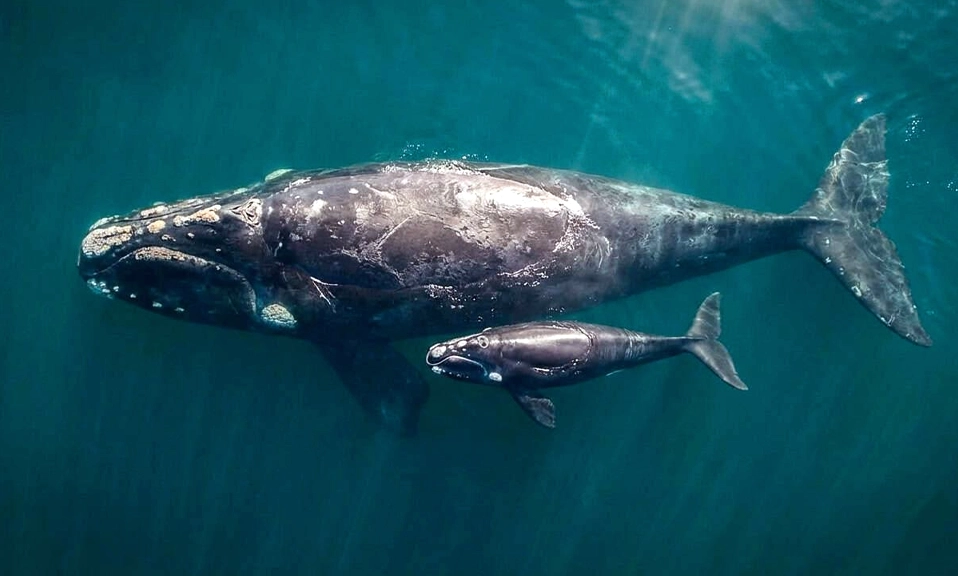
A 15,000-pound baby whale went missing for months. Scientists just found it—and it’s the best news the species has had in nearly two decades.
The Calf Nobody Saw Coming
It should be hard to lose a 15,000-pound animal. But for the researchers who track North Atlantic right whales—one of the rarest marine mammals on Earth—that’s exactly what happened.
In September 2026, a team from the Mingan Island Cetacean Study photographed an unidentified calf swimming alongside its mother off Anticosti Island in Quebec . When the photos reached the New England Aquarium’s Anderson Cabot Center, scientists cross-referenced them against the North Atlantic Right Whale Catalog—the exhaustive photographic database of every known individual in the species. The verdict: this was a calf that had never been documented before .
The mother was Silt, a 38-year-old whale who has survived multiple fishing gear entanglements and has now produced six known offspring . Silt was briefly seen in the southeastern U.S. calving grounds in February 2026, but without a calf. Scientists believe she may have given birth there and slipped away before anyone could photograph the pair together .
“This is an exciting discovery for us so late in the year,” said Amy Warren, a scientist at the Anderson Cabot Center .
Why One Calf Matters So Much
For a species numbering only about 380 individuals, every birth carries outsized significance . But this calf is more than a data point. It pushes the 2025-2026 calving season total to 24—the highest number of right whale births since 2009, and the fourth-highest count on record .
The context makes that number remarkable. Between 2010 and 2020, the North Atlantic right whale population dropped by roughly 25 percent . In 2018, zero births were recorded . The species has been in what NOAA calls an Unusual Mortality Event since 2017, with more than 20 percent of the population sick, injured, or killed .
Only about 70 reproductive-age females remain . And female right whales are calving less frequently—every 7 to 10 years on average, compared to a healthy interval of three to four . To stop the decline and allow recovery, NOAA estimates the species needs approximately 50 or more calves per year for many years . Twenty-four is a good year. It is not enough.
“It just goes to show you how big the ocean is, and how those animals can get lost out there,” said Richard Sears, founder of the Mingan Island Cetacean Study .
The Threats That Haven’t Gone Away
The calf’s discovery is a cause for joy. It is not a cause for complacency.
North Atlantic right whales face two primary human-caused threats: entanglements in fishing gear and collisions with boats and ships . Ocean warming is also shifting their prey and their migration patterns, pushing them outside protected waters and into busy shipping lanes .
The political landscape has been discouraging. Conservationists have condemned recent U.S. government decisions to delay new species protections for a decade to aid commercial fishing . The species remains critically endangered, and the recovery is fragile.
But there are signs of hope. Of the 23 mom-calf pairs identified during the official calving season, 20 were returning mothers—and 13 of those had last calved in 2021 or 2022, a shorter interval than the recent average . Researchers also documented approximately 500 sightings of 129 individual right whales in the Southeast, representing more than a quarter of the population . That suggests reproductive health may be improving .
A 15,000-pound baby
whale was swimming off the coast of Quebec for months, and nobody knew it existed. Now that they do, it is a reminder of two things at once: how fragile this species is, and how resilient it can be.
Twenty-four calves is the best the North Atlantic right whale has managed since 2009. It is a number worth celebrating. It is also a number that falls far short of what the species needs to survive. The calf discovered off Anticosti Island is a symbol of what’s possible—and a reminder of how much work remains.
Silt survived multiple entanglements to raise six calves. Her newest calf survived long enough to be found. For a species on the edge, that is not just good news. It is a lifeline.