It had the tail of a beaver, the feet of a platypus, and the teeth of an otter. And it was, for its time, a giant. But the most remarkable thing about this newly discovered Jurassic mammal isn’t how it looked — it’s how it ate.
A Chimera From the Age of Dinosaurs
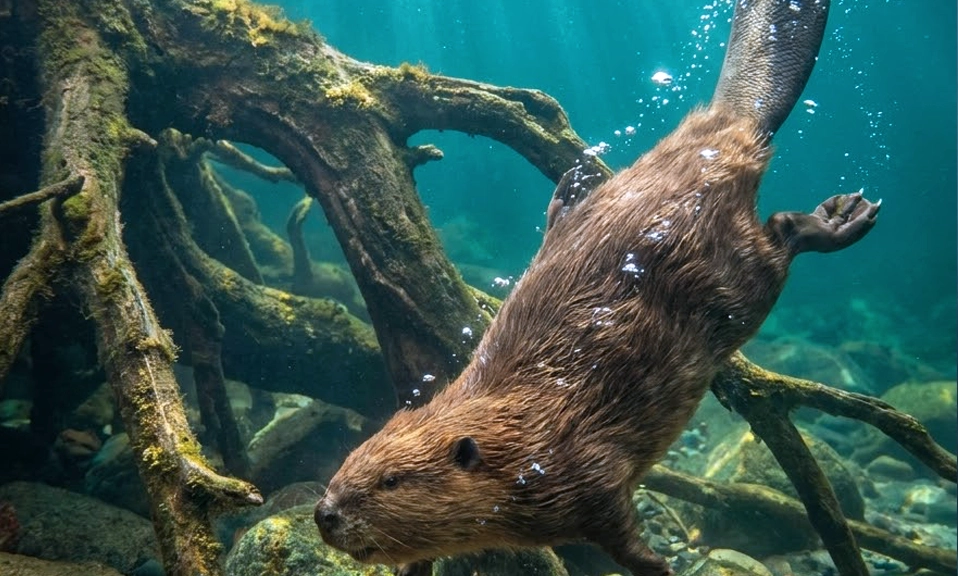
About 165 million years ago, in the lakes and rivers of what is now Inner Mongolia, a furry creature roughly the size of a modern otter hunted fish and salamanders. It had a broad, flattened tail like a beaver, hind limbs built for paddling like a platypus, and a skull filled with sharp, curved teeth perfectly suited to catching slippery prey.
It was a chimera — a creature assembled from parts that, to modern eyes, seem to belong to entirely different animals. And it was, by the standards of its time, enormous.
The creature has been named Megacauda sungei — “big tail,” a reference to its most distinctive feature, and a nod to palaeontologist Sun Ge. It was 40 to 50 centimetres long and weighed one to two kilograms. That may not sound impressive today, but in the Middle Jurassic, most mammals were shrew-sized. Megacauda was twice as big as the next-largest member of the mammalian lineage — a genuine giant in a world ruled by dinosaurs.
The discovery, published in the journal Nature, was led by an international team from the University of Chicago, the University of Bonn, and institutions in China. The fossil was found by local farmers in the Daohugou area of Inner Mongolia and eventually made its way to the Paleontological Museum of Liaoning in Shenyang, where researchers identified it as a new species.
The Real Breakthrough: A Throat That Changed Everything
Megacauda’s appearance is striking. But its true significance lies in something far less visible: its throat.
The fossil is preserved with remarkable detail, including impressions of skin and fur, and — crucially — the delicate bony structures of the throat that are rarely fossilised. Using CT scanning and X-ray fluorescence imaging, the team was able to reconstruct Megacauda’s entire throat anatomy in three dimensions.
What they found was the earliest known evidence of the mammalian feeding apparatus — the complex system of hyoid bones, soft palate, and throat muscles that allows modern mammals, including humans, to chew food into small pieces and swallow it one lump at a time.
“This is an incredibly important evolutionary innovation,” said Zhe-Xi Luo, professor at the University of Chicago and senior author of the study. “After mammals chew their food, be it plants or meat, they all swallow it in the same efficient and effortless way”.
Most vertebrates can’t do this. Crocodiles gulp down large birds. Pythons stretch their jaws to swallow a whole mammal. Even a thin snake can easily swallow a whole rodent. They have teeth, but because their jaws can’t chew, they simply gulp their food in chunks.
Megacauda could do something different. Its throat structure allowed it to breathe and feed at the same time — a seemingly simple ability that is actually one of the defining features of mammals. The same anatomy also gave baby mammals the ability to suckle milk, separating the airway from the food passage so they could drink without choking.
“It was this adaptation that made brain development, eventually leading to humans, possible,” said Thomas Martin of the University of Bonn. “The soft palate and the shaping of the oral cavity and pharynx are directly linked to the evolution of mammals”.
A Mammal That Lived Like a Reptile
Megacauda belonged to a group called docodonts — an extinct lineage of mammaliaforms that first appeared about 200 million years ago and flourished for around 90 million years before leaving no living descendants.
The docodonts were remarkably diverse. Some burrowed. Some lived on the ground. Some lived in trees. And Megacauda, as its fossil reveals, became semiaquatic — the earliest known mammal to do so.
Its body was built for water. The hind limbs had long outer digits like a platypus, and the tail vertebrae were wide and H-shaped, supporting a broad, flat tail that would have acted as a paddle or rudder. It was a powerful swimmer, capable of pursuing prey in lakes and rivers.
And it was a successful predator. Researchers found tiny limb fragments in the fossil’s stomach area that resembled the bones of salamanders — likely its last meal. At its size, Megacauda had its pick of food items, and its sharp, curved teeth were perfectly adapted for catching slippery prey.
“Megacauda adds to a growing body of evidence that mammals could be ecologically diverse, even in the dinosaur-dominated ecosystem,” Luo said.
Why This Matters
Megacauda is not just a curiosity. It represents a pivotal moment in the evolutionary history of mammals.
For most of the Mesozoic Era, mammals were small, subordinate creatures living in the shadows of dinosaurs. The traditional narrative holds that mammals only diversified into the wide range of forms we see today after the asteroid strike 66 million years ago wiped out the dinosaurs.
Megacauda complicates that story. It shows that mammals were already ecologically diverse during the Jurassic — capable of occupying specialised niches like semiaquatic predation, and already equipped with the feeding apparatus that would later allow them to become the dominant land animals on Earth.
The discovery also provides the earliest evidence of suckling, one of the most distinctive behaviours of mammals. The same throat structures that allowed Megacauda to swallow chewed food also allowed it to produce the suction needed to drink milk. This adaptation, researchers suggest, may have been a key driver of mammalian evolution — enabling mothers to nourish their young in ways that other vertebrates could not.
“We used to know very little about the evolutionary pattern of pharyngeal and hyoid structure,” Luo said. “Now we know their evolutionary origins went back to before the rise of the modern mammals”.
Megacauda sungei
was a small creature in a world of giants. It weighed barely four pounds. It lived in lakes and rivers, hunting salamanders, while dinosaurs thundered across the land.
But it carried within its throat the biological machinery that would, hundreds of millions of years later, allow mammals to chew, swallow, suckle, and — eventually — think. It was a pioneer, occupying a niche no mammal had occupied before. And its fossil, preserved in exquisite detail, has given scientists their clearest window yet into the moment when mammals began to become the animals we recognise today.
It had the tail of a beaver, the feet of a platypus, and the teeth of an otter. But its greatest legacy was something far less visible: the ability to swallow a meal, one small piece at a time.
That, it turns out, was the beginning of everything.