Astronomers have long pictured distant planets as smooth, perfectly round spheres — tidy circles sketched onto the blackboard of space. But new observations from the James Webb Space Telescope have just shattered that assumption. The atmosphere of a scorching alien world called WASP-17b is lopsided, bulging outward on one side like a slowly deflating balloon. And for the first time, scientists know exactly why.
The discovery, published in Nature Astronomy, comes from a study jointly led by Cornell University and the University of Bristol. Using a new technique called “transmission strings,” researchers mapped the three-dimensional structure of WASP-17b’s atmosphere and found that one edge extends noticeably farther into space than the other. The bulge is small — the planet’s outline varies by about 0.9% to 1.6% of its radius — but its implications are enormous.
Here’s what’s really happening on this distant world.
Meet WASP-17b: The Puffy, Backward Hot Jupiter
WASP-17b is not a typical planet. Located roughly 1,300 light-years from Earth, it is a “hot Jupiter” — a gas giant that orbits so close to its star that a full year lasts just 3.7 days. It is nearly twice as wide as Jupiter but has less than half of Jupiter’s mass, making its atmosphere extraordinarily puffed up and diffuse.
It also orbits backward, moving against the direction of its star’s spin — a rare and puzzling characteristic that has made it a favorite target for astronomers.
But the most important thing to know about WASP-17b is that it is tidally locked. Like the Moon to Earth, it always shows the same face to its star. One hemisphere is locked in permanent daylight; the other is trapped in endless night.
That permanent divide is the key to the bulge.
The Cause: A Tale of Two Edges
The atmosphere of WASP-17b has two distinct “edges” where day meets night.
On the morning side, night is turning into day. Gas that has spent hours in the planet’s frigid darkness is finally catching the first light of its star. On the evening side, day is turning into night. Gas that has been baking in stellar radiation all day is rotating out of view, still carrying the heat it absorbed.
The difference in temperature between these two edges is staggering.
According to the new measurements, the morning side is about 1,085°F (585°C). The evening side is about 2,280°F (1,250°C) — more than 1,000°F hotter.
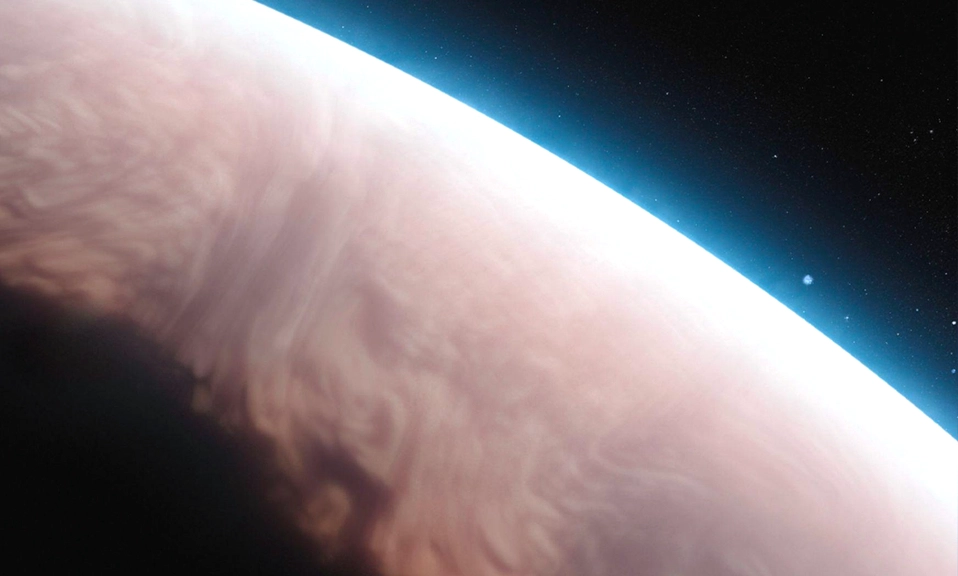
Hot gas expands. The evening side’s atmosphere thins out with altitude about 1.8 times more slowly than the morning side’s, causing it to bulge outward into space. The morning side, cooler and denser, contracts inward.
The result is an atmosphere that is not a perfect circle, but a slightly egg-shaped outline — fatter on the evening edge, flatter on the morning edge.
The Winds That Move the Heat
The temperature difference isn’t static. It’s created and sustained by powerful winds that circulate heat around the planet.
On a tidally locked world, the dayside absorbs enormous amounts of stellar energy. That heat doesn’t stay put. It is carried by atmospheric circulation — winds that race from the blistering dayside toward the frigid nightside, redistributing energy across the planet’s surface.
As gas moves from day to night, it passes through the evening edge still hot and swollen. By the time it reaches the morning edge, it has spent hours in darkness, cooled, and contracted. The bulge is a direct physical signature of this global wind pattern — a weather system on a planetary scale.
Models of WASP-17b had predicted exactly this kind of asymmetry. The new observations confirm that those models were right.
The Technique: Seeing the Edge in 3D
The discovery was made possible by a new method developed by astrophysicists Dr. David Grant and Dr. Hannah Wakeford at the University of Bristol.
Normally, when a planet passes in front of its star, astronomers analyze the thin ring of starlight that filters through its atmosphere — the “limb” — as a single average. That approach assumes the planet is a perfect circle with a uniform radius all the way around.
Transmission strings — also called transit mapping — breaks that assumption. Instead of averaging the whole limb, it splits the ring into segments, measuring how the atmosphere changes at different points around the planet’s edge, from equator to poles.
“Rather than assuming your planet is a circle with the same radius all the way around, our technique allows you to pull out different distances from the center to the edge of the planet,” explained lead author Dr. Lili Alderson, a Klarman Postdoctoral Fellow at Cornell University. “We’ve gone from a ring to understanding where on the ring the gemstones are, so to speak”.
The team applied the technique to observations taken in March 2023 by three of Webb’s instruments — NIRISS, NIRSpec, and MIRI — covering wavelengths from 0.6 to 12 microns. They measured the atmosphere at points every 45 degrees around the edge, then every 20 degrees, analyzing each point as if it were a separate planet.
The cost of that detail is wider error margins and less color precision at each point. But the payoff is a three-dimensional picture of an alien atmosphere — something that had never been done before.
Why This Matters: Planets Are 3D Objects
The discovery is more than a curiosity about one strange planet. It’s a proof of concept that changes how astronomers study exoplanets.
“This is proof of concept that planets are in fact 3D objects, and that consistently, as they go around their star, what we predict should be happening is happening,” Alderson said. “To move beyond computational exercises and see it for real is a different matter”.
For decades, exoplanet atmospheres have been treated as one-dimensional averages — a single spectrum, a single temperature, a single composition. That simplification was necessary because the data wasn’t precise enough to do better. Webb has changed that.
“Planets are temperamental, their atmospheres complex and chaotic,” said co-author Dr. Hannah Wakeford. “The fact that all of these numbers came together and showed us this very structured, dynamical picture of this giant world over 1,000 light-years away was just really exciting”.
WASP-17b is now a benchmark — a reference point for studying the more than 6,000 confirmed exoplanets, and a template for applying transmission strings to other worlds. The technique can be used to map the atmospheres of other hot Jupiters, probe their wind patterns, and test whether our models of planetary climate hold up in the extreme environments of other solar systems.
And it’s a reminder that the universe is not made of perfect circles. It’s made of messy, dynamic, three-dimensional worlds — and we’re only just beginning to see them as they truly are.