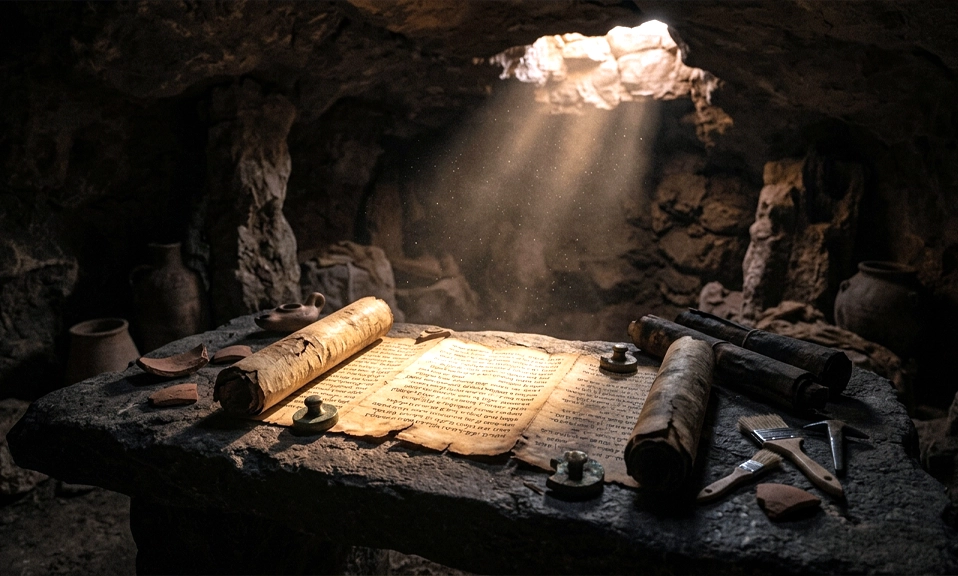
After 70 years, the last unreadable code in the Dead Sea Scrolls has finally been cracked — and it reveals something no one expected.
For seven decades, two tiny fragments of leather sat in a museum collection, covered in an alphabet that no living person could read. Scholars called them “Cryptic B.” They were considered impossible to decipher. Some speculated they contained forbidden doctrines, secret rituals, or the hidden teachings of an ancient sect.
The truth, it turns out, is both simpler and more fascinating.
The Code Nobody Could Break
The Dead Sea Scrolls were discovered in caves near the West Bank between 1947 and 1956 — thousands of fragments of parchment and leather, containing some of the oldest surviving biblical manuscripts ever found. Most were written in Hebrew, Aramaic, or Greek. But a handful used a strange, unfamiliar script that scholars dubbed “Cryptic A” and “Cryptic B.”
Cryptic A was deciphered in 1955. Cryptic B remained a mystery. Only two manuscripts — labeled 4Q362 and 4Q363 — used the cipher exclusively. Many pieces were damaged beyond recognition, with some fragments measuring just a few millimeters across. The leather was cracked, darkened, and frayed. The letter shapes were distorted and inconsistent, making the text appear undecipherable for decades.
Then Emmanuel Oliveiro, a researcher at the University of Groningen, noticed something.
The Breakthrough: Five Letters That Changed Everything
Oliveiro was studying the fragments when he spotted a sequence of five symbols that appeared repeatedly. He began to wonder if they might represent a familiar word. Then it clicked: the symbols might spell “Yisrael” — Israel in Hebrew.
That single insight unlocked the entire cipher. Working through the fragments with a combination of rigorous analysis and intuition, Oliveiro was able to map each cryptic symbol to a Hebrew letter. The code wasn’t a secret language at all. It was Hebrew, written in a deliberately obscured alphabet.
The results were published in the journal Dead Sea Discoveries, marking the first complete decipherment, transcription, and translation of the Cryptic B manuscripts.
What the Fragments Actually Say
If you were hoping for forbidden gospels or apocalyptic secrets, you’ll be disappointed. The deciphered text contains familiar biblical phrases and themes — divine judgment, the coming of a Messiah, and the ultimate destiny of Israel.
Fragment 21 references “Elohim” (God) and “your glory.” Other fragments mention Judah, Jacob, and the “tents of Jacob” — a phrase that appears in Jeremiah 30:18 and Malachi 2:12. There are references to dates and rulers, including “the second year” and “the fifth month,” which may reflect specific historical dating conventions.
As one report put it: after 70 years, scholars deciphered Cryptic B — but no secrets were found. The text isn’t a hidden gospel. It’s a religious document, written in a cipher that was likely intended to enhance the text’s sacred status and restrict access to a select audience of priestly elites.
But the absence of secrets doesn’t mean the discovery is insignificant. Cryptic B was the last undeciphered writing system in the Dead Sea Scrolls. Its decipherment means scholars can now read every word of the Qumran library — and that completeness matters enormously for understanding the community that produced it.
The 2,000-Year-Old Calendar Mystery
The Cryptic B breakthrough isn’t the only Dead Sea Scrolls mystery solved this year. A separate study from Tel Aviv University has proposed a solution to one of the most enduring puzzles in Qumran scholarship: the 364-day calendar.
The Qumran sect — the Jewish community associated with the Dead Sea Scrolls — used a calendar that was radically different from the lunisolar calendar of the Jerusalem Temple. Their year had exactly 364 days, divisible by seven, producing 52 full weeks. Every religious festival always fell on the same day of the week. For the sect, this mathematical perfection reflected a divine order established at Creation.
But scholars have debated for decades whether the sect actually used this calendar or merely theorized about it. Some argued it was a symbolic ideal. Others insisted the community must have added days or weeks to keep it synchronized with the seasons.
According to Professor Eshbal Ratzon of Tel Aviv University, both views are partially correct. Her research, published in the journal Tarbiz, argues that the Qumran sect did use the 364-day calendar in its early years — and that this calendar was one of the reasons the community separated from the Jerusalem establishment in the first place.
The 364-day year has a fatal flaw: it’s about 1.25 days shorter than the actual solar year. Over two decades, the error accumulates to nearly a month, throwing agricultural festivals completely out of sync with the seasons. A harvest festival meant for spring could end up in winter.
Ratzon argues the sect eventually abandoned the calendar — not because of the astronomical problem, but because of politics. Under King Alexander Jannaeus (103–76 BCE), relations between the Qumran community and the Hasmonean dynasty improved. The king’s religious views aligned more closely with the sect’s, and they were able to switch to a more practical calendar while maintaining the 364-day system as a religious ideal and a symbol of their identity.
AI Is Rewriting the Timeline
While scholars were cracking codes and solving calendar puzzles, artificial intelligence was quietly rewriting what we know about when the scrolls were written.
A machine-learning model called Enoch — named after the biblical prophet and early scientist — was trained on 24 radiocarbon-dated scroll fragments and their handwriting features. When tested, Enoch predicted manuscript dates within an uncertainty of about 30 years, more accurate than standalone radiocarbon dating for this period.
The results were striking. About 80% of the time, Enoch’s age estimates came back earlier than those of human paleographers who study ancient handwriting. Some scrolls may be up to a century older than previously thought.
The implications are significant. If the scrolls are older, then the ideas and literacy they represent were spreading across the ancient Near East earlier than scholars believed. The Dead Sea Scrolls might be closer in time to the original biblical authors than we realized.
Mladen Popović, head of the Qumran Institute at the University of Groningen and lead author of the study, was careful to note that AI won’t replace human scholars. “AI needs human beings, especially in its development,” he said. “It’s a tool like the microscope is a tool for a biologist”.
The Great Isaiah Scroll Wasn’t Always One Scroll
One of the most famous Dead Sea Scrolls — the Great Isaiah Scroll, the oldest near-complete book of the Hebrew Bible at 7.34 meters long — has its own mystery. New research suggests it was originally two separate scrolls that were later joined together.
Professor Marcello Fidanzio of the Università della Svizzera Italiana analyzed the physical characteristics of the scroll and found striking differences between its first eight sheets and its final nine. The first section has both vertical and horizontal folds. The second has only vertical ones. The first section has significantly more parchment repairs. The handwriting differs slightly between the two parts.
Fidanzio’s conclusion: the two sections were created as separate scrolls and became one at a later point in time. He doesn’t know whether they were made at the same time or the second was produced later to complete the first, but the material evidence is clear. The scroll tells its own story of bisection and reunification.
The Great Isaiah Scroll will be displayed in its entirety for the first time since 1968 at the Israel Museum in early 2026, accompanying Fidanzio’s new book on the subject.
The Next Frontier: Where Did the Scrolls Come From?
Even with all these breakthroughs, one fundamental question remains unanswered: where were the Dead Sea Scrolls actually written?
The texts were found in caves near Qumran, but scholars still don’t know with certainty where they were produced. A new five-year research project called “Tracing Scribes and Scrolls” aims to change that.
Funded by a €2.5 million grant from the European Research Council, the project will combine artificial intelligence with chemical analysis to trace the origins of approximately 250 scroll samples from the Israel Antiquities Authority’s collection. Researchers will analyze the parchment, papyrus, and ink to determine where the materials came from — and, by extension, where the scrolls were written.
The project, led by Popović, represents the most ambitious attempt yet to reconstruct the ancient supply chains behind the Dead Sea Scrolls. If successful, it could finally answer the question that has haunted Qumran scholarship since 1947: who wrote these texts, and where did they come from?
What It All Means
The Dead Sea Scrolls are more than 2,000 years old. They’ve been studied for nearly 80 years. And yet, in a single year, researchers have deciphered the last unreadable code, solved the mystery of the 364-day calendar, redated significant portions of the collection using AI, and discovered that the most famous scroll of all was originally two.
The lesson is simple: we’re not done learning from the past. Every generation brings new tools — new technologies, new perspectives, new questions — to old texts. The Dead Sea Scrolls have survived two millennia in desert caves. They’ve survived wars, looting, and the passage of empires. And they’re still teaching us things we never knew.
The code is broken. The calendar is explained. The timeline is shifting. And the scrolls, it turns out, have more stories to tell.