t is one of the oldest debates in personal finance, and it is one that almost everyone confronts at some point: you have a chunk of money—a bonus, a tax refund, a monthly surplus—and you have to decide whether to use it to pay down debt or to invest it. The question feels simple, but the answer is not. It depends on the interest rate on your debt, the expected return on your investments, your tax situation, your risk tolerance, and—crucially—how you sleep at night.
The good news is that there is a clear framework for making this decision. The bad news is that the framework produces different answers for different people. Here is how to think about it.
The Math: Compare the Interest Rate to the Expected Return
At its core, the decision is a comparison of two numbers: the guaranteed return you get from paying off debt, and the expected return you get from investing.
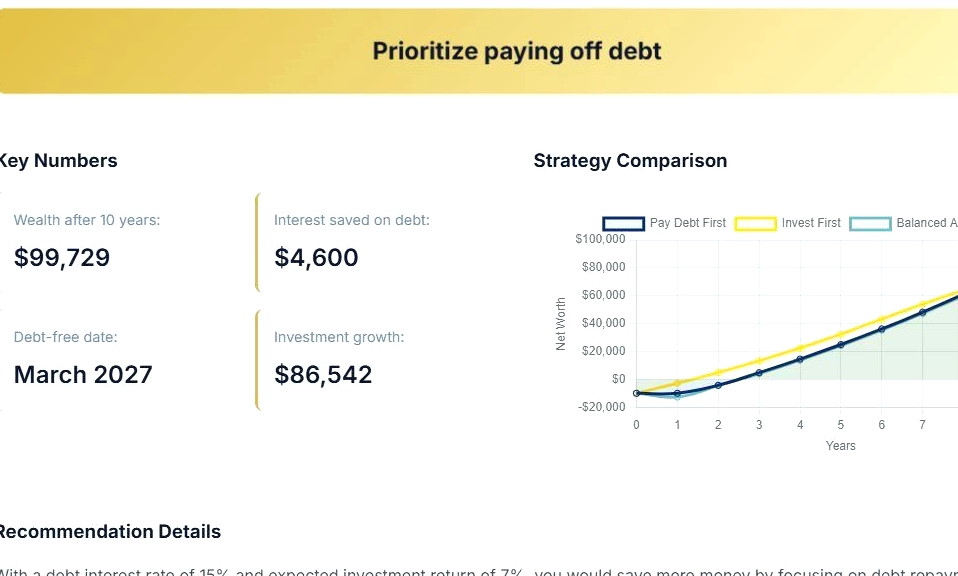
Paying off a debt with a 20% interest rate is equivalent to earning a guaranteed, risk-free, tax-free 20% return on your money. There are very few investments in the world that can reliably deliver that. Investing in the stock market, by contrast, has historically returned around 7% annually after inflation over the long term—but that return is not guaranteed, and it comes with volatility.
The principle is straightforward: if the interest rate on your debt is higher than the expected after-tax return on your investments, pay off the debt first. If the interest rate is lower, investing may make more mathematical sense.
Here is how common debts stack up:
Credit cards (18–25% APR): This is the clearest case. No diversified investment portfolio reliably returns 20% per year. Paying off credit card debt is almost always the highest-return, lowest-risk financial move available to you.
Personal loans (8–15% APR): Still above the long-term expected return of the stock market. Paying these off is usually the better mathematical choice, though the case is less overwhelming than for credit cards.
Student loans (4–8% APR): This is where the math becomes more nuanced. Federal student loans in the U.S. often carry rates in the 4–7% range, and interest may be tax-deductible. At the lower end of that range, investing may outperform debt repayment over a long horizon—especially in tax-advantaged accounts.
Mortgages (6–7% APR in 2026): Mortgage rates have risen significantly, which has shifted the calculus. A 7% mortgage is a meaningful guaranteed return, and paying it down early is a more compelling option than it was when rates were 3%. But mortgages are also long-term, tax-advantaged (in the U.S., mortgage interest may be deductible), and often the cheapest debt you will ever have. Many financial planners recommend prioritizing retirement investing over extra mortgage payments, particularly if you have decades left on the loan.
Auto loans (5–8% APR): Similar to student loans. The math is close enough that other factors—like your emergency fund, your retirement contributions, and your comfort with risk—should drive the decision.
The Psychology: Why the Math Is Not the Whole Story
If the decision were purely mathematical, most people would pay off high-interest debt and invest the rest. But personal finance is not a spreadsheet. It is a behavioral discipline, and the psychological dimension matters as much as the arithmetic.
Debt creates stress. A 2023 study from the American Psychological Association found that money is the top source of stress for adults, and debt is a major contributor. Eliminating debt can improve your mental health, your relationships, and your overall quality of life in ways that a slightly higher investment return cannot replicate.
Debt reduces flexibility. When you have debt, a portion of your income is committed to servicing it. That reduces your ability to weather a job loss, take a career risk, or respond to an emergency. Paying off debt buys back optionality—and optionality has value that is difficult to quantify on a spreadsheet.
The behavioral risk of investing while in debt. There is a well-documented behavioral trap: people who carry high-interest debt while investing often end up doing neither effectively. They dip into investments to pay bills, they panic-sell during downturns, or they use the presence of an investment account as an excuse to keep spending. For many people, the discipline of paying off debt first is a more reliable path to long-term wealth than the theoretically optimal strategy of investing while carrying debt.
The “debt-free” feeling is real. There is a reason so many people describe paying off their last debt as one of the most liberating moments of their financial lives. The psychological benefit of being debt-free is not a soft consideration. It is a real, measurable improvement in well-being that can make it easier to focus on the next financial goal.
The Middle Ground: A Hybrid Approach
The good news is that you do not have to choose one or the other. For most people, the optimal strategy is a hybrid—a sequence of steps that prioritizes the highest-impact actions while preserving the benefits of investing.
Step 1: Build a Starter Emergency Fund
Before you do anything else, set aside enough cash to cover one month of essential expenses in a high-yield savings account. Without this buffer, an unexpected expense will force you to rely on credit cards—undoing your progress and adding to your debt.
Step 2: Capture Any Employer Match
If your employer offers a retirement plan match—for example, a 401(k) match of 50% or 100% of your contributions up to a certain percentage of your salary—contribute at least enough to get the full match. This is free money, and no debt repayment strategy can match its guaranteed return. A 50% match is an immediate 50% return on your contribution. Prioritize it.
Step 3: Pay Off High-Interest Debt Aggressively
After the starter emergency fund and the employer match, direct all available resources toward high-interest debt—credit cards, personal loans, and anything else with an interest rate above roughly 8%. Use the avalanche method (paying the highest-interest debt first) to minimize the total interest paid, or the snowball method (paying the smallest balance first) if you need psychological wins to stay motivated. Both work; the avalanche is mathematically optimal, the snowball is behaviorally effective.
Step 4: Build a Full Emergency Fund
Once the high-interest debt is gone, build a full emergency fund covering three to six months of expenses. This is the foundation that makes everything else possible—it allows you to invest without fear of being forced to sell during a downturn, and it protects you from the kind of financial shock that derails long-term plans.
Step 5: Invest for the Long Term
With high-interest debt cleared and a full emergency fund in place, you can now invest with confidence. Maximize your tax-advantaged accounts (401(k), IRA, HSA, or local equivalents) before contributing to taxable accounts. Invest consistently, keep costs low, and let compounding work over decades.
Step 6: Consider Low-Interest Debt
For low-interest debt—such as a mortgage or a student loan below roughly 5%—the decision becomes a matter of personal preference and risk tolerance. If you value the psychological benefit of being debt-free, paying it down early is a reasonable choice. If you are comfortable with the debt and want to maximize long-term returns, investing the difference may be the better path.
The Tax Factor
Taxes can tip the balance in either direction. On the debt side, mortgage interest and student loan interest may be tax-deductible, which effectively reduces the cost of carrying that debt. On the investment side, tax-advantaged accounts (401(k), IRA, HSA) shelter your returns from taxation, which increases the effective return on your investments.
The practical implication is that the after-tax comparison is what matters. A 6% mortgage with deductible interest may effectively cost you 4.5%—which is closer to the expected return on a diversified portfolio. A 20% credit card has no tax advantage and should be eliminated as quickly as possible.
The Answer Depends on Your Circumstances
So, should you pay off debt or invest first? The honest answer is: it depends—but the decision is not as complicated as it feels once you establish a sequence.
For most people, the right order is this:
Build a one-month emergency fund.
Capture your full employer match.
Pay off high-interest debt (above ~8%) aggressively.
Build a three-to-six-month emergency fund.
Invest for the long term, maximizing tax-advantaged accounts.
Consider low-interest debt repayment based on your preference and risk tolerance.
This sequence captures the best of both worlds. It gives you the guaranteed, risk-free return of eliminating high-interest debt while preserving the most valuable investment opportunities—the employer match and long-term compounding in tax-advantaged accounts.
The math and the psychology do not have to conflict. By prioritizing the highest-impact actions first, you can build a strategy that is both financially optimal and emotionally sustainable. The goal is not to be debt-free or invested—it is to be in control of your money. That is a destination worth reaching.