The arcade racing genre has been running on fumes for years. Then a small studio of former Burnout developers, armed with the Star Wars license and a radical idea, quietly built one of the best-reviewed games of 2026. Star Wars: Galactic Racer isn’t just a nostalgia trip—it’s a blueprint for how to bring an entire genre back to life.
The Game That Shouldn’t Exist (But Does)
Star Wars: Galactic Racer launched on October 6, 2026, for PlayStation 5, Xbox Series X|S, PC, and Amazon Luna. It’s the debut release from Fuse Games, a Guildford-based studio founded by former Criterion Games developers—the people behind Burnout and several Need for Speed titles. It was published by Secret Mode in collaboration with Lucasfilm Games.
Set in the early years of the New Republic, after the fall of the Empire, the game follows Shade, a lone racer recruited by promoter Darius Pax to take down the reigning champion, the arrogant nepo-baby Kestar Bool, in an unsanctioned underground circuit called the Galactic League. It’s a classic underdog story, but with a Star Wars twist: the racing is fast, the stakes are high, and the galaxy is still rebuilding from fascism.
But the story isn’t the reason critics are calling it “the best arcade racing game in a generation”. The reason is the structure.
The Genre-Blending Gamble: Roguelike Meets Arcade Racer
The most radical thing about Galactic Racer is that it’s not just an arcade racer. It’s a roguelike—or, more precisely, a roguelite.
Instead of a traditional linear campaign, the game uses a run-based structure. Players choose branching Tours of randomized events, earning upgrades, abilities, and parts for their craft as they progress. A failed run—whether from crashing too many times or failing to place in the top three of an Eliminator race—sends you back to the start of a new Tour, though certain perks and unlocks carry over.
Polygon’s review described the game as “the Hades of racing games” for this exact reason: it takes the loop that made roguelikes so addictive and applies it to high-speed racing. You’re not just racing to win. You’re racing to build—to assemble a vehicle and a playstyle that can survive the escalating difficulty of each run.
The buildcrafting is deep. At the start of a run, you choose from three vehicle types, 14 racing styles with different traits and starting abilities, and game-modifying Favors. During a run, you earn upgrades that enhance your craft in specific conditions—and those conditions matter. Planetary environments like Sentinel I’s toxic atmosphere or Jakku’s blazing heat affect cornering, engine cooling, and more.
This is where Galactic Racer diverges from the arcade racers of the 2000s. It’s not just about reflexes. It’s about decisions—which route to take, which upgrade to install, which risk to accept. As Fuse Games co-founder Matt Webster put it: “Three and a half years ago, Fuse Games was a handful of people, a pitch, and no shipped game to our name. We walked into Lucasfilm Games with nothing but an idea and conviction that it was time for a new Star Wars racing game, and that it should be something that pushes the genre forward”.
The Vehicles: Landspeeders, Speeder Bikes, and Podracers
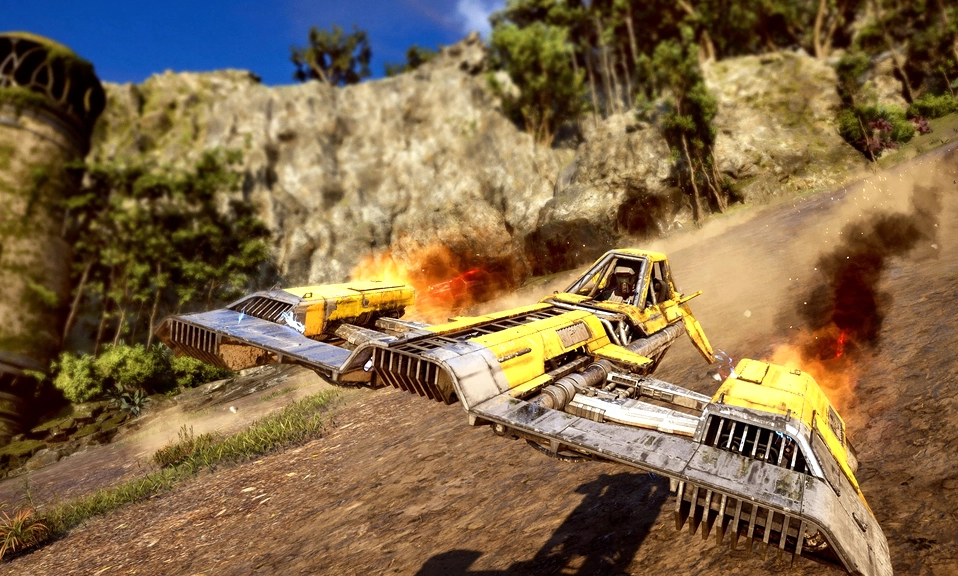
The game features four distinct vehicle classes, each with its own handling model and racing philosophy:
Landspeeders emphasize aggressive racing, takedowns, and smooth cornering.
Speeder bikes favor hard braking and rapid acceleration.
Skim speeders reward momentum and precise racing lines, including a Knife Edge ability designed for navigating narrow gaps.
Podracers are considerably faster and compete separately because of their higher speeds.
Tracks span both familiar and new Star Wars locations, including Jakku’s Graveyard of Giants (where you race among crashed Star Destroyers and AT-ATs), the frozen terrain of Ando Prime, and the hazardous environment of Sentinel I. Familiar characters appear too, including Sebulba from The Phantom Menace and even Ben Quadinaros, the Toong podracer who has become a cult favorite.
The variety is deliberate. It’s not just one type of racing repeated across different backdrops. Each vehicle class changes how you approach a track, and each planet changes how the track behaves. The result is a game that stays fresh across dozens of hours—a rarity in a genre that often runs out of ideas after the first Grand Prix.
The Reception: A Genuine Critical Triumph
The reviews are, by any measure, extraordinary.
Star Wars: Galactic Racer holds an 88 on Metacritic and an 87 on OpenCritic, with 96% of critics recommending it. On Steam, it sits at 86% positive from over 6,000 reviews—a “Very Positive” rating that climbed from 69% on launch day as more players experienced the game.
To put that in perspective: it is the highest-rated Star Wars game since 2003, behind only Knights of the Old Republic, Dark Forces 2, Rogue Squadron 2, and Jedi Outcast on Metacritic’s all-time list. It has a higher rating than every Star Wars film except the original.
The reviews praise different things. Polygon called it “the best arcade racing game in a generation,” praising its “structurally innovative” design and its willingness to be “hard, innovative, and [have] a lot going on”. CNET said it’s “F-Zero meets Burnout” and “one of my favorite games of 2026”. GamesRadar+ awarded it four out of five stars, calling it “a blueprint for others to follow” and praising its “exhilarating risk/reward racing” and “excellent run-based format”. Eurogamer, Mirror Gaming, Giant Bomb, and Radio Times all gave it full marks.
The criticisms are minor and consistent. GamesRadar+ noted that the campaign “stalls a little at the end” and wanted “more planets and tracks for a truly galactic feel”. Polygon observed that the game “won’t hold your hand”—the tutorial is brief, and the difficulty ramps up quickly, which is a deliberate philosophical choice from the developers. These are the complaints of a game that people wish had more of, not less.
Can It Revive the Arcade Racing Genre?
The short answer is: it already has.
For years, the arcade racing genre has been defined by what it used to be. Burnout was the last great innovator, and it’s been dormant since Burnout Paradise in 2008. F-Zero hasn’t had a new entry in decades. Wipeout is gone. The genre has survived on remasters, spiritual successors, and the occasional Forza Horizon—which, excellent as it is, belongs to a different lineage of open-world driving games.
Galactic Racer doesn’t just imitate those classics. It learns from them and moves forward. The Burnout DNA is unmistakable—the takedowns, the boost mechanics, the sense of speed that makes the screen blur and the controller rumble. But the roguelike structure is new. The buildcrafting is new. The integration of planetary conditions and vehicle classes into a run-based loop is new.
“Racing game fans don’t get a new release like Star Wars: Galactic Racer every day,” Polygon wrote. “We don’t get one every year. Recently, we haven’t even got one every console generation. We should savor it”.
The commercial and critical success of Galactic Racer sends a clear message to the industry: arcade racers can still work. They can still sell. They can still earn headlines. And they can still be innovative. The genre didn’t die because players stopped wanting it. It died because publishers stopped taking risks on it. Fuse Games took a risk, and it paid off.
Whether other studios will follow is another question. The game took three and a half years to make, and it required a major license to secure the budget and attention it needed. Not every studio has access to a Star Wars-sized IP. But the design—the run-based structure, the buildcrafting, the focus on consequence and choice—isn’t dependent on the license. It’s a template that could be applied to any racing game with a modest budget and a clear vision.
Star Wars: Galactic Racer
is not just a good Star Wars game. It’s not just a good racing game. It’s a proof of concept for an entire genre that many had written off as obsolete.
It’s fast. It’s hard. It’s smart. And it respects its players enough to let them fail, learn, and try again. That’s what arcade racing was always supposed to be—not a nostalgia act, but a thrill ride with stakes.
The genre isn’t dead. It was just waiting for someone to hit the accelerator.