“Powerful” is not one number. A fighter’s power may be measured in air-combat results; a bomber’s in the ability to reach defended targets with a heavy payload; a transport’s in how much it can lift; and an experimental aircraft’s in how far it pushed the limits of speed, altitude, or engineering. This ranking weighs peak capability, breadth of capability, operational impact, and demonstrated results—while keeping design figures, test records, and routine mission performance separate.
How the ranking works
The list is a qualitative ranking, not a horsepower league table. I gave the most weight to four questions:
1.What could the aircraft do? Speed, altitude, thrust, payload, range, sensors, survivability, or lift all matter—but only in the context of the aircraft’s mission.
2.How broad was that power? A platform that combines several major advantages outranks one that dominates only a single measure.
3.Was the capability demonstrated? Combat records, operational service, world records, and test results count, but they are labeled as such. A maximum design figure is not treated as a typical mission result.
4.Did it change aviation or strategy? Longevity, strategic effect, engineering significance, and influence on later systems break close calls.
That method necessarily compares unlike things. The F-15 is here because of validated air-superiority power; the An-225 because of extraordinary lift; the X-15 because it achieved piloted hypersonic and near-space research milestones. “Most powerful” therefore means most compelling overall combination of capability and consequence within the aircraft’s role, not simply fastest, biggest, or most heavily armed.
1. McDonnell Douglas F-15 Eagle
The F-15 takes the top spot because it combines exceptional performance with the strongest operational proof in the group. Development began under the U.S. Air Force’s F-X program in 1965; the first F-15A flew in 1972, and the type reached initial operating capability in 1975. The Smithsonian describes the Eagle as the USAF’s principal air-superiority fighter during the late Cold War and beyond.
Its published capability is broad: Mach 2.5 maximum speed, a 65,000-foot service ceiling, two afterburning engines rated at 23,450 lbf each in the listed C/D configuration, and a mission-dependent air-to-air loadout including AIM-9 and AIM-120 missiles. Those are specification figures, not a claim that every sortie reached every maximum.
What separates the Eagle is evidence in combat. In Operation Desert Storm, USAF F-15Cs flew 5,685 sorties and accounted for 34 of 37 USAF air-to-air victories. The Smithsonian also reports more than 100 enemy aircraft shot down by F-15s across nations and no Eagle lost to enemy action in air-to-air combat. The combination of speed, maneuverability, radar, electronic warfare support, weapons carriage, continuing modernization, and a rare record of sustained air-combat effectiveness makes the F-15 the most complete package here.
2. Northrop Grumman B-2 Spirit
The B-2 ranks second because it turned low observability, intercontinental reach, and heavy precision or nuclear strike capability into an operational system. It first flew in 1989, reached initial operating capability in 1997, and made its combat debut over Serbia and Kosovo in 1999. Air Force sources also describe a 2001 Afghanistan mission from Missouri and back lasting about 44 hours.
The aircraft’s power is not raw speed. It is the integration of a flying-wing design and reduced radar, infrared, acoustic, electromagnetic, and visual signatures with a large payload. The USAF lists a 60,000-pound payload and a combat ceiling of 50,000 feet; official figures also give approximately 6,000 nautical miles of unrefueled range and 10,000 nautical miles with one aerial refueling. These are capability and planning figures, not a promise that maximum payload and maximum range occur together.
Its record supports the design’s strategic value. During Operation Allied Force, the Air Force credits B-2s with destroying 33% of all Serbian targets in the first eight weeks. Air Force Global Strike Command reports 100% on-time takeoffs and 98% JDAM effectiveness over more than 1,400 flight hours. The B-2 is below the F-15 only because its power is more specialized and support-dependent—but its ability to carry a large payload through sophisticated defenses gives it enormous strategic weight.
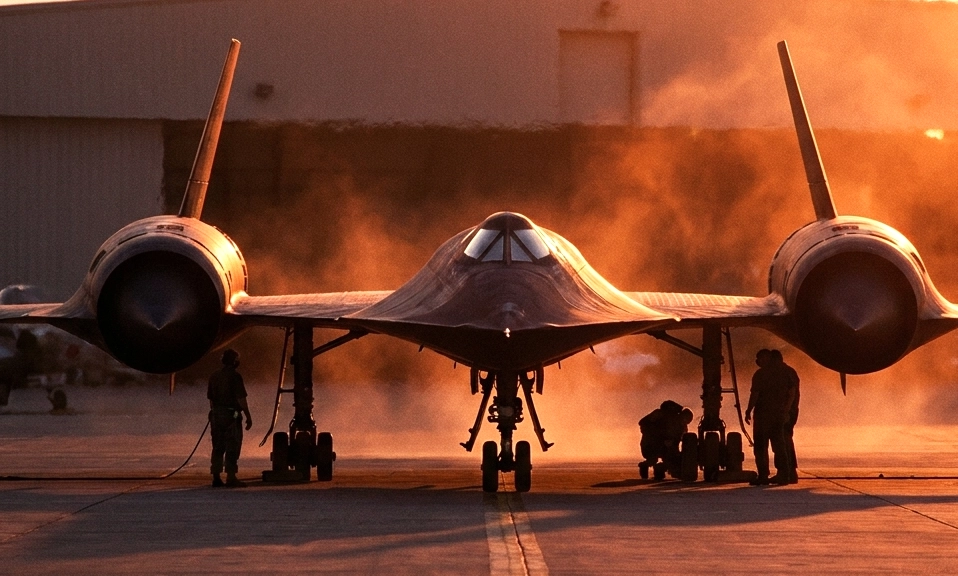
3. Lockheed SR-71 Blackbird
The SR-71 is the list’s clearest example of speed and altitude becoming a defensive system. It first flew in 1964 and entered Air Force service in 1966, becoming a central Cold War intelligence platform. It gathered imagery and signals in missions connected with Vietnam, the 1973 Yom Kippur War, Lebanon, Libya, and the Persian Gulf.
The Blackbird combined long-range reconnaissance, reduced radar signature, electronic countermeasures, specialized air intakes, titanium construction, and continuous afterburner operation. Its documented design capability was Mach 3.3 at more than 85,000 feet, approximately 2,200 mph. In 1976, the Smithsonian records the aircraft setting class marks of 2,193.2 mph and 85,069 feet in sustained horizontal flight.
Those records must not be confused with routine sortie performance, but they show why the aircraft was so difficult to challenge. Its power came from putting sensors where few other aircraft could go, at a speed and altitude that reduced interception risk. The SR-71 ranks below the B-2 because it carried intelligence sensors rather than a heavy strike payload, but as an integrated high-speed reconnaissance system it remains extraordinary.
4. Tupolev Tu-160 Blackjack
The Tu-160 is the ranking’s most formidable conventional-looking combination of size, speed, range, and weapons capacity. Work began in the early 1970s; the prototype first flew in 1981, and testing of the first serial aircraft began in 1984. The type connects late-Soviet strategic-aircraft engineering with Russia’s continuing long-range aviation force.
UAC lists a maximum takeoff weight of 275,000 kilograms, a maximum speed of 2,220 km/h, an unrefueled range of 12,300 km, and up to 40 tonnes of bomb capacity. It can also carry up to 12 Kh-55MS cruise missiles internally. Four afterburning NK-321 turbofans are listed at about 245 kN each. The 12,300-km range is not the same measure as the separately listed 7,300-km combat radius, and these maximums should not be imagined as simultaneous routine mission conditions.
The Tu-160’s case is therefore multidimensional: strategic standoff attack, internal missile carriage, heavy bomb load, long missions, and supersonic dash in one platform. A documented 2010 patrol covered 18,000 km in 23 hours, further demonstrating its reach. It falls below the SR-71 because its speed and survivability are less singular, but few aircraft combine so much strategic payload and range with supersonic performance.
5. Antonov An-225 Mriya
The An-225 earns fifth place through a kind of power that combat aircraft cannot match: lift on an immense scale. It first flew in 1988, designed to carry the Buran spacecraft and Energia launch-system components. The sole completed aircraft later returned to service for commercial heavy and oversized freight.
Antonov gives the Mriya a 250-tonne maximum payload capability, a 600-tonne maximum takeoff mass, six D-18T turbofans, and an 88.4-metre wingspan. It was built to carry unusually large loads internally or externally, not merely to move ordinary freight efficiently.
Operations validate the aircraft’s exceptional lift without erasing the distinction between ratings and records. Antonov records a 247-tonne commercial cargo flight in 2004, while Ukraine’s State Aviation Museum reports a separate 254-tonne payload-to-altitude record in 2001. Those are different documented events and should not be merged into a claim that every flight could exceed the nominal 250-tonne capability. The An-225 ranks this high because its specialized cargo power was both uniquely large and demonstrably useful.
6. Lockheed C-5M Super Galaxy
The C-5M is less spectacular than the An-225 but more important as a sustained strategic-airlift instrument. The C-5 entered U.S. Air Force operational service in 1970 and supported major operations including Vietnam, Desert Storm, and Operation Enduring Freedom, as well as humanitarian relief. The C-5M modernization combined avionics upgrades with re-engining intended to improve thrust, takeoff roll, climb, navigation, communications, safety, and maintainability.
The published design figures are imposing: a maximum allowable payload of 281,001 pounds, maximum takeoff weight of 840,000 pounds, four engines rated at 51,250 lbf each, and a cargo bay 143 feet 9 inches long with 36 pallet positions. Published range reaches up to 7,000 nautical miles without cargo or approximately 4,800 nautical miles with 120,000 pounds of cargo; actual range varies with load, fuel, routing, and conditions.
A 2009 test flight carried 176,610 pounds to 41,188 feet in 23 minutes 59 seconds. That was a reported aviation-record/test result, not the same thing as the maximum allowable payload or a normal mission profile. The C-5 ranks above the 747-8 because its outsized military cargo mission, through-loading design, and operational strategic role give its size a more direct logistical and national-security effect.
7. North American X-15
The X-15 is lower on an all-aircraft list only because its power was brief, specialized, and experimental—not because its achievements were modest. The joint NASA–U.S. Air Force–U.S. Navy program made 199 research flights from 1959 to 1968 and generated data used by later human-spaceflight programs.
Its XLR-99 rocket engine could produce up to 57,000 lbf of thrust. X-15A-2 reached 4,520 mph, or Mach 6.7, on October 3, 1967, while X-15-3 reached 354,200 feet on August 22, 1963. These were record flights by different aircraft, not one routine operating profile. Missions were generally air-launched from a B-52, lasted 8–12 minutes, and used rocket thrust for roughly 80–120 seconds before an unpowered glide to landing.
With Inconel-X skin for extreme heating and reaction controls for thin-atmosphere flight, the X-15 was a piloted laboratory for hypersonic aerodynamics, reentry, and human factors. Its actual peaks are among the most impressive in aviation history, but its short missions and research role keep it below aircraft that delivered broader operational power.
8. Mikoyan-Gurevich MiG-25 Foxbat
The MiG-25 was a specialized answer to high-altitude, high-speed threats. Designed from 1958 to 1962, it entered Soviet service in 1970 as an interceptor and reconnaissance aircraft. Its heavy structure and powerful engines prioritized speed, altitude, radar, and missile reach over close-combat agility.
The National Museum of the U.S. Air Force cites a maximum or top speed of Mach 2.83, two afterburning R-15B-300 turbojets producing approximately 22,500 lbf each, and a maximum air-to-air load of four missiles. A separate FAI record reached 37,650 metres—123,523 feet—but that was achieved by an experimental MiG-25, not a standard operational interceptor.
The Foxbat’s power is therefore concentrated rather than universal. The Smithsonian describes it as the fastest interceptor aircraft of its time, while also emphasizing its bulk and poor close-combat maneuverability. It ranks below the X-15 because its altitude record needs the experimental-aircraft qualification and because its operational role was narrower, but its speed-and-interception package was formidable.
9. Boeing 747-8
The 747-8 represents commercial and cargo power: the ability to move very large passenger or freight loads across intercontinental networks. Launched in 2005, it was produced as both the 747-8 Intercontinental and 747-8 Freighter. The freighter entered revenue service in 2011 and the passenger model in 2012; the final 747-8 Freighter was delivered in January 2023.
Boeing’s airport-planning data lists a maximum design takeoff weight of 447,695 kilograms and, for the 747-8F in its higher-weight configuration, a maximum structural payload of 132,630 kilograms. The passenger aircraft’s specified three-class layout has 467 seats, while the passenger version’s usable fuel capacity is listed at 238,609 litres. Cruise speed is Mach 0.855 for the Intercontinental and Mach 0.845 for the Freighter.
These are configuration and design capabilities, not a claim that every flight carries maximum payload, fuel, or seats. The 747-8 ranks below the C-5M because its power is optimized for commercial economics and airline operations rather than military outsized logistics. Still, its combination of mass, payload, fuel capacity, and global passenger or freight utility makes it one of the most powerful airliners ever built.
10. North American XB-70 Valkyrie
The XB-70 closes the list as a spectacular prototype whose technological power exceeded its operational legacy. Conceived as a high-altitude nuclear bomber, the program was canceled in 1961 before the aircraft could enter service. Only two prototypes were completed; the second was lost in a 1966 midair collision, while the survivor became a NASA and Air Force research aircraft.
The planned aircraft was to cruise at Mach 3 around 70,000 feet. The National Museum of the U.S. Air Force lists a maximum of 2,056 mph, or Mach 3.1, at 73,000 feet, a 77,350-foot service ceiling, and six afterburning YJ93 engines rated at 30,000 lbf each. One prototype sustained Mach 3 for 32 minutes in May 1966.
Those numbers make the Valkyrie a credible entry on a list of powerful aircraft, but the qualifications matter. It was never an operational bomber; after one Mach 3 flight, the first prototype was limited to about Mach 2.5 because of directional-stability concerns. Its later contribution was research into supersonic transport, sonic booms, aerodynamics, propulsion, structures, and handling. The XB-70 ranks tenth because its design ambition and test performance were immense, while its intended combat role remained unrealized.
There is no single winner
if “power” means only one thing. The F-15 Eagle is the best all-around choice because its high performance, weapons and sensors, longevity, and combat record reinforce one another. The B-2 has the strongest case for strategic penetration; the SR-71 for sustained speed-and-altitude reconnaissance; the Tu-160 for supersonic strategic payload; the An-225 for outsized lift; and the X-15 for piloted research achievement.
The ranking’s central lesson is that aircraft power is mission-shaped. A record speed, a maximum payload, a combat result, and a strategic effect are not interchangeable—but when the evidence is kept in its proper category, each of these ten aircraft shows a genuinely different way of being powerful.