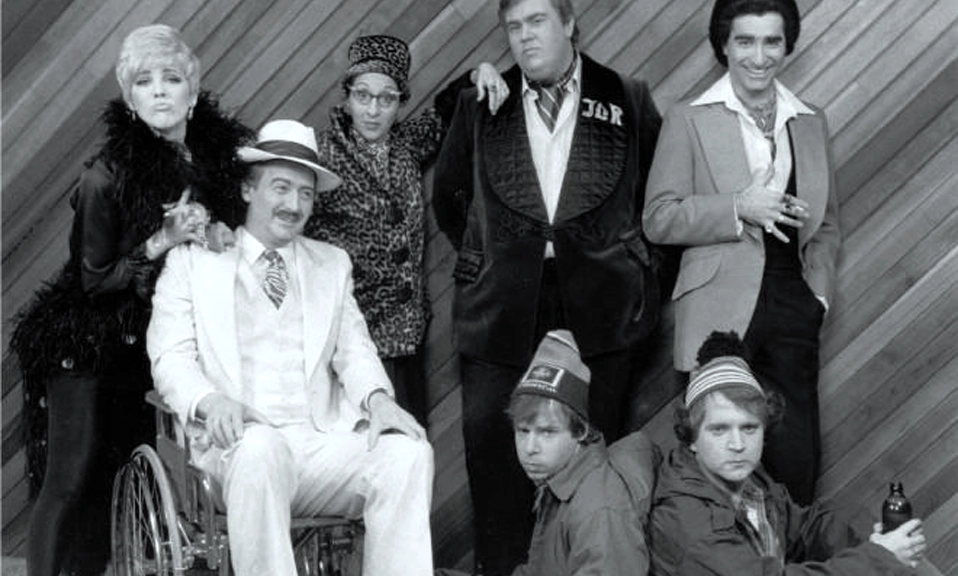
Everyone knows Saturday Night Live. No one knows the show that was funnier than Saturday Night Live.
Its name was SCTV — Second City Television — a Canadian sketch show made in Edmonton and Toronto for the price of a used car, that aired from 1976 to 1984, and that quietly invented almost everything you love about modern comedy.
If SNL was the cool kids party in New York, SCTV was the weird, brilliant kids making fun of the party from a basement in Canada — and being right.
What Was SCTV?
While being technically a sketch comedy show, SCTV was more a parody of television in general, which the sketches not just being premises, but rather comprised mostly of ads for fake products and TV and movie parodies.
The premise: SCTV is a terrible, low-budget TV station in the fictional town of Melonville run by greedy, incompetent owner Guy Caballero — who uses a wheelchair only to gain sympathy and respect, then stands up when no one’s looking.
That one idea changed everything. SCTV, from its earliest days to its later iterations, fundamentally changed the landscape of sketch comedy and television satire. The innovative format of creating a fictional network allowed for a meta-commentary on television itself, a concept that has been borrowed and adapted by many subsequent shows.
Instead of random sketches, every sketch was a show on that fake network:
- A sleazy late-night movie with horror host Count Floyd (Joe Flaherty)
- A trashy celebrity interview show with Lola Heatherton (Catherine O’Hara)
- A polka show with the Schmenge Brothers (John Candy & Eugene Levy)
- A news show with Floyd Robertson and Earl Camembert, who openly hated each other
- Fake commercials for “Al Peck’s Used Fruit,” “Harry’s Shoes: For The Clinically Deformed Foot,” and “The Alimony Show”
It wasn’t sketch comedy. It was a universe.
SCTV wasn’t just chasing the next laugh—it was building a universe, a fully realized, brilliantly absurd world inside the confines of a struggling TV station.
The Cast That Should Be on Mount Rushmore
The cast of the show came from the stage of the renowned Second City comedy theater, which at the time had branches in Chicago and Toronto, and included soon-to-be comedy greats John Candy, Eugene Levy, Andrea Martin, Catherine O’Hara, Rick Moranis, and Martin Short, as well as Harold Ramis.
Read that list again:
- John Candy — turned down SNL to stay loyal to SCTV. First billed, arguably the greatest actor on the show, Candy’s legacy remains a stirring picture. He became Uncle Buck, Home Alone’s polka king, Planes Trains and Automobiles.
- Catherine O’Hara — Moira Rose in Schitt’s Creek 40 years later, still doing SCTV characters
- Eugene Levy — Johnny Rose, and every Christopher Guest movie
- Rick Moranis — Ghostbusters, Spaceballs, Honey I Shrunk the Kids
- Martin Short — Only Murders in the Building, still the most chaotic man alive
- Andrea Martin, Joe Flaherty, Harold Ramis — who went on to write Animal House, Ghostbusters, Groundhog Day
SCTV is a groundbreaking Canadian sketch comedy series that launched the careers of many comedy legends.
SNL had 1 breakout star every 3 years. SCTV had 7 at once, all in one room, improvising.
Why It Changed Television
1. It Invented Meta-Comedy
Before SCTV, sketch comedy was often seen as a lesser form of entertainment, something that was disposable and not to be taken too seriously. SCTV changed all of that by demonstrating that sketch comedy could be intelligent, sophisticated, and even profound.
SCTV didn’t make fun of politicians. It made fun of how television covers politicians. It didn’t make fun of movies. It made fun of how a cheap local station would show that movie at 2am with a drunk host.
That meta layer — a show about watching shows — is now everything:
- 30 Rock is SCTV (a show about making a terrible NBC show)
- Arrested Development has SCTV’s layered running jokes
- The Office, Parks & Rec, What We Do In The Shadows — mockumentary format SCTV pioneered
- Key & Peele, Portlandia, Documentary Now! — all cite SCTV as direct parent
Think about shows like Arrested Development, 30 Rock, or even Key & Peele – you can see echoes of SCTV’s DNA in their comedic structures.
2. Characters, Not Catchphrases
Unlike some comedy that ages poorly, SCTV’s commentary often remains surprisingly relevant. The show’s ability to create fully realized recurring characters, like the lounge singer Floyd Robertson, the alien Lola Heatherton, or the incompetent station manager Guy Caballero, was unparalleled. These characters weren’t just one-off gags; they evolved and interacted, creating a rich tapestry.
SNL’s characters say the same catchphrase every week. SCTV’s characters grew. Johnny LaRue (John Candy) started as a hacky host and slowly revealed he was a lonely, delusional man desperate to be liked. You laughed, then you felt bad for laughing. No other sketch show did that.
3. It Assumed You Were Smart
The genius of SCTV was that it never pandered. It assumed you were in on the joke.
There’s a reason SCTV still holds up, while so much of SNL feels like an artifact of its era. It’s the difference between crafted satire and disposable sketch comedy.
They did 15-minute parodies of Ben-Hur, Ingmar Bergman films, and Federico Fellini — on a network that could barely afford costumes. They trusted you to know who Fellini was in 1981 in Edmonton. SNL would never.
Groundbreaking comedy series SCTV left a massive cultural dent on pop culture, reshaping the comedy landscape with its edgy humor and proving that razor-sharp satire didn’t need a New York address or the Saturday Night Live stage to change television.
Why It Still Deserves Recognition (And Why It Doesn’t Get It)
Because it was Canadian, cheap, and never wanted fame.
SCTV wasn’t the most commercially successful show of its time, but its influence on the comedic landscape has been profound.
- It never had a massive live audience screaming
- It aired at weird times — first in syndication in Canada, then late-night on NBC after Johnny Carson
- You can’t stream most of it properly because music clearances for all the parodies cost millions — so Gen Z never found it on Netflix
Unlike both Fridays and SNL, SCTV was consistently funny. SCTV remains as poignant and funny as it was when it first aired.
But ask any comedian who matters:
- Conan O’Brien says SCTV DVD set is his favorite comedy ever
- Seth Meyers, Tina Fey, John Mulaney, Bill Hader — all say SCTV > SNL for craft
- Martin Scorsese cast Catherine O’Hara and Eugene Levy because of SCTV
Second City Television was more than just a television show; it was a comedic institution. Its innovative style, talented cast, and enduring legacy have cemented its place as one of the most important and influential comedy programs of all time.
Where To Watch It Now
It’s hard — and that’s part of the tragedy. Where Can You Watch the Landmark Sketch Comedy Series ‘SCTV’? is a real Google search because it’s scattered.
Start YouTube: Search “SCTV Schmenge Brothers,” “SCTV Count Floyd Monster Chiller Horror Theater,” “SCTV Farm Film Celebrity Blow Up.” If you laugh once, you’ll go down a 3-hour rabbit hole.
SCTV remains a testament to the power of improvisation, the importance of character development, and the enduring appeal of smart, satirical humor.
SNL taught television how to be live. SCTV taught television how to be smart about being television.
And we still haven’t thanked it properly.
Have you ever actually watched SCTV, or did you just know the stars from their later movies? If you haven’t, start with Guy Caballero — the guy who fakes being in a wheelchair to get respect. You’ll get it immediately.