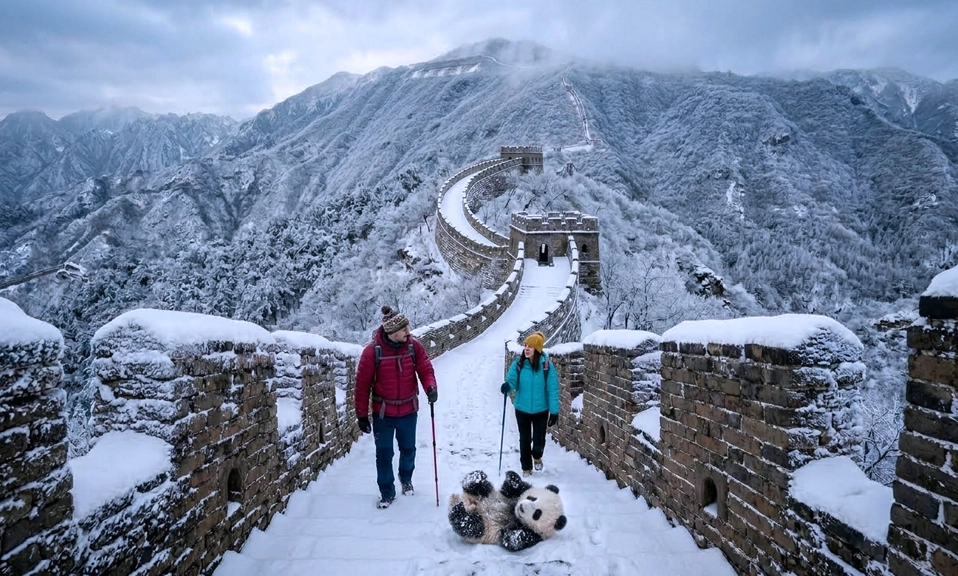
If you ask anyone on the street to name a wonder of ancient China, they will say the Great Wall. It’s on every postcard, in every history textbook, and at the top of every traveler’s bucket list. It is the ultimate symbol of Chinese engineering.
But if you ask a historian, an economist, or a civil engineer, they will tell you a secret: The Great Wall is actually a massive, expensive failure.
Built by conscripted labor, it was notoriously difficult to maintain, rarely kept invaders out (the Mongols and the Manchus both breached it), and today, it is largely a crumbling ruin. It was a monument to isolation and defense.
China’s true greatest wonder isn’t a wall built to keep people out. It’s a waterway built to bring the country together.
It is the Grand Canal (Jing-Hang Grand Canal), and it makes the Great Wall look like a simple garden fence.
🌊 The Scale is Mind-Boggling
To understand why the Grand Canal is the ultimate wonder, you have to look at the numbers.
Stretching over 1,100 miles (1,794 kilometers) from Beijing in the north to Hangzhou in the south, it is the longest artificial river in the world.
To put that in perspective:
- It is 17 times longer than the Panama Canal.
- It is 10 times longer than the Suez Canal.
- The main route was completed in 609 AD during the Sui Dynasty, making it over a millennium older than its European counterparts.
It is a waterway so massive it literally altered the geography, economy, and culture of an entire civilization.
🧠 Why It’s “Greater” Than the Wall
The Great Wall was built to divide. The Grand Canal was built to connect. Here is why the Canal takes the crown:
1. It Actually Still Works 🚢
The Great Wall is a beautiful ruin. You can walk on it, take photos, and leave. You cannot do that with the Grand Canal because it is still in use today.
While the northern sections have dried up or been repurposed, the southern half of the canal remains a bustling, vital commercial waterway. Millions of tons of cargo, coal, and building materials are shipped along it every year. It has been functioning continuously for over 2,500 years (counting its earliest sections). Try getting a 2,000-year-old highway to still carry heavy freight today.
2. It is the Reason Beijing Exists 🏙️
This is the ultimate historical plot twist: Without the Grand Canal, Beijing could never have been the capital of China.
Beijing is in the dry, arid north. It doesn’t produce enough food to feed a massive imperial court and army. The fertile, rice-growing heartland of China is in the south. The Grand Canal was the logistical miracle that allowed the empire to transport millions of tons of grain from the south to the north. It was the ancient equivalent of a massive, high-speed supply chain. It unified the country’s economy and kept the empire from starving.
3. The Engineering Defied Nature 🏗️
Building a canal that spans 1,100 miles across a country with varying elevations, rivers, and drought-prone regions should have been impossible with ancient technology.
To solve the problem of water levels, an engineer named Qiao Weiyi invented the pound lock system in the 10th century. This brilliant mechanism used a series of chambers to raise and lower boats through changes in water elevation. This exact same technology is the foundation of how modern ships navigate the Panama Canal today. The Chinese invented it a thousand years before the West.
4. It Created a Cultural Superhighway 🎭
The Great Wall just housed bored soldiers. The Grand Canal moved people.
As merchants, scholars, artists, and officials traveled up and down the canal, they brought their food, their dialects, their music, and their ideas. The canal is the reason Peking Duck (from the north) and sweet southern flavors eventually met on the same plate. It is the cultural artery that blended a massive, diverse landmass into a cohesive civilization.
🚶♂️ Why Isn’t It as Famous?
If the Grand Canal is so incredible, why doesn’t it have the global brand recognition of the Great Wall?
Because it doesn’t look like a traditional “monument.”
The Great Wall snakes over dramatic mountain ridges and is visually spectacular. The Grand Canal, for much of its length, looks like a very wide, very long river. It blends into the landscape. It is surrounded by bustling cities, ancient water towns (like Wuzhen and Xitang), and working docks. It doesn’t scream “look at me”—it simply does its job, quietly and efficiently, day after day, century after century.
Connection Over Isolation
The Great Wall is a symbol of a fortress mentality. It represents a civilization trying to hide from the world.
The Grand Canal is a symbol of integration, commerce, and ingenuity. It represents a civilization mastering its environment to feed its people, connect its regions, and build a lasting economy.
One was built to keep the world out. The other was built to bring the country together.
When you look at it that way, the choice for China’s greatest wonder is clear. The Great Wall is a great photo op, but the Grand Canal is the ultimate masterpiece.
Have you ever visited the Grand Canal or the ancient water towns along its route? Do you think the Great Wall deserves its fame, or is the Grand Canal the true unsung hero of ancient engineering? 🚢🌊