When you watch a blockbuster film, you’re witnessing a miracle of modern engineering. Explosions ripple across the screen, dragons soar through photorealistic skies, and dialogue is so crisp you can hear a pin drop.
But behind every frame of cinematic magic is a suite of highly specialized, incredibly powerful software.
The movie industry doesn’t just use “video editors.” It relies on a complex, interconnected pipeline of tools, each designed to solve a highly specific problem. From the first draft of the script to the final color grade, here is a breakdown of the most used, industry-standard software that actually makes Hollywood movies.
📝 1. Pre-Production: The Blueprint
Before a single camera rolls, the movie must be planned, budgeted, and scripted.
- Final Draft: The undisputed king of screenwriting. If a script is being submitted to a major studio or agency, it is almost certainly formatted in Final Draft. Its rigid adherence to industry-standard formatting ensures that one page equals roughly one minute of screen time, which is crucial for scheduling.
- Movie Magic Budgeting & Scheduling: This is the financial and logistical backbone of Hollywood. Line producers and First Assistant Directors (1st ADs) use this software to break down the script, calculate the cost of every prop, actor, and location, and generate the daily shooting schedules (call sheets) that keep a multi-million dollar production on track.
✂️ 2. Picture Editing: The Assembly
This is where the movie is actually “written” for the second time.
- Avid Media Composer: If you are watching a major theatrical release, an Oscar-winning drama, or a prestige HBO series, it was almost certainly edited in Avid. Why? Because it is built for stability and collaboration. Avid allows multiple editors, assistants, and directors to work on the same massive project simultaneously across different computers without the system crashing. It’s not the prettiest software, but it is the most robust.
- Adobe Premiere Pro: While Avid rules high-end feature films, Premiere Pro dominates commercials, music videos, indie films, and YouTube. Its seamless integration with After Effects and Photoshop makes it the ultimate tool for fast-paced, highly visual, and agile post-production workflows.
🎨 3. Visual Effects (VFX) & 3D: The Illusion
When you see a superhero fly or a city get destroyed, you are looking at the work of VFX artists using a very specific set of tools.
- Autodesk Maya: The absolute industry standard for 3D modeling, rigging, and character animation. If a character is CGI (like Thanos, Gollum, or Baby Groot), it was likely modeled, rigged with a digital skeleton, and animated in Maya.
- SideFX Houdini: The king of procedural VFX. If there is an explosion, a massive tidal wave, swirling magic, or realistic smoke and fire in a movie, it was simulated in Houdini. Unlike other software where you animate things by hand, Houdini uses complex mathematical nodes to simulate the actual physics of the real world.
- The Foundry Nuke: This is the holy grail of compositing. Once the 3D elements are rendered and the live-action footage is shot, they are brought into Nuke. Nuke is a node-based compositing software that allows artists to seamlessly blend CGI, green screen backgrounds, and live-action plates together so perfectly that the human eye cannot tell them apart.
🎬 4. Color Grading: The Mood
Have you ever noticed how The Matrix is tinted green, or Mad Max: Fury Road is saturated with orange and teal? That’s color grading, and there is only one true king in this arena.
- DaVinci Resolve (by Blackmagic Design): Originally a $100,000 hardware and software system used only by elite colorists, DaVinci Resolve is now the undisputed, universal standard for feature film color grading. It offers the most precise color wheels, scopes, and tracking tools in the industry. Recently, it has also evolved into a massive “all-in-one” suite, adding professional-grade editing, VFX (Fusion), and audio tools, making it a massive disruptor in the industry.
🔊 5. Sound Design & Mixing: The Invisible Half
George Lucas famously said, “Sound is 50 percent of the movie experience.” If the audio is bad, the audience will reject the film, even if the visuals are perfect.
- Avid Pro Tools: Just as Avid Media Composer rules picture editing, Pro Tools rules audio post-production. Every major film’s dialogue editing, sound effects (Foley), and final surround-sound mix (like Dolby Atmos) are assembled and balanced in Pro Tools. Its precise editing grid and industry-standard plugin ecosystem make it irreplaceable in professional sound studios.
🚀 The Rising Star: The Open-Source Disruptor
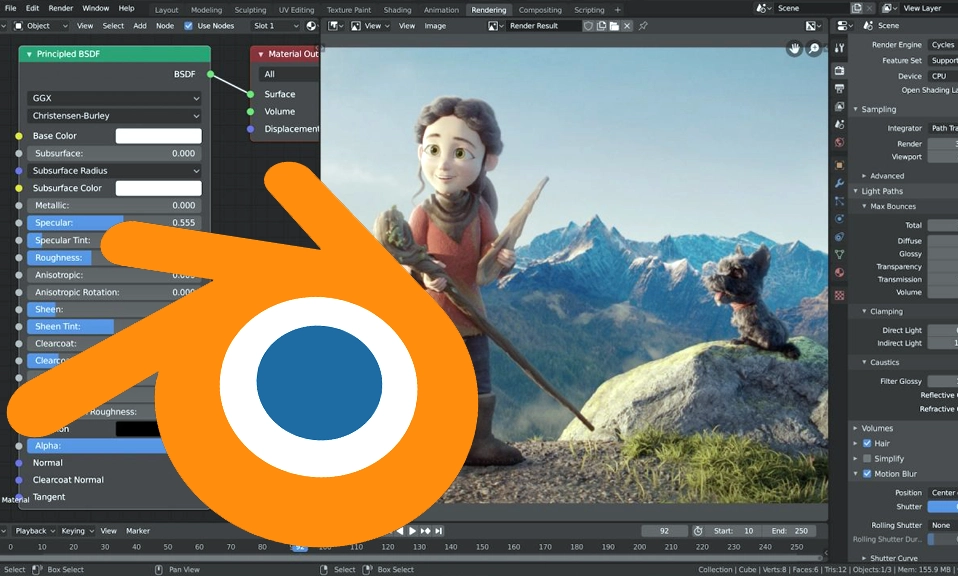
- Blender: For decades, high-end 3D software was prohibitively expensive. Then came Blender. Originally a clunky, open-source tool, Blender has undergone a massive renaissance. Today, it is a fully-featured, free 3D creation suite that is rapidly being adopted by indie studios, freelance artists, and even some major studios for pre-visualization and asset creation. It is the single biggest disruptor in the 3D space right now.
It’s All About the Pipeline
No single piece of software makes a movie. A modern blockbuster is a relay race.
A script is written in Final Draft, scheduled in Movie Magic, shot on set, edited in Avid, sent to VFX houses where it’s modeled in Maya, simulated in Houdini, and composited in Nuke. It then goes to a colorist using DaVinci Resolve, and finally to a sound mixer using Pro Tools.
The magic of cinema isn’t just in the acting or the directing. It’s in the seamless, invisible handoff between these incredibly powerful pieces of software, working together to make us believe, for two hours, in something that doesn’t exist.