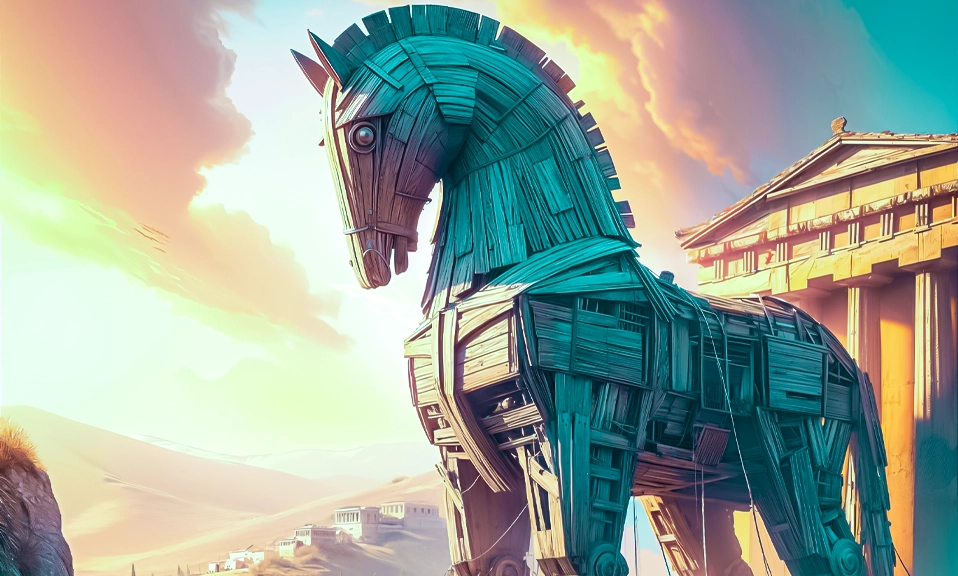
For centuries, the fall of Troy has been told through the image of a giant wooden horse — dragged inside the city walls, celebrated as a sacred gift,
For centuries, the fall of Troy has been told through the image of a giant wooden horse — dragged inside the city walls, celebrated as a sacred gift, and ultimately used to unleash hidden Greek warriors. It is one of the most famous stories in Western culture. But when we strip away the poetry and art, the literal “wooden horse” collapses under its own weight.
The truth is simpler, sharper, and far more human: the Trojan Horse was never a horse at all. It was a story of deception, fatigue, and symbolism — later reshaped into the impossible statue we imagine today.
Why the Wooden Horse Doesn’t Work
No dimensions recorded → Neither Homer nor Virgil gave measurements. Later art kept changing the design century by century.
Engineering limits → A hollow wooden horse big enough to hide dozens of soldiers would collapse under its own weight.
Transport problem → Dragging such a structure across terrain and through Troy’s gates would be nearly impossible.
Visibility issue → The Trojans weren’t “stupid.” They would have noticed if the horse was absurdly oversized or suspiciously hollow.
The literal horse is a mythic invention, not a historical fact.
Alternative Interpretations
Ship theory → In ancient Greek, “horse” (hippos) could metaphorically mean “ship.” The Greeks may have left a vessel disguised as a sacred gift, later retold as a horse in oral tradition.
Siege engine theory → Some historians argue the “horse” was a battering ram or siege tower, misremembered in myth as a statue.
Metaphor theory → The horse may have been purely symbolic — representing trickery itself. Oral tradition compressed a complex military maneuver into a single, vivid image.
Why the Trojans Accepted It
The Trojans weren’t fools. They were deceived by:
Religious framing → The Greeks claimed the horse was dedicated to Athena. Destroying it risked divine wrath.
War fatigue → After ten years of siege, Troy was desperate for peace. A “gift” looked like closure.
Manipulation → Sinon, the Greek left behind, convinced them it was safe.
Omens → Laocoön’s death by serpents was interpreted as a divine sign to accept the horse.
This was psychological warfare, not stupidity.
The Evolution of the Horse
Homer’s Iliad → No horse at all; the poem ends before Troy falls.
Virgil’s Aeneid → The horse becomes central, a dramatic symbol of deception.
Medieval art → The horse grows massive, ornate, almost fantastical.
Modern cinema → The horse is re‑imagined again, towering over Troy in epic spectacle.
Each era reshaped the horse to fit its imagination. The “real” horse was never fixed — it was always a story.
The Horse as Human Error
The Trojan Horse was not a giant wooden statue. It was either a ship, a siege engine, or simply a metaphor for deception. The Trojans were not “too stupid” to notice soldiers inside — they were tricked by religion, omens, and exhaustion.
The lesson is timeless: civilizations don’t fall because they are foolish. They fall because they are deceived, fatigued, and manipulated into believing the wrong story. The Trojan Horse is not about wood and nails — it is about the fragility of human judgment under pressure.