We know the lions, the tigers, the leopards. They dominate our documentaries, our conservation campaigns, and our collective imagination. But beyond the charismatic megafauna lies a hidden world of wild cats—creatures so secretive, so rare, and so perfectly adapted to their invisible lives that most people have never heard of them.
Some are so elusive that science has only a handful of photographs. Others were just formally described in 2026. A few were rediscovered after decades of being presumed extinct. And at least one is known from a single living individual, living quietly in a rescue sanctuary in Bolivia.
These are the world’s most mysterious wild cats—the felines that exist at the edges of our knowledge, in the shadows of the forests and mountains where they make their homes.
1. The Tilcayo (Leopardus tilcayo)
Where: Bolivia’s Yungas cloud forest
Why it’s mysterious: It was formally described in September 2026—the first new living wild cat species named in over a century. The tilcayo is a tiger cat, a group of small spotted felines so similar in appearance that even experts struggle to tell them apart. For decades, it was hidden in plain sight, classified as part of a species that was actually five species.
The tilcayo is tiny—about 46 centimetres long and 1.3 kilograms, smaller than the average domestic cat. Its fur is light brown with irregularly shaped rosettes. But what makes it truly mysterious is how little we know. Researchers have examined only two live individuals and a small number of camera-trap records. One of those individuals, a 10-year-old male nicknamed “Tigrino,” was found in the forest by a local resident who thought it was a domestic kitten. It now lives in a sanctuary, the only confirmed living member of its species.
The tilcayo’s lineage split from other tiger cats about 1.4 million years ago. It is a species that has been evolving in isolation for longer than our own species has existed—and we only just noticed it.
2. The Borneo Bay Cat (Catopuma badia)
Where: Borneo
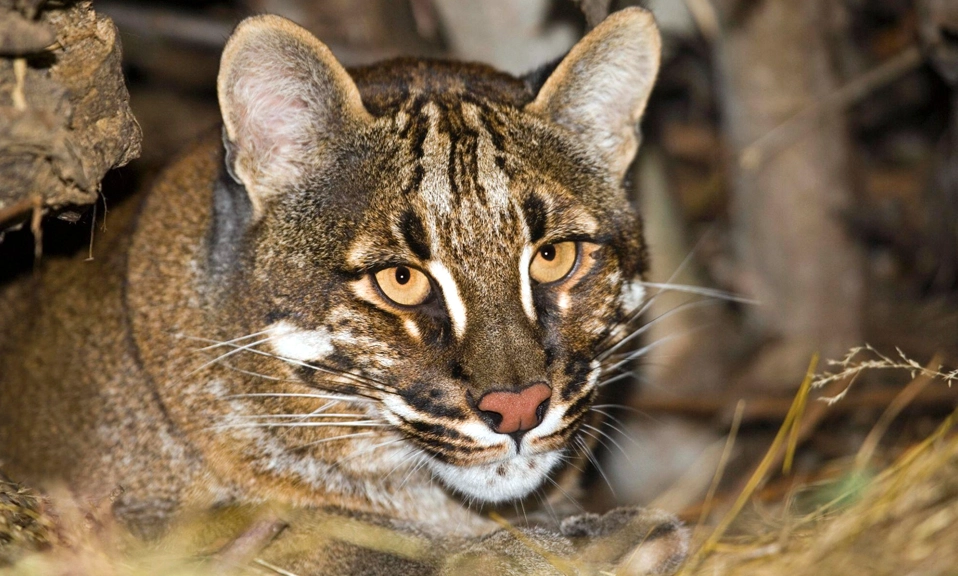
Why it’s mysterious: The bay cat was rediscovered by science in 1992, decades after it was last seen in Sarawak. It is endemic to Borneo—found nowhere else on Earth—and it is one of the least-known cats in the world. There are few records or population estimates available for the species, and it is so rarely encountered that even camera traps struggle to capture it.
The bay cat is a small, reddish-brown feline with a long tail and rounded ears. It is classified as Endangered, and its rarity is compounded by its preference for dense forest—habitat that is disappearing rapidly as Borneo’s lowland forests are cleared for palm oil plantations. In 2016, researchers captured rare video footage of a bay cat, a moment that was celebrated as a major achievement. For a species this elusive, a few seconds of footage is a scientific windfall.
3. The Flat-Headed Cat (Prionailurus planiceps)
Where: Lowland forests and wetlands of Southeast Asia (Malaysia, Indonesia, Thailand, Borneo, Sumatra)
Why it’s mysterious: The flat-headed cat is a wetland specialist—one of the only cats in the world adapted to a semi-aquatic lifestyle. It has a long, flattened head, close-set eyes, and partially webbed toes, all designed for hunting fish, frogs, and crustaceans in shallow water. It is restricted to lowland forests and wetlands, habitats that are being destroyed faster than almost any other ecosystem in Asia.
There are just a few camera-trap photos of wild flat-headed cats in existence. The species is so poorly known that its population size is unknown, and its biology is almost entirely undocumented. It is a cat that lives at the water’s edge, in the vanishing wetlands of Southeast Asia, and it may disappear before we ever truly understand it.
4. The Andean Mountain Cat (Leopardus jacobita)
Where: High-altitude Andes of Argentina, Bolivia, Chile, and Peru
Why it’s mysterious: The Andean mountain cat is one of the rarest and most understudied felids in the world. It lives in the arid, semi-arid highlands above the tree line, at altitudes of 3,000 to 5,000 metres. There have been fewer than a dozen confirmed sightings of live cats in the wild. Most of what we know about it comes from camera traps and fecal samples, not direct observation.
The species is classified as Endangered, with a population that does not exceed 2,500 mature individuals. Its density in northern Chile is estimated at just two individuals per 100 square kilometres. It is a ghost of the high Andes—a cat so rare and so secretive that its biology and status are, in the words of researchers, “almost completely unknown”.
5. The Black-Footed Cat (Felis nigripes)
Where: Steppe and savannah of southern Africa (Botswana, Namibia, South Africa)
Why it’s mysterious: The black-footed cat is the smallest wild cat in Africa—and one of the smallest in the world. Females weigh an average of just 1.3 kilograms. It is strictly nocturnal, spending its days in abandoned springhare burrows, aardvark holes, or termite mounds, and emerging at night to hunt. In a single night, it can travel up to 16 kilometres in search of food.
Despite its small size, it is a remarkably effective hunter. It feeds on 54 different prey species, and it is capable of killing prey up to twice its own weight, such as Cape hares. It is rarely seen by humans—so rarely that it is almost impossible to view outside a few protected areas where it has been studied for decades. It is a tiny, secretive predator, living invisibly in the arid grasslands of southern Africa.
6. The Margay (Leopardus wiedii)
Where: Central and South America, from Mexico to Argentina
Why it’s mysterious: The margay is known as the “tree ocelot”—and for good reason. It is one of the most agile and acrobatic cats in the world, with the unique ability to rotate its hind ankles 180 degrees, allowing it to climb down trees head-first. It is a forest specialist, more strongly associated with forested habitats than any other Neotropical felid. It is also one of the only cats known to mimic the calls of monkey infants to lure prey.
The margay is listed as Near Threatened, and it is uncommon to rare throughout its range. It does not reproduce easily in captivity, and most zoo animals are wild-born. It is a cat that lives high in the canopy, in the disappearing forests of Latin America, and it is still revealing its secrets to science—including the first observations of melanism in the species, reported in Colombia in 2013 and Costa Rica in 2014.
7. The Pallas’s Cat (Otocolobus manul)
Where: Grasslands and montane steppes of Central Asia
Why it’s mysterious: The Pallas’s cat, also known as the manul, is one of the most elusive and little-known wildcats in the world. It is a small, stocky cat with a flat face, rounded ears, and the densest fur of any cat—an adaptation to the extreme cold of its high-altitude habitat. It is found across 16 Central Asian countries, but its population is declining due to agricultural expansion, industrial development, and dog attacks.
It is so poorly known that new records are still being reported. In 2026, researchers documented the first record of Pallas’s cat in the Karakoram Wildlife Sanctuary in Ladakh, India. It is a cat of the remote steppes and mountains, living in some of the most inhospitable terrain on Earth, and it remains one of the least understood felines in Asia.
8. The Iriomote Cat (Prionailurus bengalensis iriomotensis)
Where: Iriomote Island, Japan
Why it’s mysterious: The Iriomote cat is a subspecies of the leopard cat that lives on one island in Japan—Iriomote, the world’s smallest island inhabited by wildcats. It was discovered in 1965, and it is the sole carnivore and apex predator on the island. There are only about 100 individuals remaining, making it one of the rarest cats in the world.
It is classified as Endangered, and its population is declining. It is a small, spotted cat, adapted to the subtropical forests and mangroves of its island home. It exists nowhere else on Earth, and its survival depends entirely on the conservation of a single, fragile island ecosystem.
9. The Rusty-Spotted Cat (Prionailurus rubiginosus)
Where: India, Sri Lanka, and Nepal
Why it’s mysterious: The rusty-spotted cat is the smallest wild cat in the world. It has a head-and-body length of just 35–48 centimetres and weighs about 1.5 kilograms. It is a tiny, nocturnal predator, and despite its wide range, it is so elusive that research on the species remains fragmented, focusing mainly on incidental camera-trap data.
It is listed as Near Threatened, and it faces threats from habitat loss, road mortality, and hunting. It is a cat that could fit in the palm of your hand as a kitten, living invisibly in the forests and grasslands of South Asia—and it is one of the least-studied felids on the planet.
10. The Kodkod (Leopardus guigna)
Where: Central and southern Chile, and western Argentina
Why it’s mysterious: The kodkod, also known as the güiña, is the smallest cat in the Americas. It is about the size of a small domestic cat, and it is restricted to a narrow strip of temperate rainforest in southern South America—one of the most restricted distributions known for any felid.
Little is known about the kodkod’s ecology and behaviour. It is classified as Vulnerable, and it faces threats from human land use and climate change. It is a cat of the Valdivian Temperate Rainforest—a globally significant biodiversity hotspot—and its future is tied to the survival of one of the most threatened forest ecosystems on Earth.
The Cats We Hardly Know
These ten cats share more than rarity. They share invisibility. They are creatures that have evolved to avoid detection—by their prey, by their predators, and by us. They live in dense forests, high mountains, and remote wetlands. They hunt at night. They leave few traces. And they are disappearing before we have had the chance to understand them.
The tilcayo was only named in 2026. The bay cat was rediscovered in 1992. The Andean mountain cat has been seen alive fewer than a dozen times. The flat-headed cat has been photographed in the wild only a handful of times. These are not just rare animals. They are unknown animals—species whose biology, behaviour, and population status remain, in many cases, a mystery.
And that mystery is the point. In a world that has been mapped and measured, these cats remind us that there are still things left to discover—and still things left to lose.