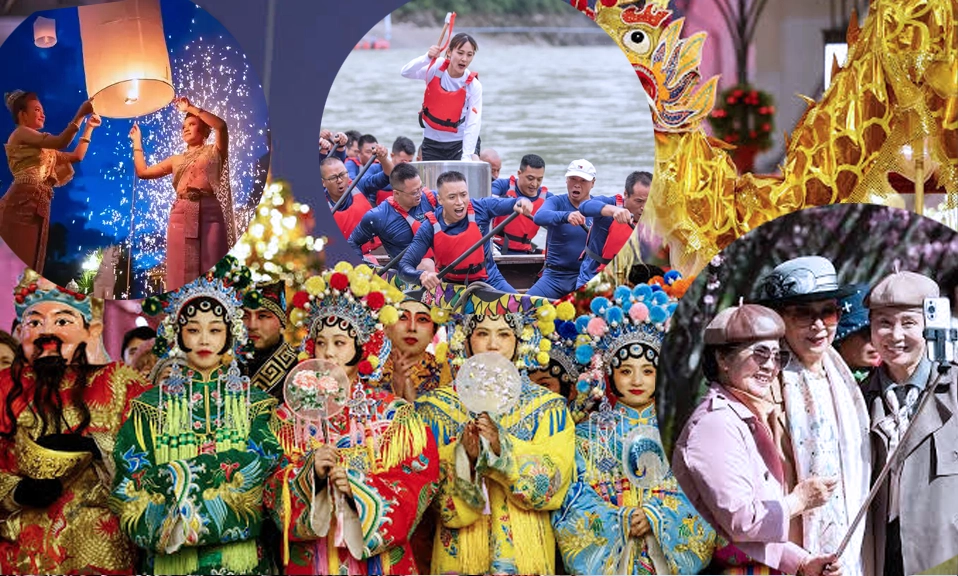
China’s festivals aren’t just dates on a calendar. They are moments when the entire country shifts its rhythm — when ancient traditions, family bonds, and spectacular public celebrations collide. If you time a trip around one of these, you don’t just visit China. You feel it.
China celebrates a rich tapestry of festivals throughout the year, blending lunar calendar traditions, seasonal changes, and deep cultural heritage. From the explosive energy of the Spring Festival to the quiet reflection of Qingming, each celebration offers a unique window into Chinese life. Here are the 10 annual festivals you shouldn’t miss.
1. Spring Festival (Chinese New Year) — February 2026
The Spring Festival is the most important festival in the Chinese calendar — a celebration so significant it was added to UNESCO’s Representative List of the Intangible Cultural Heritage of Humanity in December 2024. It marks the beginning of the new lunar year and triggers the largest annual human migration on Earth, as families reunite across the country.
When: The 2026 Spring Festival runs from February 15 to 23, a nine-day national holiday. The festivities traditionally begin a week earlier with the Little New Year and stretch to the Lantern Festival 15 days later.
What to experience: The centerpiece is the New Year’s Eve reunion dinner — a meal families travel thousands of miles to share. Homes are decorated with red couplets and paper cuts, firecrackers ring out at midnight to scare away the mythical beast Nian, and red envelopes filled with cash are given to children as symbols of good fortune. Dragon and lion dances parade through streets, and temple fairs offer traditional performances, snacks, and crafts. If you’re in Beijing, head to the Ditan Park Temple Fair rather than the Forbidden City on day one — the crowds are more manageable and the atmosphere is authentic.
2. Lantern Festival — March 2026
The Lantern Festival is the magical finale of the Spring Festival celebrations, falling on the 15th day of the first lunar month — the night of the first full moon of the new year. It became a festival about 2,000 years ago and remains one of the most visually stunning nights in China.
When: The 2026 Lantern Festival falls in early March.
What to experience: Cities across China transform into seas of glowing lanterns. People gather to admire elaborate displays, guess riddles written on lanterns, and eat tangyuan — round, glutinous rice balls with sweet fillings that symbolize family reunion. Daytime celebrations include dragon lantern dances, lion dances, stilt-walking, and drum performances. It’s one of the most beautiful nights you’ll ever witness.
3. Qingming Festival (Tomb Sweeping Day) — April 4–6, 2026
Qingming is a festival of contrasts. With a history spanning 2,500 years, it uniquely combines ancestral worship with the celebration of spring — a day for honoring the dead and embracing the living.
When: April 4 to 6, 2026 (a three-day holiday).
What to experience: Families visit gravesites to sweep tombs, burn incense, and offer paper money and symbolic gifts to their ancestors. But Qingming is also a celebration of spring’s arrival. After the solemn rituals, people go for picnics, fly kites, and enjoy the blossoming landscapes. It’s sometimes called “Walking amid Greenery Day” — a gentle, reflective holiday that offers a softer, more peaceful side of China.
4. Dragon Boat Festival — June 19–21, 2026
The Dragon Boat Festival is pure energy — fast, loud, and thrilling. It commemorates Qu Yuan, a patriotic poet from the Warring States Period who drowned himself in the Miluo River in protest against corruption.
When: June 19 to 21, 2026 (a three-day holiday).
What to experience: Dragon boat races are the centerpiece — teams of paddlers drive colorful boats forward to the rhythm of beating drums, a tradition inspired by villagers who raced to rescue Qu Yuan. The festival’s signature food is zongzi, sticky rice dumplings wrapped in bamboo leaves, traditionally thrown into the river to prevent fish from eating Qu Yuan’s body. You’ll also see people hanging mugwort and calamus on their doors to ward off evil, children wearing five-color silk threads around their wrists, and scented sachets filled with aromatic herbs.
5. Qixi Festival (Chinese Valentine’s Day) — August 2026
Qixi, also known as the Double Seventh Festival, is China’s most romantic holiday. It celebrates the legendary love between a mortal cowherd and a fairy weaver girl, who are separated by the Milky Way and allowed to meet only once a year on this night.
When: The seventh day of the seventh lunar month, typically falling in August.
What to experience: Qixi is a celebration of love and steadfast romance. Couples exchange gifts, enjoy romantic dinners, and gaze at the stars, looking for the two bright stars — Vega and Altair — that represent the star-crossed lovers. It’s China’s answer to Valentine’s Day, but with a mythology that stretches back to the Han Dynasty.
6. Hungry Ghost Festival — August 2026
The Hungry Ghost Festival is China’s version of Halloween — a month-long period when the gates of the afterlife are believed to open and spirits roam the earth. It falls on the 15th day of the seventh lunar month, a month considered unlucky and filled with supernatural activity.
When: August 15, 2026.
What to experience: Families burn joss paper (spirit money) and leave food offerings for their deceased ancestors and wandering spirits. The festival blends Buddhist and Taoist traditions — Taoists call it the Zhongyuan Festival, a celebration of the Earth God’s birthday, while Buddhists observe Ullambana, a day of offerings to monks. It’s a fascinating, eerie, and deeply spiritual window into Chinese beliefs about death and the afterlife.
7. Mid-Autumn Festival — September 25–27, 2026
The Mid-Autumn Festival is one of China’s most cherished holidays, ranking alongside the Spring Festival and Dragon Boat Festival. It’s a celebration of the harvest moon, family reunion, and the timeless myth of Chang’e, the moon goddess.
When: September 25 to 27, 2026 (a three-day holiday).
What to experience: The festival is defined by mooncakes — round pastries filled with lotus seed paste, red bean, or mixed nuts, whose circular shape mirrors the full moon and symbolizes family completeness. Families gather for reunion dinners, gaze at the full moon, and light lanterns. In some regions, people craft lanterns from watermelons or pomelos, set off sky lanterns, or perform fiery dragon dances. The Mid-Autumn Festival also marks the beginning of the “three great lantern festivals” alongside Spring Festival and Lantern Festival.
8. Double Ninth Festival (Chongyang) — October 2026
The Double Ninth Festival, or Chongyang, falls on the ninth day of the ninth lunar month. In Chinese culture, nine is a yang (masculine, positive) number, and the double nine makes this day particularly auspicious. The festival is about longevity, respect for elders, and enjoying autumn’s beauty.
When: October 2026.
What to experience: The tradition is to climb mountains or high places to absorb fresh autumn energy and pray for good fortune. Families visit and care for older relatives, often organizing group outings or offering small gifts. People also drink chrysanthemum wine, wear cornel twigs, and eat flower cakes — all symbols of growth and longevity. It’s a festival that combines ancestor worship with a celebration of life.
9. Winter Solstice Festival (Dongzhi) — December 2026
The Winter Solstice Festival, or Dongzhi, marks the shortest day and longest night of the year. In Chinese cosmology, it’s the moment when yin (darkness) begins to wane and yang (light) starts to grow — the beginning of a new cycle.
When: December 21 or 22, 2026.
What to experience: Dongzhi was once considered the second most important festival after the Spring Festival. In northern China, families eat dumplings (jiaozi) to protect their ears from frostbite — a tradition linked to the legendary physician Zhang Zhongjing. In southern China, people eat tangyuan (glutinous rice balls) to symbolize reunion. It’s a quiet, family-centered holiday that marks the turning point of winter.
10. National Day (Golden Week) — October 1–7, 2026
National Day is not a traditional festival, but it’s one of the biggest celebrations on the Chinese calendar. It marks the founding of the People’s Republic of China on October 1, 1949, and triggers a seven-day national holiday known as “Golden Week”.
When: October 1 to 7, 2026 (a seven-day holiday).
What to experience: Golden Week is a massive celebration — fireworks, flag-raising ceremonies, and cultural events across the country. But be warned: it’s also the busiest travel period of the year. Iconic destinations like the Great Wall, the Forbidden City, and Zhangjiajie become extremely crowded. The energy is unmatched, but if you’re planning to travel during Golden Week, book everything — transport, hotels, tickets — well in advance. In 2026, the Mid-Autumn Festival (September 25–27) and National Day (October 1–7) are separated by just three working days, creating the potential for a 13-day break for those who can bridge the gap.
Honorable Mention: Harbin Ice and Snow Festival — January 2026
While not a traditional festival, the Harbin International Ice and Snow Festival deserves a mention. The 42nd edition kicked off on January 5, 2026, at Harbin Ice-Snow World, the world’s largest ice and snow theme park. The festival features massive ice sculptures, illuminated at night in spectacular colors, along with over 200 cultural, sports, and trade activities. If you’re visiting China in winter, Harbin is an unforgettable experience.
China’s festivals
are more than holidays. They are living traditions — threads of history, mythology, and family that have been woven into the fabric of daily life for thousands of years. From the explosive joy of the Spring Festival to the quiet reverence of Qingming, each celebration offers a different perspective on what it means to be Chinese.
The dates shift each year with the lunar calendar, so plan ahead. But whenever you visit, there’s a festival waiting to show you a side of China you won’t find in any guidebook.