The ghost of the 1990s is haunting consumer electronics. From the translucent purple of the original Game Boy Color to the see-through casing of the iMac G3, the decade’s most distinctive aesthetic was a refusal to hide the hardware. For years, that look felt like a relic—a charming but dated reminder of a time before the sleek, black, sealed slab became the universal standard. In 2026, the transparent gadget is back, and it is no longer a novelty. It is the most striking way to signal that your device is different.
The transparent revival is not confined to one product category. It is a cross-category movement, spanning phones, earbuds, headphones, keyboards, power banks, and gaming handhelds. It is driven by a mix of nostalgia, a desire to stand out, and a deeper cultural shift away from the uniform, opaque minimalism that has defined the last decade of industrial design. But the most interesting question is not why it looks cool. It is whether transparency is a genuine design philosophy or a passing aesthetic—and whether it can overcome the practical trade-offs that have always kept the see-through gadget on the margins.
The Phones: Transparency as a Statement
The smartphone is the least transparent it has ever been. Modern flagships are sealed glass and metal sandwiches, with internal components hidden behind layers of opaque material. That is what makes the transparent phone such a potent statement.
Xiaomi is reportedly preparing to revive its transparent design language with the Xiaomi 18 series. The company last used a see-through back on the Mi 8, Mi 9, and the Mi 10 Ultra in 2020, and the return is expected to be a special edition for the premium market. The transparent back is not a gimmick in the Xiaomi lineage; it was a signature design identity that made the company’s flagships instantly recognizable.
Huawei has been exploring an even more radical concept. The rumored Project Mirror (or OptiX) is described as a fully transparent smartphone that can alternate between opacity and augmented reality interfaces, with prototypes potentially appearing as early as 2026. It is important to be clear: Huawei has not publicly launched a transparent phone as a real product. The reports are based on concepts, patents, and recreations. But the ambition is real, and it points to a future where transparency is not just a visual flourish but a functional interface.
The market data reflects this momentum. The global next-gen transparent mobile market was valued at USD 85 million in 2025 and is projected to reach USD 812 million by 2034, growing at a compound annual rate of 28.5%. The premium smartphone segment accounts for 54% of that market, and transparent OLED technology holds a 48% share, with transparent MicroLED as the fastest-growing sub-segment. This is not a mass-market category yet. It is a premium, experimental segment that is growing fast because it offers something the opaque slab cannot: a visible declaration of technological sophistication.
The Audio: Transparency as a Design Language
If phones are where transparency is most ambitious, audio is where it has already become a genuine design language.
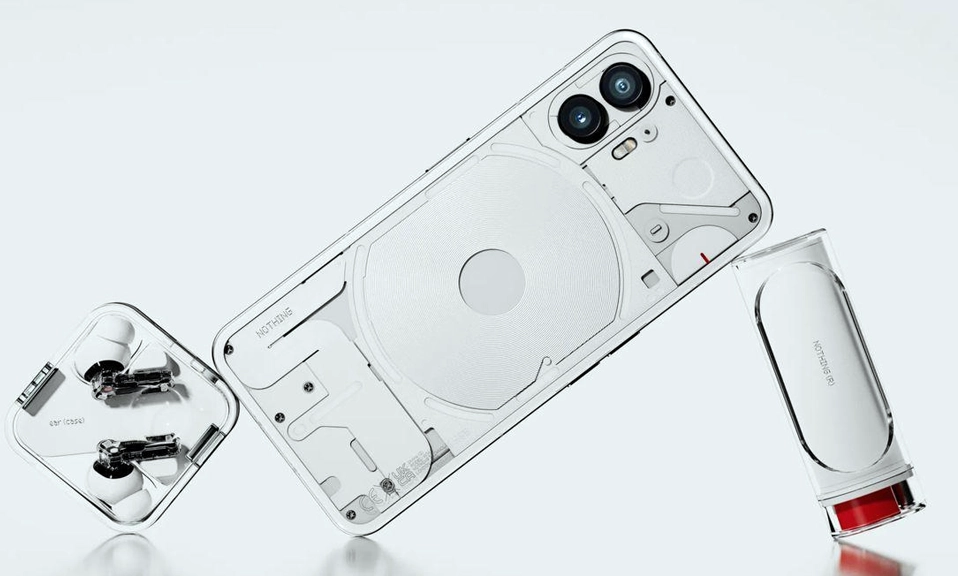
Nothing is the company most associated with the transparent aesthetic. Its Ear (open) earbuds, priced at $99, feature a slim, transparent design that has become the brand’s signature. The upcoming Nothing Ear 3a is expected to continue that language, with leaked renders showing a transparent charging case and see-through design elements in black, white, yellow, and pink finishes, at a price point of around €99. Nothing has built its entire brand identity on the idea that technology should reveal its internals rather than hide them.
Other companies are following. JBL has released a series of “Ghost” colorways for its Soundgear Clips earbuds—Blue Ghost, Black Ghost, White Ghost, Purple Ghost, and Copper Ghost—and added an Emerald Green Special Edition in China, a transparent shell with a darker internal tint and gold detailing that reviewers have described as “straight out of The Matrix”. Beats offers a transparent version of its Studio Buds +, exposing the internal workings through a frosted casing while still delivering up to 36 hours of listening time. FiiO’s EH11 headphones feature a transparent casing that provides a clear view of the internal components. And the Mondo Freestyle headphones pair transparent earcups with bright orange cushions, turning the act of listening into a “sartorial spectacle” while still offering Bluetooth 5.3 and 22 hours of playtime.
The transparent earbud and headphone is not a compromise. It is a way to make the hardware itself the aesthetic. The chips, the drivers, the circuit boards—they become part of the design rather than something to be concealed.
The Design Philosophy: Why We Want to See Inside
The transparent revival is not just about looks. It is a response to a cultural shift in how people relate to their devices.
The alienation from the opaque object. Modern electronics are black boxes. You cannot open them, you cannot see how they work, and you often cannot repair them. The BGR analysis of the trend argues that the return of transparent devices is driven by a “feeling of alienation” as media and entertainment become increasingly digital and ephemeral. The desire to hold something tangible—to see physical structures and how they function—has become more palpable. Transparency makes the device feel less like a sealed appliance and more like a machine with visible parts, even if you do not understand what those parts do.
The rejection of uniformity. Smartphones have converged on a single design language: a rectangular slab with a camera bump. The Design Milk analysis notes that the market is “pushing back against the uniformity of modern smartphones that conceal everything behind sleek, opaque shells”. Transparent design offers distinction and authenticity. It says that this device is not like the others.
The retro-futuristic duality. As Beats CMO Chris Thorne put it, transparent tech is “both nostalgic and futuristic. It’s iconic to the Y2K era, yet shows off the technological chips and components that continue to develop and be more powerful than ever”. That duality is key. The transparent gadget is a bridge between the 1990s and the 2020s—a way to evoke the past while celebrating the present.
The Technology: What Makes It Possible
The transparent revival is enabled by advances in display and materials technology that were not available in the 1990s.
Transparent OLED is the dominant technology for transparent phones and displays. It holds 48% of the next-gen transparent mobile market. Transparent MicroLED is the fastest-growing sub-segment, offering higher transmittance and lower manufacturing costs than transparent OLED, and it is being explored for smartphones, wearables, and AR glasses. Electrochromic displays, which can switch between transparency and opacity, are also part of the technology roadmap.
The materials science is equally important. The transparent phone concept requires reinforced glass or crystal with light transmission rates as high as 99.8%, and under-display camera systems that can capture images through the display without visible lenses. These are not trivial engineering challenges. They are the reason why transparent phones remain a premium, experimental category rather than a mass-market one.
The Trade-Offs: What Transparency Costs
The transparent gadget is not without its drawbacks, and those drawbacks are the reason it has never become the default.
Durability. Transparent materials are often more fragile than opaque ones. A clear polycarbonate shell can scratch and crack more easily than a metal or opaque plastic one. The see-through phone is, by definition, a device with fewer layers of protection between its internals and the world.
Privacy. A transparent device reveals more than its components. It reveals what is on the other side. A transparent phone, in particular, raises obvious privacy concerns: if the back is see-through, can someone see the screen from the other side? The technology to switch between transparency and opacity (like electrochromic displays) exists, but it adds cost and complexity.
Cost and manufacturing complexity. Transparent displays and materials are more expensive to produce than their opaque equivalents. The transparent mobile market is growing at a 28.5% CAGR precisely because it is starting from a small base. The transparent gadget is a premium product for people who are willing to pay for the aesthetic.
The novelty question. The most fundamental critique of the transparent trend is that it is a performance—a way of signalling a certain identity rather than a genuine functional improvement. A transparent earbud does not sound better because you can see its driver. A transparent phone does not work better because you can see its circuit board. The aesthetic is the point. Whether that is enough to sustain a long-term trend or whether it will fade like the translucent plastics of the 1990s is an open question.
A Future, But Not the Future
Are transparent gadgets the future? The honest answer is that they are a future—a distinct, growing, and aesthetically compelling category that will coexist with the opaque mainstream rather than replace it.
The transparent phone is unlikely to become the default smartphone design. The engineering trade-offs, the cost, and the privacy concerns are too significant. But the transparent phone as a premium special edition—a statement piece for people who want their device to look like nothing else on the market—has a clear and growing audience. Xiaomi’s rumored return to transparent design and Huawei’s concept explorations suggest that the category is being taken seriously by companies that understand the value of differentiation.
The transparent earbud and headphone, by contrast, are already a genuine design language. Nothing has built a brand on it, JBL is iterating on it, and Beats has embraced it. In audio, transparency is not a gimmick. It is a way to make the hardware visible, to turn the device into an object of desire.
The broader transparent tech trend—keyboards, power banks, gaming handhelds—is part of the same cultural movement: a rejection of the sealed, opaque, uniform device in favour of something that feels mechanical, tangible, and distinct. It is a nostalgia for a time when technology was not afraid to show its guts, combined with a contemporary desire for authenticity and individuality.
The transparent gadget is not the future of all technology. But it is a future that a growing number of people want to live in—one where the device on your desk, in your ears, or in your pocket is not a black box, but a machine you can see, feel, and understand. In an era of invisible software and cloud-based everything, there is something deeply satisfying about a gadget that lets you look inside.