There are countries that play football.
And then there is Uruguay — a country of 3.5 million people, wedged between Brazil and Argentina, that invented what it means to win.
No nation in football history exemplifies punching above its weight quite like Uruguay, a small country nestled between Brazil and Argentina in southern South America. Despite having a population roughly equivalent to a city like Madrid, about 3.5 million, Uruguay’s football achievements are extraordinary.
For a country of barely three and a half million people, its record is extraordinary: two FIFA World Cups, won in 1930 and 1950, two Olympic football gold medals in 1924 and 1928, and a record fifteen Copa America titles.
Look at their shirt and you’ll see the proof: four stars above the crest. Not two — four.
The four stars above Uruguay’s football crest represent the four FIFA recognized world championships won by the Uruguay national football team in 1924, 1928, 1930, and 1950. From the outset, FIFA and global football associations have recognized the Olympic football tournaments of Paris 1924 and Amsterdam 1928 as open world championships.
Uruguay counts the Olympics as World Cups. Because back then, they were.
1924 and 1928: The World Learns La Celeste
Before the World Cup existed, the Olympics was the World Cup.
In Paris 1924, Uruguay arrived unknown. No European had seen South American football. They had a Black player — José Andrade, nicknamed The Black Marvel — when European teams were all white. They had short passing, one-touch football when Europeans still kicked and rushed.
Key players like Jose Nasazzi, Pedro Cea, and Jose Andrade played pivotal roles in leading Uruguay to Olympic success.
They destroyed everyone: 7-0 vs Yugoslavia, 3-0 vs USA, 5-1 vs France, 2-1 vs Netherlands, 3-0 vs Switzerland in the final. The crowd in Colombes was so shocked they gave Uruguay a standing ovation and FIFA begged them to host the first World Cup.
In Amsterdam 1928, they did it again — beating Argentina 2-1 in a brutal final replay. That rivalry is why the World Cup had to be created.
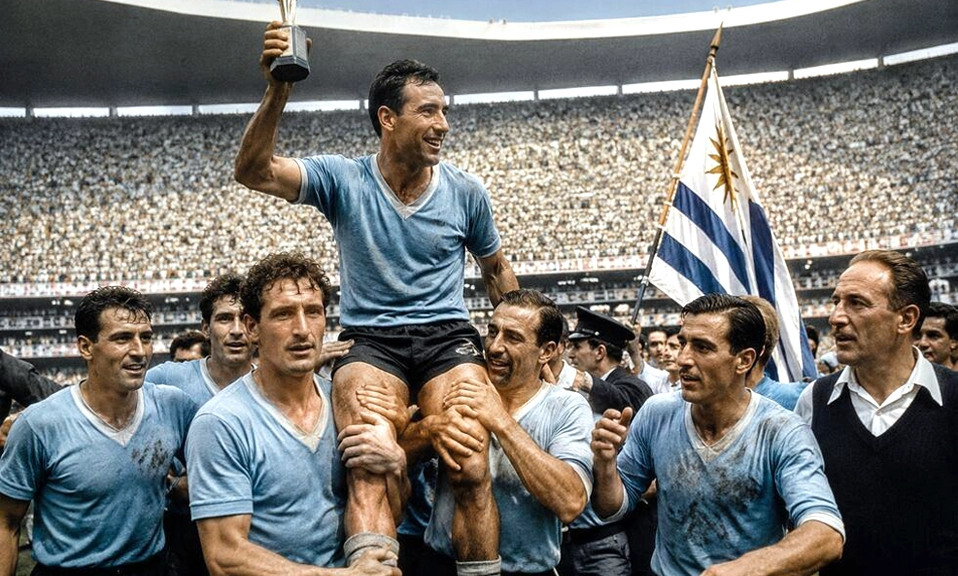
Uruguay’s national team, affectionately known as La Celeste (The Sky Blue), made history by winning both Olympic gold medals in 1924 and 1928 before clinching two FIFA World Cup titles.
1930: The First World Cup — At Home
FIFA chose Uruguay to host the event after they won the gold medal in men’s soccer at both the 1924 and 1928 Summer Olympics.
Why Uruguay? They offered to pay all travel costs for European teams and build a new stadium — Estadio Centenario — in 6 months. They built it. FIFA has even declared the stadium a Historical Monument of World Football — the only one of its kind.
The final was held on July 30, 1930, and it drew a crowd of approximately 93,000 spectators. Uruguay vs Argentina. The ball was disputed — Argentina brought their ball for first half, Uruguay for second half. Argentina led 2-1 at halftime.
In a thrilling match, Uruguay emerged victorious, defeating Argentina with a score of 4-2. This historic win not only established Uruguay as the first World Cup champions but also set the stage for the tournament’s enduring legacy.
Montevideo didn’t sleep for a week.
1950: Maracanazo — The Greatest Upset Ever
This is why Uruguay is myth.
Brazil 1950. World Cup final round, not even a final — but Brazil vs Uruguay in the Maracanã, 200,000 Brazilians (largest crowd ever) expecting to celebrate. Brazil only needed a draw. They had already engraved the trophies. They had composed a samba called “Brazil the Victors.” The mayor of Rio gave a speech before kickoff: “You, who I already consider victors.”
Brazil scored first. The Maracanã exploded.
Then Uruguay did what Uruguayans call garra charrúa — the Charrúa claw. Named after the indigenous warriors who never surrendered.
Schiaffino equalized. Then Alcides Ghiggia, tiny winger, cut inside and scored at the near post. Silence. 200,000 people silent.
Brazil 1 – Uruguay 2. Uruguay had won its second World Cup in the temple of its biggest rival.
Uruguay’s two World Cup victories represent one of the most remarkable achievements in football history, particularly considering the nation’s population of just 3.5 million.
In Uruguay, they still say: In 1950, only three people silenced the Maracanã: Frank Sinatra, Pope John Paul II, and Alcides Ghiggia.
Beyond The Cups: Copa América Kings
In the entire World Cup history, no country smaller than Uruguay has ever managed to win the tournament. This historical moment came to pass in 1930, when Uruguay had a mere 1.75 million inhabitants.
They also have 15 Copa América titles — tied with Argentina for most ever until Argentina overtook them in 2024 with 16. Uruguay won their last in 2011 with Luis Suárez and Diego Forlán.
Forlan, Suárez, Cavani, Godín, Valverde — the lineage never stops.
What Is Garra Charrúa?
It’s not tactics. It’s identity.
Governed by the Uruguayan Football Association, the AUF, which was founded in 1900, the team joined CONMEBOL in 1916 and FIFA in 1923. But they played before that — British rail workers brought football to Montevideo in the 1880s. Uruguay made it theirs.
Garra charrúa means: We are small. We will be kicked. We will be outspent. We will not quit. We will fight for every ball like it’s the last.
You saw it in 2010 — Uruguay finished 4th in South Africa, Suárez handballing on the line vs Ghana, crying, then celebrating. You saw it in 2018 — Cavani’s volley vs Portugal. You see it every time a 3.5 million nation qualifies while giants stay home.
Uruguay won the inaugural FIFA World Cup in 1930, adding a second title in 1950. FIFA President Gianni Infantino called upon the double FIFA World Cup winning achievements of Uruguay.
2026: Still Here
Uruguay qualified for 2026 — their 15th World Cup appearance. Best recent finishes: 4th place in 1970 and 2010. They are the only country to host the first World Cup, and now will host one game in 2030 — the centenary — back at the Centenario.
They have 2 World Cups, but they wear 4 stars because they know what Europe tried to forget: Before there was a World Cup, there was La Celeste.
As Eduardo Galeano, Uruguayan writer, said: “The history of football is a sad voyage from beauty to duty. But Uruguay still plays like it was beauty.”
Small country. Giant shadow.