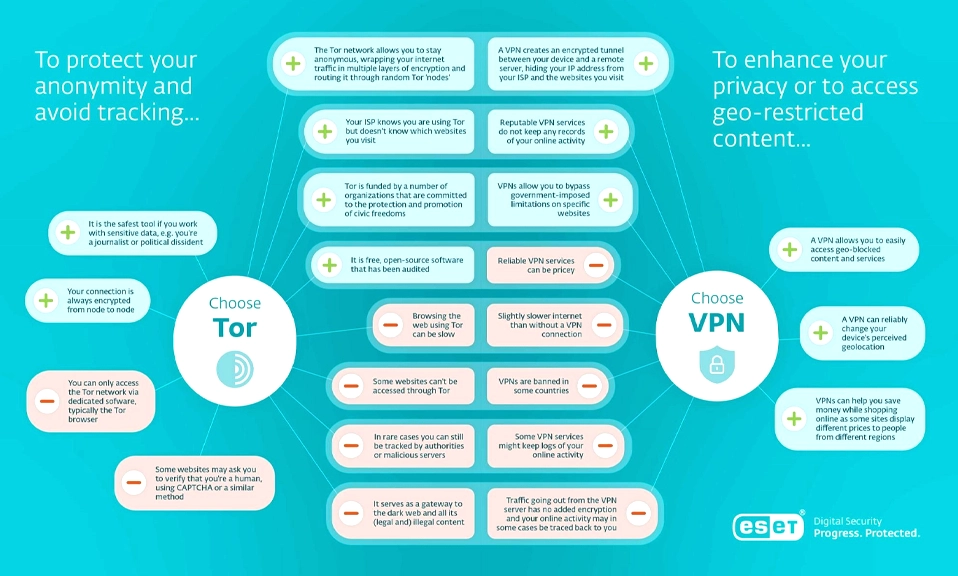
Which Actually Offers Better Online Privacy?
When it comes to protecting your digital footprint, two names dominate the conversation: VPNs and the Tor Browser.
If you want to hide your IP address, bypass geo-restrictions, or keep your Internet Service Provider (ISP) from tracking your every move, both tools promise to get the job done. But despite their similar goals, they operate on completely different philosophies, architectures, and trade-offs.
Choosing the wrong one could leave you frustrated by sluggish speeds, or worse, give you a false sense of security.
Let’s break down the mechanics of both, compare their strengths and weaknesses, and help you decide which tool is the right shield for your specific online needs.
🛡️ 1. The VPN: The Armored Convoy
What it is: A Virtual Private Network (VPN) creates a secure, encrypted “tunnel” between your device and a remote server operated by a commercial VPN provider. All your internet traffic is routed through this server.
The Analogy: Imagine you need to travel across a dangerous city. Instead of walking, you hire an armored convoy. You get inside, the doors lock, and the convoy drives you directly to your destination. The people on the street (your ISP or hackers) can see the armored truck moving, but they have no idea who is inside or what you are carrying.
The Pros:
- High Speed: Because your traffic only makes one stop (the VPN server), the speed impact is minimal, especially with modern protocols like WireGuard.
- System-Wide Protection: A VPN encrypts all traffic from your device, including background apps, games, and torrent clients.
- User-Friendly: Most modern VPNs are “one-click” solutions with apps for every device, including smart TVs and routers.
- Bypasses Geo-Blocks: Excellent for streaming Netflix, Hulu, or sports from other countries.
The Cons:
- The Trust Factor: You are shifting your trust from your ISP to your VPN provider. If your VPN provider keeps logs (and many free ones do), they can see everything you do. You must choose a reputable, audited “no-logs” provider.
- Centralized: All your traffic funnels through a single company’s server, making it a potential (though heavily encrypted) single point of failure.
🧅 2. The Tor Browser: The Decentralized Maze
What it is: Tor stands for The Onion Router. It is a free, open-source network that routes your internet traffic through a randomized series of at least three volunteer-run servers (nodes) around the world: an Entry node, a Middle node, and an Exit node. Each layer of the journey is encrypted, like the layers of an onion.
The Analogy: Imagine you need to send a highly sensitive letter. You put it in a locked box, give it to Stranger A. Stranger A only knows you gave it to them, and that they must give it to Stranger B. Stranger B opens their layer, sees the next instruction, and hands it to Stranger C. Stranger C finally opens the last layer and delivers the letter. No single stranger knows both who you are and where the letter is going.
The Pros:
- Unmatched Anonymity: Because the traffic bounces through three random, decentralized nodes, it is virtually impossible to trace the traffic back to your physical location or identity. spammers, or malicious exit nodes.
- No Central Authority: There is no single company to trust, subpoena, or hack. The network is run by a global community of volunteers.
- Bypasses Extreme Censorship: Tor is the gold standard for activists and journalists living under oppressive regimes with heavy internet firewalls.
The Cons:
- Painfully Slow: Routing your data through three random computers across the globe, with multiple layers of encryption, destroys your browsing speed. Streaming or large downloads are practically impossible.
- Browser-Only: Tor only protects the traffic that goes through the Tor Browser. It does not protect your other apps, background services, or system-wide traffic.
- ISP Visibility: Your ISP cannot see what you are doing on Tor, but they can see that you are using the Tor network, which can draw unwanted scrutiny in certain countries.
⚔️ Head-to-Head Breakdown
Feature | VPN (Virtual Private Network) | Tor Browser |
|---|---|---|
Primary Goal | Privacy & Security | Maximum Anonymity |
Speed | Fast (negligible drop with good providers) | Very Slow (due to multi-node routing) |
Scope | Entire device (system-wide) | Application-specific (Tor Browser only) |
Trust Model | You must trust the VPN provider’s “no-logs” policy | Decentralized; no single entity to trust |
Ease of Use | Very Easy (one-click apps) | Moderate (requires adjusting habits) |
Best For | Daily browsing, streaming, public Wi-Fi, torrenting | Whistleblowing, extreme censorship, maximum anonymity |
🏆 The Verdict: Which Is Better for You?
The answer isn’t about which technology is objectively “better,” but rather which tool matches your threat model and daily needs.
Choose a VPN if:
- You want to protect your data on public Wi-Fi (coffee shops, airports).
- You want to hide your browsing history from your ISP.
- You want to stream geo-blocked content or torrent safely.
- You need a fast, seamless, system-wide solution that works on your phone, laptop, and smart TV.
- Bottom Line: A VPN is the right choice for 95% of everyday users.
Choose Tor if:
- You are a journalist, activist, or whistleblower who needs to communicate without leaving a traceable digital footprint.
- You live in a country with severe internet censorship and need to bypass government firewalls.
- You are accessing the “dark web” (.onion sites).
- You are willing to sacrifice speed and convenience for the absolute highest level of anonymity.
- Bottom Line: Tor is a specialized tool for high-risk scenarios, not a daily driver.
🤯 Bonus: Can You Use Both? (Tor over VPN)
For the ultimate privacy nerds, you can combine them. By connecting to a VPN first, and then opening the Tor Browser, you hide your Tor usage from your ISP (they just see VPN traffic), and you protect yourself against malicious Tor entry nodes.
However, be warned: combining them will make your internet connection incredibly slow. It’s overkill for checking your email, but it’s the nuclear option for those who truly need it.
Layer Your Defense
Privacy is not a one-size-fits-all concept. For most of us, a reputable, paid, no-logs VPN provides the perfect balance of speed, convenience, and robust protection against everyday data harvesting.
Tor remains a miraculous, vital tool for the internet, but it is a scalpel, not a Swiss Army knife. Use it when you need surgical levels of anonymity, but don’t expect it to replace your daily web browser.
Assess your needs, choose the right tool, and take back control of your digital life.