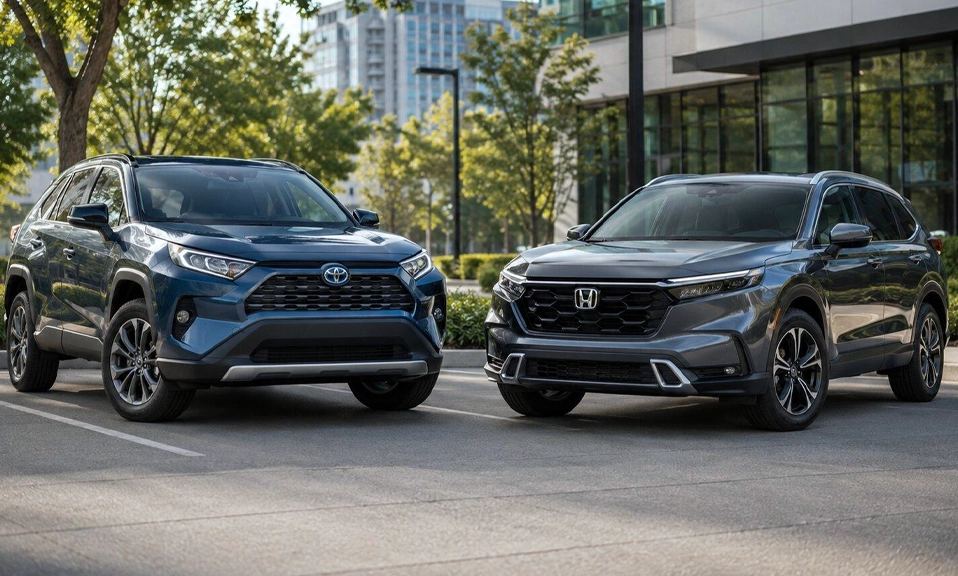
The answer to which is the better family SUV in 2026 is not a simple one. It is a choice between two fundamentally different philosophies, and the gap between them has widened enough that the “right” answer now depends entirely on what you value most: the Toyota RAV4’s unwavering commitment to efficiency and value, or the Honda CR-V’s focus on space, comfort, and a more engaging drive.
The stakes are high. These are the two best-selling compact SUVs in America, and for 2026, they have taken divergent paths. Toyota has made a bold bet, eliminating the gas-only RAV4 entirely and making every model a hybrid . Honda has stuck with a more traditional approach, offering both a turbocharged gas engine and a hybrid, while giving the CR-V a more upscale feel and a roomier interior . The result is a classic showdown between efficiency and outright family-friendly practicality.
Here is the definitive breakdown of how they compare, based on pricing, powertrains, interior space, safety, and the real-world experience of driving both.
📊 The Specs at a Glance
Before diving into the details, here is how the two family haulers line up on paper.
| Feature | 2026 Toyota RAV4 | 2026 Honda CR-V |
|---|---|---|
| Base Price (MSRP) | $31,900 (LE Hybrid) | $30,920 (LX Gas) / $35,630 (Sport Hybrid) |
| Top Trim Price | $43,300 (Limited) | $42,250 (Sport Touring Hybrid) |
| Powertrain | Hybrid Only (2.5L I4 + electric motors) | Gas (1.5L Turbo) or Hybrid (2.0L I4 + two motors) |
| Horsepower | 226 hp (FWD) / 236 hp (AWD) | 190 hp (Gas) / 204 hp (Hybrid) |
| Fuel Economy (Combined) | Up to 44 mpg | Up to 40 mpg (FWD Hybrid) / 37 mpg (AWD Hybrid) |
| Cargo Space (Behind 2nd Row) | 37.8 cu ft | 39.3 cu ft |
| Max Cargo Space | 70.4 cu ft | 76.5 cu ft |
| Rear Legroom | 37.8 inches | 41.0 inches |
| IIHS Safety Award (2026) | Not yet rated (redesign); scored “Acceptable” in updated test | No award (lost due to “Poor” rating in updated test) |
💰 Pricing: The RAV4 Wins the Value Battle at the Bottom
On the surface, the Honda CR-V has a lower starting price. The gas-powered CR-V LX starts at $30,920** (plus destination), undercutting the entry-level **RAV4 LE Hybrid at $31,900 . However, this is not a like-for-like comparison. The RAV4’s base price buys you a hybrid, while the CR-V’s base price gets you the less efficient, less powerful gas engine.
When you compare hybrid to hybrid, the RAV4’s value advantage becomes clear. The RAV4 LE Hybrid starts at $31,900**, while the **CR-V Sport Hybrid starts at $35,630—a difference of $3,730 . That is a significant gap for families on a budget.
The dynamic flips at the top of the range. The CR-V Sport Touring Hybrid, the most expensive CR-V, starts at $42,250**, while the **RAV4 Limited tops out at $43,300 . Honda’s top trim actually undercuts Toyota’s by about $1,000, but you are comparing a fully loaded CR-V to a fully loaded RAV4, and the price gap has essentially vanished.
The Verdict on Price: The RAV4 is the clear value winner for buyers shopping at the lower and mid-level trims. The CR-V becomes competitive only at the very top of the lineup.
⚙️ Powertrains and Efficiency: The RAV4’s All-Hybrid Gamble Pays Off
This is the RAV4’s strongest hand. By making every model a hybrid, Toyota has made exceptional fuel economy a standard feature rather than an expensive upgrade . The 2.5-liter four-cylinder hybrid system produces 226 hp in front-wheel drive and 236 hp with all-wheel drive, and returns up to 44 mpg combined . The 47 mpg city rating is particularly impressive for a compact SUV .
The CR-V Hybrid is no slouch. Its 2.0-liter four-cylinder and two-motor system delivers 204 hp and returns up to 40 mpg combined in front-wheel drive (37 mpg with AWD) . That is efficient, but it trails the RAV4 by a meaningful margin. The CR-V’s advantage is that it still offers a 190-hp turbocharged gas engine for buyers who want a lower entry price and do not want a hybrid .
The RAV4 also offers a Plug-in Hybrid (PHEV) variant with 320 hp and up to 52 miles of electric-only range, something the CR-V does not currently match .
The Verdict on Powertrains: The RAV4 wins decisively. It offers more power, significantly better fuel economy, and the option of a plug-in hybrid. The CR-V’s only advantage is the availability of a cheaper gas model.
🛋️ Interior and Cargo Space: The CR-V’s Family-Friendly Advantage
This is where the Honda fights back, and it is a compelling argument for families.
The CR-V is the roomier vehicle. It offers 41.0 inches of rear legroom, a full 3.2 inches more than the RAV4’s 37.8 inches . That is the difference between a comfortable rear seat for taller teenagers and a cramped one. The CR-V’s rear doors also open nearly 90 degrees, making it significantly easier to install child car seats and for passengers to get in and out .
In terms of cargo, the story is split. The CR-V has more maximum cargo space (76.5 cu ft vs. 70.4 cu ft) and more space behind the second row (39.3 cu ft vs. 37.8 cu ft) in its non-hybrid form . However, the RAV4 actually has slightly more cargo space behind the second row than the CR-V Hybrid (37.8 cu ft vs. 36.3 cu ft in most trims), though the CR-V Hybrid’s maximum capacity still edges out the Toyota .
The RAV4’s interior has been redesigned for 2026 with better materials and a more modern look, but reviewers note it still feels more focused on durability than luxury, and the center console is obtrusively large, eating into front-seat space . The CR-V’s cabin, by contrast, feels more upscale, with excellent fit and finish and a simple, intuitive layout .
The Interior: The CR-V wins for families. The extra rear legroom, easier car-seat access, and more spacious, upscale cabin make it the more comfortable and practical choice for carrying people and their belongings.
🛡️ Safety: A Critical Differentiator for 2026
Safety is where the 2026 model year delivers a surprising and significant twist.
The 2026 Honda CR-V lost its IIHS Top Safety Pick award. In the updated, stricter moderate-overlap front crash test—which specifically evaluates rear-seat protection—the CR-V earned a “Poor” rating . This is a serious black mark for a family SUV, as it indicates a potential weakness in protecting rear passengers in a common type of collision.
The 2026 Toyota RAV4 is all-new and has not yet been fully rated by the IIHS, but early results are more promising. In the same updated moderate-overlap test, the RAV4 Hybrid earned an “Acceptable” rating, which is the second-highest score . While not a “Good” rating, it is significantly better than the CR-V’s “Poor” result.
Both vehicles come with comprehensive suites of standard driver-assistance technology: Toyota Safety Sense 4.0 on the RAV4 and Honda Sensing on the CR-V . But the crash-test disparity is a critical factor that safety-focused buyers cannot ignore.
The Verdict on Safety: The RAV4 has a clear edge based on the available crash-test data. The CR-V’s “Poor” rating in the updated rear-seat protection test is a significant concern.
💻 Technology and Driving Experience: Two Different Priorities
The RAV4 has made a major leap in technology for 2026. Its new infotainment system, anchored by a 10.5-inch standard touchscreen (larger than the CR-V’s 9-inch unit), has been widely praised as a huge improvement and “one of the best offered in any vehicle, in any class” . The digital instrument cluster is also available in a larger 12.3-inch size on higher trims, compared to the CR-V’s 10.2-inch unit . However, some reviewers note the RAV4’s interior still has some cheap plastics and the driving position can feel cramped for taller drivers .
The CR-V prioritizes a simple, intuitive, and ergonomic experience. Its controls are easy to learn, with physical buttons and dials for climate and audio, which many families prefer . The cabin is quieter and more refined, and the driving experience is more engaging, with better bump absorption over rough surfaces . The RAV4 counters with a slightly more rugged character and available trims aimed at light off-road use .
The Verdict on Tech and Driving: The RAV4 wins on screen size and infotainment ambition. The CR-V wins on ergonomics, cabin refinement, and driving engagement.
💎 The Bottom Line: Match the SUV to Your Family’s Needs
The honest answer is that there is no single winner. Both are excellent, and the right choice depends on what your family values most.
Choose the Toyota RAV4 if:
Fuel efficiency and value are your top priorities. It is the more affordable hybrid and delivers significantly better gas mileage.
You want the most power and the option of a plug-in hybrid.
Safety is a primary concern. Its crash-test results are stronger than the CR-V’s for 2026.
You want the most modern infotainment system with a large, standard screen.
Choose the Honda CR-V if:
Space and comfort are non-negotiable. It offers significantly more rear legroom and easier access for child seats.
You want a more refined, upscale cabin that feels built to last.
You prefer a more engaging driving experience with better ride quality.
You want the option of a cheaper, gas-powered model to keep the entry price down.
The RAV4 is the efficiency and safety champion. The CR-V is the space and comfort champion. For a family with growing teenagers or multiple car seats, the CR-V’s extra room is hard to beat. For a family that prioritizes low running costs and the latest tech, the RAV4 is the smarter choice. The best SUV is the one that fits your life, not the one that wins on a spec sheet.