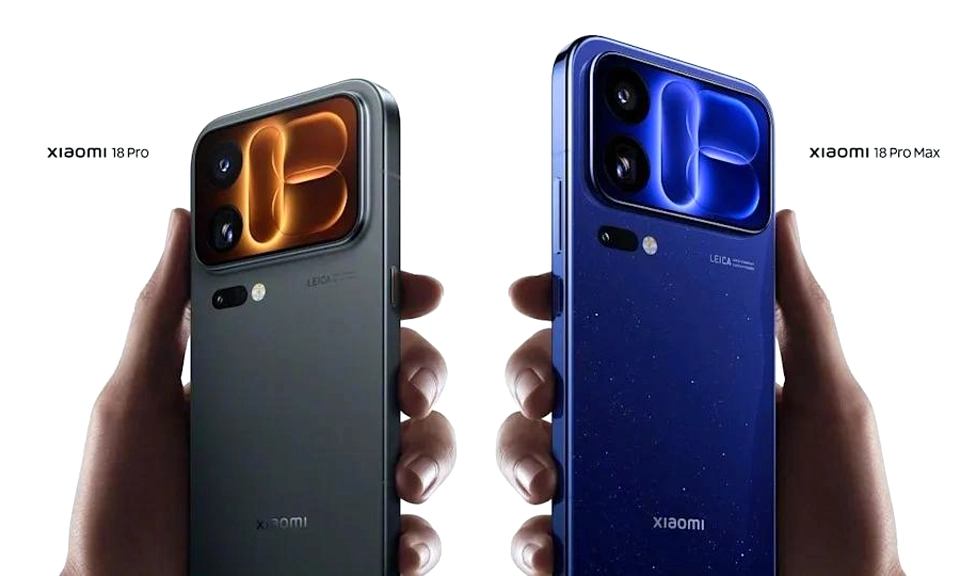
The Xiaomi 18 Pro and 18 Pro Max are not two versions of the same phone. They are two different answers to the same question: what do you actually want from a flagship?
Both launched in China on September 23, 2026, and both carry the same headline feature—the 妙享背屏 (rear display) that Xiaomi has now made central to its Pro identity. But beneath that shared surface, the Pro and the Pro Max diverge in ways that matter far more than a size bump. One is a compact flagship that refuses to compromise on battery or camera. The other is a maximalist statement that treats battery life as a luxury good.
Here is the breakdown that will tell you which one to wait for.
The Core Difference: Size vs. Stamina
The most obvious distinction is the screen. The Xiaomi 18 Pro uses a 6.4-inch “small direct screen” (小直屏), while the Pro Max stretches to 6.9 inches. Both are RGB OLED panels with M11发光材料, BT.2020 color gamut, LTPO 1–120Hz refresh, and 4000 nits peak brightness. Both also feature hardware-level privacy protection—the ability to physically narrow the screen’s viewing angle so the person next to you on the subway cannot read your banking app.
But the size difference creates a chain reaction. The larger chassis of the Pro Max allows for a dramatically larger battery: 8500mAh versus 7000mAh on the Pro (China versions). Both support 100W wired and 50W wireless charging.
The trade-off is not subtle. The Pro is a phone you can comfortably use one-handed. The Pro Max is a phone you buy because you have decided that two-day battery life is worth the ergonomic cost. If you have ever felt genuine anxiety watching your battery drop below 20% at 4 p.m., the Pro Max is the answer. If you have ever wished your flagship felt like a flagship instead of a tablet, the Pro is the answer.
Performance: The Same Generation, Different Tiers
This is where Xiaomi’s naming gets genuinely confusing.
The Xiaomi 18 Pro is powered by the Snapdragon 8 Elite Gen 6 (第六代骁龙8至尊版).
The Xiaomi 18 Pro Max is powered by the Snapdragon 8 Elite Extreme Gen 6 (第六代骁龙8超级至尊版)—a higher-binned variant of the same 2nm platform. The Extreme version is clocked at 5GHz, which Xiaomi describes as the highest mobile CPU frequency in history. It also features a new GPU/NPU architecture, advanced OFFSET PoP packaging, and a new annular cooling pump (环形冷泵) that Xiaomi claims delivers one hour of sustained full-frame gaming under heavy load.
In practice, the difference will be measurable in benchmarks but difficult to feel in daily use. Both chips are built on TSMC’s 2nm process. Both are faster than anything Qualcomm shipped in 2025. The Extreme version exists for the Pro Max’s marketing narrative and for the small subset of users who genuinely push sustained performance—competitive gamers, heavy emulators, and people who render video on their phones.
For most buyers, the Pro’s standard Elite Gen 6 is more than enough. The Pro Max’s advantage is real, but it is a specialist’s advantage, not a mainstream one.
Cameras: Identical Hardware, Different Tuning?
On paper, the camera systems are the same.
Both phones carry a 200MP main camera with a 1/1.28-inch sensor (the “光影猎人960” sensor), a 50MP ultra-wide (17mm equivalent), and a 200MP periscope telephoto with a 1/1.56-inch sensor, 3.2x optical zoom, and 12cm macro capability.
The software is where they may differ. Both support Xiaomi’s “传奇一瞬” (Legendary Moment) computational photography pipeline, which uses on-device and cloud processing to simulate the “optical flavor” of classic cameras. Both support AI-assisted framing, location-aware scene recommendations, and intelligent pose guidance.
The Pro Max’s larger body may allow for slightly better thermal management during sustained video recording or computational photography bursts, but Xiaomi has not published a meaningful hardware differentiator in the camera module itself. If camera parity is your priority, the Pro delivers the same hardware in a smaller package.
The Rear Display: The Feature That Defines the Series
The 妙享背屏 is not a gimmick, but it is also not equally useful to everyone.
Xiaomi reports that the rear display has 3.97 million daily active users, with the rear display assistant used 138 million times per month and users adding 497 million wallpapers per month. Those are not vanity metrics. They suggest genuine engagement.
The display supports:
AI-generated wallpapers from photos of pets, people, or objects
Interactive cards for reminders, countdowns, and calendars
Smart home controls for Xiaomi ecosystem devices
Voice interaction with the rear display assistant
4000 nits peak brightness, matching the main display
The Pro Max has a slightly different rear display implementation—it is described as an “integrated flat rear screen” (一体式纯平背屏), while the Pro’s implementation may differ in curvature or integration. The functional difference is minimal. The rear display is a series-defining feature, not a Pro Max exclusive.
Price: The Gap That Forces a Decision
| Configuration | Xiaomi 18 Pro (CNY) | Xiaomi 18 Pro Max (CNY) |
|---|---|---|
| 12GB + 256GB | 5,999 (国补后 5,499) | 6,999 |
| 12GB + 512GB | 6,999 | 7,999 |
| 16GB + 512GB | 7,999 | 8,999 |
| 16GB + 1TB | 8,999 | 9,999 |
| Transparent Special Edition (16GB + 1TB) | 9,999 | 10,999 |
Sources: Sohu, IT之家, 站长之家
The base price difference is 1,000 CNY (roughly $140). For that premium, you get a larger screen, a higher-binned chip, and a 1,500mAh larger battery. Everything else—the cameras, the rear display, the charging speeds, the IP68/IP69 rating, the ultrasonic fingerprint sensor—is shared.
The Pro Max’s value proposition is simple: you are paying for endurance and size. If those two things are not your top priorities, the Pro is the smarter buy.
The International Caveat: Do Not Assume Parity
If you are buying outside China, the calculus changes.
According to European retail listings, the international Xiaomi 18 Pro may ship with a 6000mAh battery and 90W charging, down from the China version’s 7000mAh and 100W. The international Pro Max may drop from 8500mAh to 7050mAh, though it retains 100W charging.
The chipset and camera hardware are expected to remain consistent, but the battery advantage of the Pro Max narrows significantly in global markets. If the international Pro Max is only 1,050mAh larger than the international Pro, the case for paying the premium becomes much weaker.
Xiaomi has confirmed the 18 Pro series will launch in Taiwan before the end of 2026, breaking a pattern where the Pro models never received a global release. But the exact specifications for each region have not been finalized.
The Verdict: Which Should You Wait For?
Buy the Xiaomi 18 Pro if:
You want a compact flagship that does not sacrifice battery life—7000mAh in a 6.4-inch body is genuinely unusual.
You want the same camera hardware as the Pro Max without the size penalty.
You value one-handed usability and pocketability.
You see the 1,000 CNY premium for the Pro Max as better spent on storage or accessories.
Buy the Xiaomi 18 Pro Max if:
Battery life is your single biggest priority. 8500mAh is not a phone battery; it is a power bank that happens to make calls.
You watch a lot of video, play demanding games, or use your phone as a hotspot—the larger screen and Extreme chip are built for sustained load.
You want the absolute best Xiaomi has to offer, regardless of diminishing returns.
You are comfortable with a 6.9-inch device and the ergonomic compromise that comes with it.
The Xiaomi 18 Pro: is the better value, and for most people, it is the better phone. The Pro Max is not a mistake—it is a deliberate choice for a specific kind of user who prioritizes endurance above all else. If you are unsure, wait for the international launch and check the regional battery specifications. The gap between these two phones is smaller than Xiaomi’s marketing wants you to believe, and the right choice depends entirely on whether you want a flagship that fits your hand or a flagship that outlasts your day.