The XREAL Aura and the Samsung Galaxy XR both run Google’s Android XR platform, both integrate Gemini AI, and both promise to move spatial computing out of the lab and into your life. But they are not competing for the same face. One is a pair of transparent glasses that tether to a pocket-sized computer. The other is a full mixed-reality headset that wraps around your eyes. Choosing between them is less about which is “better” and more about which kind of reality you actually want to live in.
Here is how they stack up, and which one deserves a place on your head.
The Specs at a Glance: Two Visions of Spatial Computing
| Feature | XREAL Aura | Samsung Galaxy XR |
|---|---|---|
| Starting Price | **$1,099** (promotional; $1,279 regular) | $1,799.99 |
| Form Factor | Transparent glasses + wired compute puck | Enclosed mixed-reality headset |
| Display | Sony Micro-OLED | Micro-OLED |
| Resolution per eye | 1,920 × 1,200 | 3,552 × 3,840 |
| Field of View | 70° | 109° horizontal, 100° vertical |
| Refresh Rate | Up to 120Hz | 60Hz, 72Hz; 90Hz available upon service request |
| Processor | Snapdragon Reality Elite (puck) + X1S co-processor (glasses) | Snapdragon XR2+ Gen 2 |
| Weight | 95g glasses + 265g puck | 545g headset + 302g external battery |
| Battery Life | 3–4 hours typical use | Up to 2 hours general use / 2.5 hours video |
| Input | Hand tracking, voice, puck trackpad | Eye tracking, hand tracking, voice |
| Passthrough | Transparent lenses (direct view of surroundings) | Camera-based color passthrough |
| Memory / Storage | 12GB/256GB or 16GB/512GB | 16GB/256GB |
Sources: TechRepublic, CNET, Gizmodo, Yahoo Tech, Stuff, Trusted Reviews
Design and Comfort: Light on Your Face vs. Immersed in a Headset
The most fundamental difference is how each device interacts with your face.
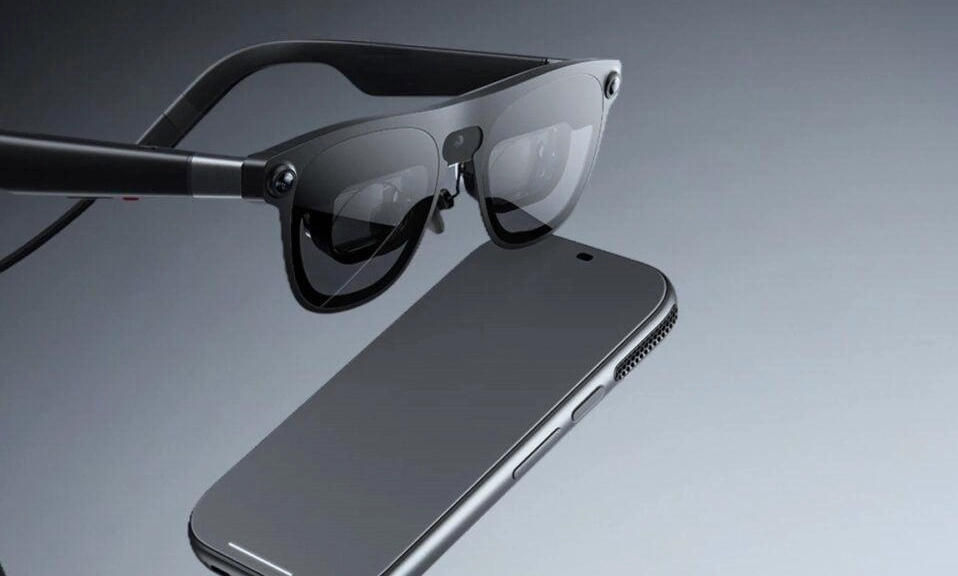
The XREAL Aura is a pair of glasses. It weighs under 95 grams—about the same as a thick pair of sunglasses—because the battery and primary processor live in a separate 265-gram compute puck that you clip to your belt or carry in a pocket. The glasses themselves are transparent, meaning you see the real world directly through the lenses, not through a camera feed. You can wear them while walking, commuting, or working in a shared space without feeling like you’ve strapped a screen to your face.
The trade-off is the tether. The Aura is not wireless. A cable connects the glasses to the puck, and you have to manage both devices. But the payoff is that the weight on your head is negligible. As one review put it, “the part that sits on your head is light enough to forget”.
The Samsung Galaxy XR is a headset. It weighs 545 grams on your face, plus a 302-gram external battery that sits in your pocket or clips to your clothing. It uses camera-based color passthrough—cameras on the front capture the real world and reproduce it on the internal displays—to blend digital objects with your physical surroundings. The enclosed design is more immersive, but it is also more isolating. You are not looking at the world; you are looking at a reproduction of it.
Verdict: If you want to stay connected to your surroundings and wear something that doesn’t feel like a helmet, the Aura wins. If you want to block out the world and step into a fully rendered digital environment, the Galaxy XR is the more capable device.
Display: Resolution vs. Field of View
The spec sheet tells a clear story, and it is the Galaxy XR’s strongest card.
The Galaxy XR’s display is dramatically sharper. At 3,552 × 3,840 pixels per eye, it delivers a level of detail that the Aura’s 1,920 × 1,200 panels cannot match. The resolution difference is not subtle—it is the difference between reading text comfortably and squinting at it. The Galaxy XR’s 109° horizontal field of view is also significantly wider than the Aura’s 70°, creating a more expansive, enveloping image.
The Aura’s display is still good. Its Sony Micro-OLED panels support up to 120Hz refresh rate—a higher peak than the Galaxy XR’s standard 60/72Hz (with 90Hz available by request)—and the transparent lenses mean you are looking at the real world directly, which can be less fatiguing than a camera passthrough feed. For virtual screens and productivity, the resolution is sufficient. For immersive gaming and high-fidelity media, it is not.
Verdict: Samsung wins on raw display quality. The Galaxy XR is the headset to choose if you want the best possible image for immersion.
Performance: A Surprising Upset
This is where the comparison gets interesting. Despite the Galaxy XR’s higher price and later release, the XREAL Aura has the more powerful chip.
The Aura runs on Qualcomm’s Snapdragon Reality Elite, paired with an X1S spatial co-processor in the glasses. The Galaxy XR uses the Snapdragon XR2+ Gen 2—a capable chip, but a generation behind the Reality Elite. Early reports indicate that the Aura’s GPU is up to 60% faster and its CPU up to 30% faster than the Galaxy XR’s processor, particularly in AI tasks.
In practice, the difference will be most noticeable in demanding applications—AI-powered features, complex multitasking, and high-fidelity gaming. For basic productivity and media consumption, both devices are more than adequate. But if you want the most future-proof hardware, the Aura has the edge.
Verdict: The Aura wins on raw compute. It is the more powerful device, even though it is the cheaper one.
Battery Life: The Aura Lasts Longer
Battery life is a critical consideration for any wearable, and the Aura has a clear advantage.
The XREAL Aura’s compute puck delivers 3 to 4 hours of typical use, with some reports suggesting up to 5 hours for simple productivity work. You can also plug in a charger during use to extend the session indefinitely.
The Samsung Galaxy XR lasts up to 2 hours of general use or 2.5 hours of video playback from its external battery pack. That is not a full workday, and it is shorter than the Aura’s runtime. For extended sessions, the Galaxy XR will require a mid-day charge or a battery swap.
Verdict: The Aura is the more practical device for long sessions. The Galaxy XR is better suited to shorter, more intense experiences.
Software and Ecosystem: Both Run Android XR, But the Experience Differs
Both devices run Android XR, Google’s spatial computing platform, and both have access to the Play Store and Gemini AI. But the way you interact with that software is different.
The Aura is designed for productivity and portability. It supports multiple virtual windows, Bluetooth keyboard and mouse pairing, and USB-C mirroring of a compatible laptop without additional software. Gemini can interpret content in your view—including mirrored laptop screens—and provide contextual assistance. Enterprise applications like Frontline.io for remote assistance and ShapesXR for spatial design are part of the ecosystem.
The Galaxy XR is designed for immersion. It adds eye tracking—a capability the Aura lacks—which enables more intuitive interaction and foveated rendering. The experience is more “VR-like” than the Aura’s “glasses-like” approach. But the software ecosystem is still early. Reviews note a lack of killer apps and limited gaming appeal, which makes the high price harder to justify.
Verdict: The Aura is the more practical device for everyday productivity. The Galaxy XR is the more immersive device, but its software is not yet mature enough to justify the premium for most people.
The Verdict: Which Mixed-Reality Experience Is Right for You?
Choose the XREAL Aura if:
You want a portable virtual workspace. The Aura is designed for people who want multiple monitors on the go—on a plane, in a coffee shop, or in a shared office.
You value comfort and lightness. At 95 grams on your face, it is a different category of wearable from a 545-gram headset.
You want the most powerful hardware. The Snapdragon Reality Elite beats the Galaxy XR’s chip.
You want longer battery life. 3–4 hours vs. 2 hours is a meaningful difference.
You want to stay connected to your surroundings. The transparent lenses let you see the real world directly.
You are budget-conscious. At $1,099 (promotional), it is $700 cheaper than the Galaxy XR.
Choose the Samsung Galaxy XR if:
You want the best possible display for immersion. The 4K Micro-OLED panels and 109° field of view are genuinely superior for media and gaming.
You want eye tracking. The Galaxy XR’s eye tracking enables more intuitive interaction and foveated rendering.
You want a true mixed-reality experience. The camera-based passthrough creates a more seamless blend of digital and physical worlds for immersive applications.
You are comfortable paying a premium for a headset. The Galaxy XR is positioned as a high-end device, and its build quality reflects that.
You are willing to wait for the software to mature. Android XR is still early, and the Galaxy XR’s best experiences may be ahead of it.
The XREAL Aura is the better value and the more practical device for most people. It is lighter, cheaper, more powerful, and lasts longer. It is designed for the way most people actually want to use spatial computing today: as a portable extension of their existing devices, not as a replacement for reality.
The Samsung Galaxy XR is the better immersive experience. Its display is sharper, its field of view is wider, and its eye tracking is a meaningful addition. But it is heavier, more expensive, and limited by a software ecosystem that has not yet delivered a compelling reason to spend $1,800.
If you want to dip your toes into spatial computing without committing to a full headset, the Aura is the safer bet. If you want to dive in headfirst and you have the budget to spare, the Galaxy XR is the more impressive piece of hardware.
They are both Android XR. They are both glimpses of the future. They just offer different paths to get there.