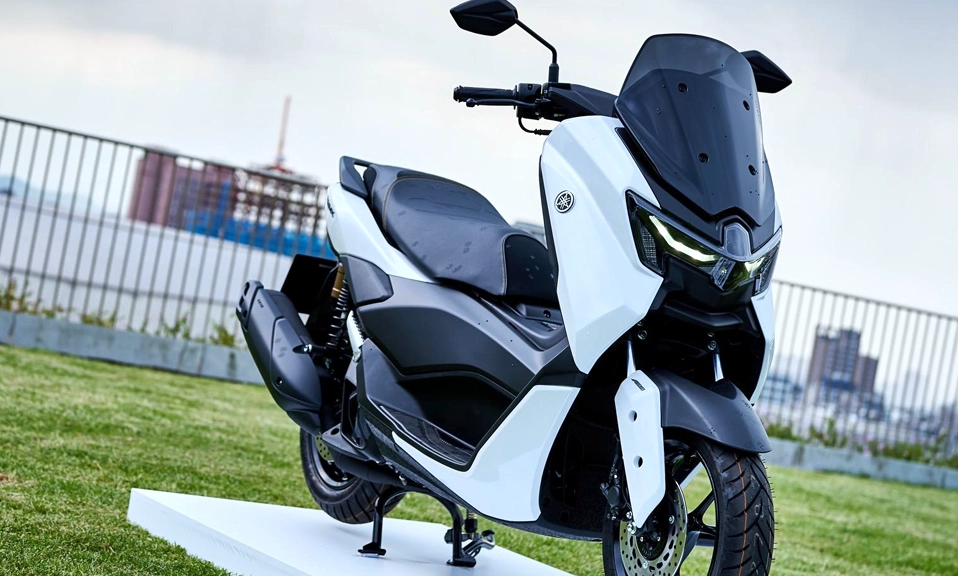
Yamaha has pulled the cover off the NMAX E, its first serious mass-production electric scooter in the MAX family, and on paper it makes a compelling case as a direct replacement for a 125cc petrol commuter. But the pitch is more nuanced than the headline 104 km range suggests. Whether it is worth the switch depends less on the number on the spec sheet and more on how you plan to charge it, where you live, and what you expect from a scooter that costs €7,799 before on-road costs.
⚡ The Specs: A 125cc Rival With Instant Torque
Yamaha is not positioning the NMAX E as a replacement for the petrol NMAX 155. It is a 125cc-class equivalent, and the numbers back that up.
The motor produces 7.5 kW (10 hp) of peak power and 33.3 Nm of torque, with peak torque arriving at just 500 rpm. That means acceleration from a standstill is immediate and punchy—exactly what you want for city traffic and red-light getaways. Yamaha has not published an official top speed, but the A1 classification and media estimates put it around 100 km/h.
The battery is a 3.5 kWh lithium-ion unit, mounted low and centrally in an L-shape to keep the centre of gravity low and the handling balanced. Yamaha claims 104 km of range on the WMTC Class 1 test cycle, which is a standardised laboratory figure. Real-world range will depend on riding mode, load, temperature, and how aggressively you use that instant torque.
🔌 The Charging Reality: Fixed Battery, 5.5 Hours
This is the single most important detail for anyone considering a switch. The NMAX E uses a fixed battery, not a removable one.
That means you cannot carry the battery into your apartment or office to charge. You need access to a household power outlet or a Type 2 AC public charging station wherever the scooter is parked. The on-board 800W charger takes approximately 5.5 hours to go from zero to full. There is no fast-charging option, and no quick battery swap.
For riders with a garage, a driveway, or a dedicated parking spot with a power point, this is workable. For riders who rely on street parking or live in an apartment without secure charging access, the fixed battery is a genuine barrier—one that removable-battery competitors do not impose.
🛠️ The Equipment: Familiar MAX Practicality, Modern Tech
The NMAX E retains the practical, sporty silhouette of the MAX family, and that is a strength. It has a 770mm seat height, a spacious footboard, and underseat storage that can accommodate a full-face helmet. It rides on 13-inch wheels with ABS and traction control as standard, plus regenerative braking to recover energy under deceleration.
The tech package is competitive for the class: a 5-inch colour TFT display with smartphone connectivity through the Yamaha Motor On app, turn-by-turn navigation, keyless ignition, a USB-C port, and three riding modes (Sport, Touring, and Eco). There is also a reverse mode for tight parking spaces.
The NMAX E is not a stripped-down compliance scooter. It is a premium, well-equipped urban machine that happens to be electric.
💰 The Price and Availability: A Premium Proposition
The European price is €7,799 including VAT, plus €300 in manufacturer costs. That is significantly more expensive than a comparable 125cc petrol scooter, and it places the NMAX E in direct competition with premium electric scooters from established players.
Yamaha plans a Spring 2027 European launch, with a Japan launch also scheduled for 2027. Production will take place in Vietnam. An India launch has not been confirmed, and if it does arrive there, it will compete with the Ather 450X, TVS iQube ST, and Bajaj Chetak.
⚖️ Is It Worth the Switch?
The honest answer is: it depends on your charging situation and your daily routine.
The NMAX E makes sense if:
You have reliable overnight charging access at home or work.
Your daily commute is well within 104 km, with margin for weather, load, and battery degradation.
You want instant torque, low running costs, and minimal maintenance (belt drive, no oil changes, regenerative braking).
You value Yamaha’s build quality and dealer network over the lowest possible price.
It is a harder sell if:
You cannot charge where you park. The fixed battery makes the NMAX E dependent on dedicated charging infrastructure in a way that removable-battery scooters are not.
You regularly ride more than 80–90 km per day. The WMTC figure is optimistic; real-world range at highway speeds or in cold weather will be lower.
You are price-sensitive. At €7,799, the NMAX E carries a significant premium over petrol equivalents, and the total cost of ownership only favours electric if you ride enough miles to offset the higher purchase price with lower energy and maintenance costs.
You need fast refuelling. A 5.5-hour charge is fine overnight, but it is not a quick top-up before a longer trip.
💎 The Yamaha NMAX E
is the most credible electric scooter Yamaha has built for the European market. It looks and feels like a real motorcycle, it has the equipment and safety features that modern riders expect, and its performance is genuinely comparable to a 125cc petrol commuter.
But the fixed battery and the 5.5-hour charging time mean it is not a universal replacement for a petrol scooter. It is a premium urban commuter for riders with guaranteed charging access—a scooter for the person who has already decided that electric is the future and wants Yamaha’s version of it. For everyone else, the switch is less a question of whether the NMAX E is a good electric scooter (it is) and more a question of whether their life is set up to live with one.
At €7,799, it is not an impulse purchase. But for the right rider, in the right circumstances, it is a genuinely compelling one.