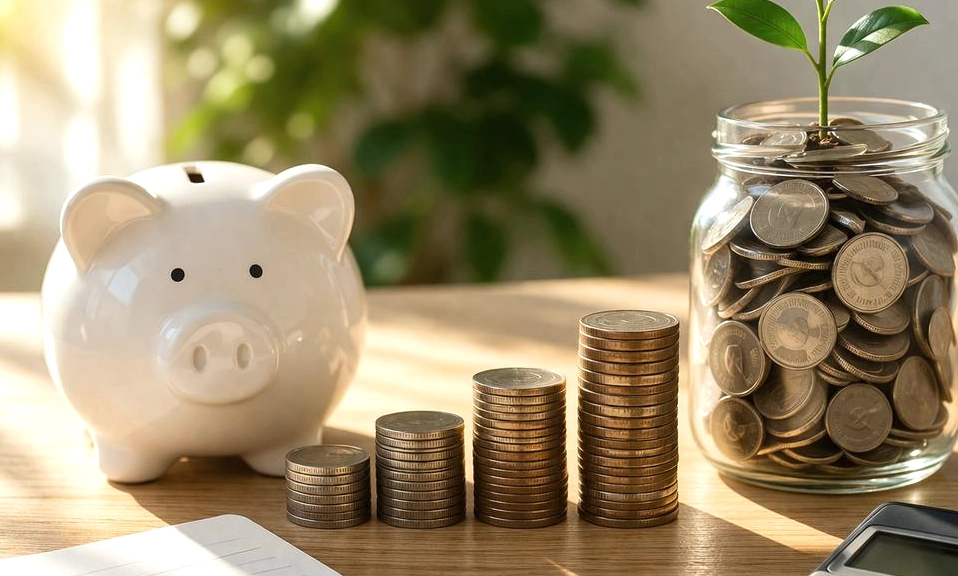
One hundred dollars a month. That’s roughly the cost of a dinner out, a couple of streaming subscriptions, or a new pair of sneakers. It doesn’t feel like life-changing money. But over time, it becomes exactly that—not because of the amount, but because of the mathematical force that multiplies it. This is the story of compound interest, the most powerful—and most ignored—tool in personal finance.
Albert Einstein reportedly called compound interest “the eighth wonder of the world.” Whether he actually said it is debatable, but the sentiment is right: compound interest is the rare financial concept that rewards patience, consistency, and time more than genius, timing, or starting capital. It is the reason a barista who invests $100 a month from age 25 can end up wealthier than a doctor who starts at 45. And it is the reason the most important decision you make about your money isn’t what you invest in—it’s when you start.
Here’s how it works, why it matters, and what $100 a month can actually become.
What Is Compound Interest?
Compound interest is interest that earns interest. When you invest money, it generates returns. Those returns are added to your principal, and the next round of returns is calculated on the new, larger balance. Over time, the growth accelerates—not linearly, but exponentially.
A simple example: If you invest $1,000 at a 7% annual return, you earn $70 in the first year. In the second year, you earn 7% on $1,070—not $1,000—so you earn $74.90. By year 10, you’re earning $131. By year 20, $262. By year 30, $515. The money you earn eventually surpasses the money you contributed, and the gap widens every year.
The same principle applies to monthly contributions. When you add $100 every month, each new deposit begins compounding immediately, and the accumulated returns from earlier deposits continue to grow. The result is a snowball effect: small, consistent contributions that build into a substantial sum over decades.
The Numbers: What $100 a Month Becomes
Let’s run the math. Assume an average annual return of 7%, which is roughly the historical inflation-adjusted return of the U.S. stock market over the long term. Assume the contributions are made monthly and the returns are compounded monthly.
| Time Horizon | Total Contributed | Ending Balance | Growth from Compounding |
|---|---|---|---|
| 10 years | $12,000 | ~$17,300 | ~$5,300 |
| 20 years | $24,000 | ~$52,000 | ~$28,000 |
| 30 years | $36,000 | ~$122,000 | ~$86,000 |
| 40 years | $48,000 | ~$264,000 | ~$216,000 |
| 50 years | $60,000 | ~$548,000 | ~$488,000 |
The numbers are striking. Over 40 years, $100 a month becomes roughly **$264,000**—of which only $48,000 is money you actually put in. The other $216,000 is growth. Over 50 years, the ending balance is nearly $550,000, and the growth component is more than eight times your total contributions.
These figures are not guarantees. They are illustrations based on a long-term average return. Markets fluctuate, and there will be years when your balance falls. But the historical record is clear: over long periods, diversified equity investments have delivered returns in this range, and compounding has done the heavy lifting.
The Cost of Waiting
The most expensive mistake in investing is not picking the wrong fund. It’s waiting too long to start. Because compounding is exponential, the earliest dollars do the most work—and every year you delay is a year of growth you can never recover.
Consider two investors:
Investor A starts at age 25, contributes $100 a month for 10 years, then stops entirely. Total contributed: $12,000.
Investor B starts at age 35, contributes $100 a month for 30 years. Total contributed: $36,000.
At age 65, assuming a 7% annual return, **Investor A has roughly $234,000**—despite contributing only $12,000 and stopping 30 years earlier. Investor B has roughly $122,000—despite contributing three times as much.
Investor A contributed one-third as much money and ended up with nearly twice the balance. The only difference is time. This is the single most important lesson in personal finance: the earlier you start, the less you need to invest to achieve the same outcome.
Why $100 Works: The Psychology of Consistency
There is another reason $100 a month is powerful, beyond the math. It is small enough to be sustainable. It is large enough to be meaningful. And it is a fixed number that removes the emotional decision-making from investing.
This is the principle behind dollar-cost averaging: investing a fixed amount at regular intervals, regardless of what the market is doing. When prices are high, you buy fewer shares. When prices are low, you buy more. Over time, this smooths out your average purchase price and reduces the risk of investing a lump sum at exactly the wrong moment.
But the real benefit of a fixed monthly contribution is behavioral. It turns investing into a habit, like paying a bill or going to the gym. You don’t have to time the market, predict a recession, or read financial news. You just have to set up an automatic transfer and let it run. The discipline of consistency is what allows compounding to work its magic—and consistency is far easier to maintain when the amount is small enough to ignore.
Where to Put the $100
The vehicle matters as much as the amount, but the options for a beginner are simpler than the financial industry would have you believe.
Low-cost index funds are the most common recommendation for long-term investors. An S&P 500 index fund or a total market index fund gives you broad exposure to hundreds or thousands of companies for a fraction of a percent in annual fees. Over decades, fees compound too—and a 1% annual fee can eat a substantial portion of your returns.
Retirement accounts should be the first stop if they are available to you. In the U.S., a 401(k) with an employer match is effectively free money—if your employer matches 3% of your salary and you contribute enough to get it, that’s an immediate 100% return on those contributions. An IRA offers tax advantages and more investment options. In other countries, equivalent tax-advantaged accounts (like the UK’s ISA or Canada’s TFSA) serve a similar purpose.
Automation is the final piece. Set up a recurring transfer from your checking account to your investment account on the same day every month. Treat it like a non-negotiable expense. The goal is to make investing something that happens to you, not something you have to remember to do.
The Caveats: What Compounding Cannot Fix
Compound interest is a powerful force, but it is not magic. Several caveats are worth keeping in mind.
Returns are not guaranteed. The 7% figure is a long-term average, not a promise. There will be decades when returns are lower, and there will be years when they are negative. A 2008-style crash can cut your balance in half. The key is to stay invested and keep contributing—market downturns are when your monthly contributions buy the most shares.
Inflation matters. The figures above are nominal, not adjusted for inflation. Over 40 years, $264,000 will not buy what it buys today. That’s why it’s important to invest in assets that have historically outpaced inflation—like stocks—rather than leaving your money in a savings account earning 1%.
Time horizon matters. If you need the money in five years, a 7% return is not a reasonable assumption. Short-term investing requires a different approach, with lower risk and lower expected returns. Compounding works best over decades, not months.
You need to start. The math is compelling, but it only works if you actually do it. The most common reason people fail to build wealth is not bad investment choices—it’s inertia. $100 a month is achievable for most people, even on a tight budget. The question is whether you will set up the transfer and let it run.
The Bottom Line
$100 a month is not a get-rich-quick scheme. It is a get-rich-slowly scheme—and that’s exactly why it works. Compounding rewards the patient, the consistent, and the disciplined. It does not reward those who wait for the perfect moment, try to time the market, or chase the hottest stock.
The math is simple: small amounts, invested regularly, over long periods, grow into substantial sums. The execution is even simpler: automate the contribution, choose a low-cost index fund, and don’t touch it. The hard part is believing that $100 matters—and then giving it enough time to prove you right.
If you are in your twenties, $100 a month today could be worth more than half a million dollars by the time you retire. If you are in your forties, it could still be worth six figures. If you are in your sixties, it is not too late to start—but the earlier you begin, the less you will have to contribute to reach the same destination.
The future is not built in a single decision. It is built in the small, repetitive, almost invisible choices you make every month. $100 is one of those choices. Make it, automate it, and let time do the rest.