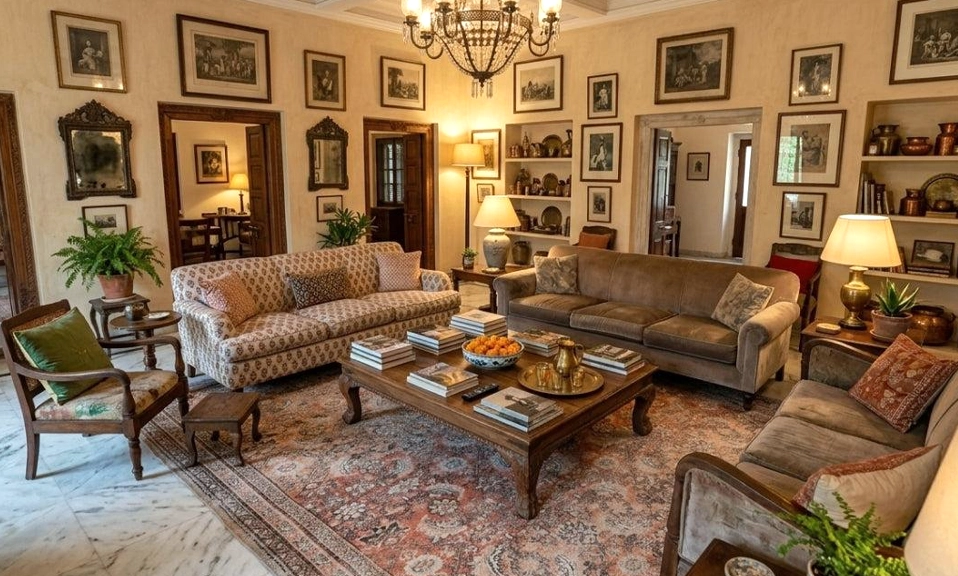
We’ve all scrolled through Pinterest or Instagram, looking at breathtaking, designer-level interiors, and thought, “I could never afford that.”
We tend to assume that a luxurious, high-end home requires a massive budget, custom-built sofas, and antique coffee tables. But interior designers know a secret that the rest of us often miss: Luxury isn’t about the price tag of your furniture. It’s about the curation, the lighting, and the details.
You don’t need to drop thousands of dollars at a showroom to make your home feel like a boutique hotel. You just need to change how you interact with the space you already have.
Here are 7 highly effective, zero-furniture-buying ways to make your space feel instantly more expensive.
💡 1. Institute the “Big Light” Ban
The Problem: Relying solely on your main overhead ceiling light. The Fix: Turn it off, and layer your lighting.
Harsh, overhead lighting is the number one killer of a luxurious vibe. It flattens the room, highlights every flaw, and feels like a dentist’s office. High-end spaces rely on layered, ambient lighting.
- How to do it: Turn off the “big light” in the evenings. Instead, use a mix of floor lamps, table lamps, and wall sconces. Place lamps in the dark corners of the room to push the walls outward visually.
- The Secret Sauce: Check your lightbulbs. Swap out any “cool white” or “daylight” bulbs (which cast a blue, clinical glow) for warm white bulbs (2700K to 3000K). Warm light mimics a sunset, instantly making your space feel cozy, expensive, and inviting.
🖼️ 2. Hang Your Curtains “High and Wide”
The Problem: Hanging curtain rods directly above the window frame. The Fix: Move the hardware to trick the eye.
This is the oldest, most effective trick in the interior design playbook, and it costs absolutely nothing if you already have curtains. When curtains are hung right at the top of the window, they make the ceilings look lower and the windows look smaller.
- How to do it: Take your existing curtain rods and mount them as close to the ceiling (or crown molding) as possible. Then, extend the rod brackets so they sit 6 to 10 inches past the window frame on either side.
- The Result: When the curtains are open, they will rest against the wall, not the glass. This lets in maximum light and makes your windows look massive and your ceilings look soaring. It instantly gives the room custom, architectural proportions.
🧹 3. Deep Clean the “Invisible” Details
The Problem: Ignoring the tiny things that accumulate grime. The Fix: A meticulous, top-to-bottom detail clean.
You can have a beautiful sofa, but if your baseboards are dusty and your light switches are smudged, the room will feel cheap. Luxury is defined by immaculate maintenance.
- How to do it: Take a damp microfiber cloth and wipe down your baseboards, door frames, and the tops of your doors. Unscrew your light switch plates and outlet covers and wash them in the sink (a yellowed, greasy switch plate instantly dates a room). Clean the grout in your bathroom and kitchen. Wipe down the actual blades of your ceiling fans.
- The Result: When the “bones” of the room are spotless, the brain registers the space as pristine, high-end, and carefully maintained.
🛋️ 4. Steam, Iron, and Fluff Your Textiles
The Problem: Wrinkled fabric and flat, sad-looking pillows. The Fix: Treat your soft goods like a high-end boutique.
Wrinkles read as “cheap” and “lived-in” in a messy way. Crisp, structured textiles read as “luxury.”
- How to do it: Take 20 minutes to steam or iron your curtains and any linen throw blankets. If you have throw pillows that look deflated, take out the insert and fluff it vigorously, or add a handful of poly-fill stuffing to give it that tight, plump, designer look.
- The Styling Trick: When placing pillows on a sofa or bed, don’t just drop them in the corner. “Karate chop” the top of the pillow to give it structure, and arrange them in varying sizes (e.g., two large squares in the back, two smaller lumbar pillows in the front).
📚 5. Style Surfaces Using the “Rule of Three”
The Problem: Cluttering coffee tables and shelves with lots of tiny, random objects. The Fix: Group items in odd numbers to create intentional vignettes.
Designers don’t just throw things on a table; they style them. The human eye is naturally drawn to odd numbers, making them feel more harmonious and intentional.
- How to do it: Clear off your coffee table, console, or bookshelf. Now, style it using the Rule of Three. Group items in threes. For example: A stack of two hardcover books (remove the dusty jackets!), topped with a small decorative object, placed next to a candle or a small plant.
- The Golden Rule: Always use a tray to corral smaller items on a coffee table or ottoman. A tray instantly turns a random collection of remotes and coasters into a “designed” moment.
🌬️ 6. Embrace “Negative Space”
The Problem: Filling every available surface and wall with something. The Fix: Edit, edit, edit.
In design, negative space (the empty space around and between objects) is just as important as the objects themselves. A room stuffed wall-to-wall with furniture and decor feels chaotic and small. A room with breathing room feels expensive.
- How to do it: Do a ruthless edit. Clear off the tops of your kitchen cabinets. Remove half the knick-knacks from your bookshelves and leave the rest beautifully spaced out. Leave the walls above your furniture mostly bare.
- The Mindset: Think of your home like an art gallery. Galleries don’t hang paintings touching each other; they give each piece room to be appreciated. Give your furniture and decor room to breathe.
🕯️ 7. Curate a “Signature Scent”
The Problem: Using cheap aerosol sprays or masking odors with synthetic plug-ins. The Fix: Create a subtle, consistent, high-end ambient scent.
Luxury hotels know that scent is tied directly to memory and perception. If a lobby smells like fresh figs and cedar, your brain instantly categorizes the space as premium.
- How to do it: Ditch the aerosol cans. Opt for a high-quality reed diffuser for a continuous, subtle scent, or use essential oils in a cool-mist humidifier.
- The DIY Hack: If you want a natural, incredibly luxurious scent for pennies, make a “simmer pot.” Boil a pot of water on the stove with sliced lemons, fresh rosemary sprigs, and a dash of vanilla extract. It will make your entire house smell like a million-dollar spa.
Luxury is a Feeling, Not a Receipt
At the end of the day, an expensive-looking home isn’t about having a $10,000 sofa. It’s about how the light hits the room, how the textiles drape, how clean the details are, and how intentionally the space is curated.
You already have everything you need to make your home feel like a sanctuary. You just have to look at it through the lens of a designer.
Take a walk through your house today with a critical eye. Turn off the big light, fluff the pillows, wipe the baseboards, and watch your space transform.