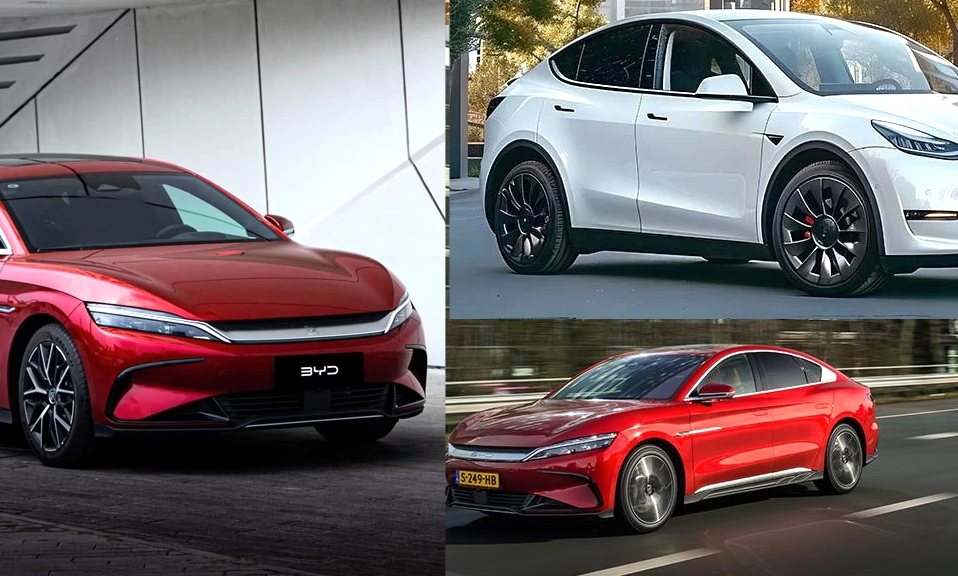
The global electric vehicle race has entered a new, more complex phase. For years, the story was simple: Tesla was the undisputed pioneer, and BYD was the ambitious challenger from China. In 2026, that narrative has been flipped on its head. BYD is no longer just challenging; it is leading by a significant margin, even as its growth slows in its home market. But Tesla is not standing still. It is pivoting aggressively toward a future of autonomy, robotics, and energy, betting that the next battleground will not be won on the strength of car sales alone.
The question of “who is winning” no longer has a single answer. On the metrics of volume and global expansion, BYD is the clear victor. On the metrics of profitability per vehicle and strategic ambition, Tesla is playing a different, longer game. Here is the definitive breakdown of the race in 2026.
📊 The Battle for Volume: BYD’s Commanding Lead
When it comes to putting cars on the road, BYD is in a league of its own.
In the third quarter of 2026, BYD sold 762,478 pure battery-electric passenger vehicles, a staggering 56.6% more than Tesla’s 486,532 deliveries. This widened the gap between the two companies to 275,946 units, a sharp increase from the previous quarter. Across the first nine months of the year, BYD’s lead stood at over 305,000 vehicles. This follows 2025, where BYD overtook Tesla for the first time on a full-year basis, selling 2.25 million pure EVs to Tesla’s 1.63 million.
However, the story is not one of uninterrupted dominance. BYD’s overall global sales for January-July 2026 actually fell 17.9% year-on-year to 1.816 million units, with its market share dipping from 19.9% to 15.4%. This decline is entirely due to a 8.2% contraction in the Chinese market, where a reduced EV purchase tax exemption and an intense price war have dampened demand.
The engine of BYD’s growth has shifted overseas. The company’s exports surged 68-71% to roughly 790,000 vehicles in the first half of 2026, now accounting for 44% of total volume and 53% of group revenue. In Europe, BYD has been outselling Tesla in key markets, with its market share reaching 2.7%, edging past Tesla’s 2.5%. BYD has revised its 2026 overseas sales target upward to 1.9-2.0 million vehicles, a massive increase from its initial 1.3 million goal.
💰 The Financial Picture: Two Very Different Stories
While BYD wins on volume, Tesla remains the more profitable company per vehicle, though its margins are under pressure.
BYD is navigating a challenging financial landscape. In the first half of 2026, revenue fell 7% to 344.8 billion yuan, and net profit dropped 20.5% to 12.3 billion yuan. However, there are signs of a rebound. In the second quarter, net profit rose 30% year-over-year to 8.2 billion yuan, even as revenue fell 3%. This counterintuitive result is because BYD is selling fewer cars but making more money on each one, thanks to the higher margins of its overseas sales. Its overseas business posted a 22% gross margin, compared to a lower margin domestically.
Tesla, on the other hand, is seeing its automotive business stagnate. In Q3 2026, automotive revenue fell 3% year-over-year to $20.56 billion**, and total revenue was flat at roughly **$28 billion. More concerning, its GAAP net income plummeted 43% to $787 million, and its operating margin has slipped to just 2.6%. This is a far cry from the double-digit margins Tesla enjoyed in its peak years.
While Tesla’s automotive gross margin (excluding regulatory credits) improved to 18.1%, it is still facing significant headwinds. The company is spending heavily on its future bets in AI and robotics, which is compressing its current profitability.
🌍 The Global Chessboard: Expansion vs. Ambition
The two companies are pursuing fundamentally different strategies for future growth.
BYD’s strategy is one of aggressive, physical global expansion. It is building a multi-region manufacturing footprint to circumvent tariffs and establish itself as a truly local player. Key operational plants include:
Thailand: A 150,000-unit facility serving as a major export hub for Southeast Asia.
Brazil: A plant with a planned capacity of 150,000 units.
Indonesia: A 150,000-unit factory that began production in June 2026.
Major new plants are also under construction in Hungary (planned capacity of 300,000 units) and Turkey (150,000 units), with the Hungarian facility targeting production in the second quarter of 2026. This “capacity going global” model is designed to replicate its domestic cost advantages in overseas markets.
Tesla’s strategy is a leap into the future, betting that its valuation will be driven not by cars, but by its AI and robotics divisions. CEO Elon Musk has explicitly framed the company’s long-term growth around three pillars: Robotaxi, the Optimus humanoid robot, and its own AI chip factory (Terafab).
Robotaxi: Tesla’s robotaxi service is expanding, operating in seven U.S. cities including Austin, Dallas, Houston, Miami, and the San Francisco Bay Area, with plans for further expansion. However, unsupervised FSD has been delayed to Q2 2027, and the service is not expected to contribute meaningful profit until after 2027.
Optimus: Production of the Optimus robot has started at Fremont. Musk’s target is an eventual output of 20,000 units per week, but external deliveries are not expected until late 2027 at the earliest.
This is a high-risk, high-reward approach. Tesla is sacrificing short-term automotive profitability to fund a future that may not materialize for years.
🔋 Technology: Batteries, Charging, and the Next Leap
BYD remains the undisputed leader in battery technology. Its second-generation Blade Battery and Flash Charging technology allow vehicles to recharge from 10% to 70% in just five minutes, and from 20% to 97% in only nine minutes. This is significantly faster than Tesla’s best current offering, which is roughly a 15-80% charge in ten minutes for its upcoming Roadster.
Furthermore, BYD is at the forefront of the solid-state battery race. It plans to introduce its first vehicle with solid-state batteries in 2027, with mass production expected around 2030. Its solid-state prototypes target an energy density of 400 Wh/kg, more than double its current Blade cells.
Tesla is making progress but is playing catch-up in this specific area. Its 4680 battery cells are finally enabling fast charging in the new Roadster, but a teardown comparison found the cells had inferior energy density and thermal efficiency compared to BYD’s Blade cells. Tesla’s innovation focus is shifting toward manufacturing efficiency, such as its “dry cathode” production method, which aims to make its cells the cheapest per kWh in the U.S..
🏆 Who Is Winning in 2026?
The answer depends on how you define “winning.”
BYD is winning the race that is happening now. It is the undisputed king of volume, selling significantly more electric vehicles than Tesla. It has a superior battery and charging technology, and it is executing a relentless global expansion strategy that is making it a dominant player in Europe, Southeast Asia, and Latin America. It has successfully pivoted its business to rely on higher-margin exports to offset a challenging domestic market.
Tesla is betting on winning the race of the future. It is no longer just a car company; it is a bet on autonomous driving, artificial intelligence, and robotics. Its automotive business is stagnating, and its profits are shrinking, but it is using those profits to fund a future where its cars are part of a massive robotaxi network and its robots work in factories. Whether this bet pays off is the single biggest question in the industry.
For now, the scoreboard favors BYD. It has the sales lead, the more advanced battery technology, and a clearer, more tangible path to growth. Tesla’s future is incredibly ambitious, but it is also highly uncertain, with key products like unsupervised robotaxis and consumer robots still years away from meaningful commercialization.
The race is far from over, but in 2026, BYD is in the driver’s seat, while Tesla is busy building the road ahead.