You’ve been told your whole life that stars are white, yellow, orange, red, or blue. Never green.
Your teacher was right — until last week.
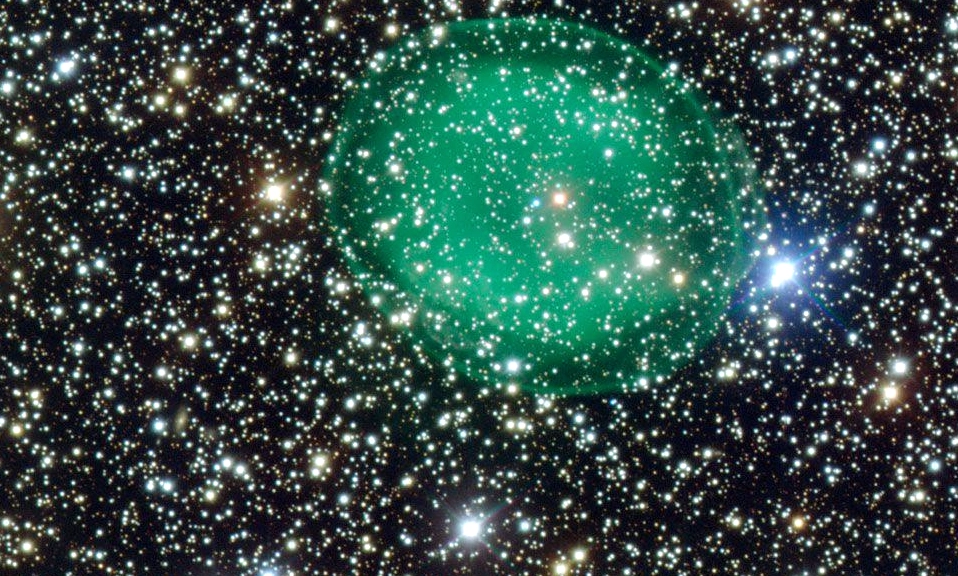
Astronomers have discovered a ghostly green star unlike any known before. Its name is WD J1330+6435, and it’s officially the first known green star in the Milky Way.
And it’s a zombie.
Meet The Star That Shouldn’t Exist
WD J1330+6435 is a white dwarf, the dense stellar remnant left behind after a star exhausts its nuclear fuel and sheds its outer layers.
In other words: It’s dead. It died about a billion years ago. It’s the leftover core of a star like our Sun, squeezed into a ball the size of Earth, but with the mass of the Sun.
It’s located 280 light-years away in the constellation Draco, and it looks like something out of science fiction.
Seen up close, WD J1330+6435 would glow a pale chartreuse green, a colour no star had shown before.
An artist’s impression of white dwarf J1330+6435, which might appear ghostly green because of certain elements in its dense atmosphere.
Why is this impossible? A star’s color typically is governed by its temperature, with cooler stars appearing orange, the sun and stars similar to it appearing white, and the hottest ones appearing a pale blue.
Green should be impossible because stars emit all colors — they are blackbodies. A star hot enough to be green would also emit red and blue, mixing to white. Our eyes mix green+red+blue = white. Only heavy absorption that cuts out other colours can leave a green tint.
And that’s exactly what happened.
Why Is It Green? It Ate Its Own Planets
Over time, this star has drawn in rocky debris from its former planetary system, introducing calcium, lithium, and sodium into its atmosphere.
When this star died, its planets died with it. The star expanded into a red giant, vaporized its inner planets, destabilized the outer ones. Asteroids, moons, rocky crusts — all got shredded and pulled into the dead star’s gravity.
White dwarfs have insanely strong gravity — 100,000x Earth’s. That debris didn’t just fall on it. It polluted its atmosphere.
According to the researchers’ calculations, these elements give the star a distinctive chartreuse green appearance.
Here’s the trick:
- Sodium absorbs orange light
- Calcium and lithium absorb other warm colors
- What you’re left with is mostly green and a little blue
“The traces of sodium in the atmosphere of this white dwarf absorb the orange part of the spectrum, leaving behind a ghostly green glow,” lead author Dr. Boris Hollands from University of Warwick told CNN. “Imagine standing on a planet and looking up at a green star.”
And what you’re left with is a star that has a beautiful chartreuse green. As far as the team knows, no other star, whether still undergoing nuclear fusion or already dead, has ever been credibly identified as genuinely green. This makes WD J1330+6435 the first known example of a green star in the Milky Way.
Why Are They Calling It A Zombie?
Because it should be dead and white. White dwarfs are supposed to be boring: hot, white, cooling slowly for billions of years until they become black dwarfs.
But this one came back to life — not with fusion, but by eating.
Green star discovery: Why astronomers are calling this strange cosmic object a ‘zombie’ after it began consuming planetary debris.
The researchers think that no other star, living or dead, has ever been credibly reported as green.
It’s a zombie that eats planets and glows green from the sodium in their rocks. It’s literally made green by the ground-up crust of its own dead worlds.
How Did We Find It?
The discovery came from the University of Warwick, using the William Herschel Telescope in La Palma and the Keck Telescope in Hawaii. They were studying polluted white dwarfs — white dwarfs with metals in their atmosphere — to figure out what exoplanets are made of.
So, scientists reconstructed how they’d look to human eyes based on the wavelengths of light they emit and found a colorful array of objects that might appear yellow, purple or pink.
Most polluted white dwarfs look slightly yellowish or bluish. This one popped out in the data: massive sodium absorption line. When they converted the spectrum to what human eyes would see — not just instruments — it was green. Pale, ghostly, chartreuse green.
In a First, Astronomers Identify a Star That Might Glow Green. New Research Highlights the Strange Hues White Dwarfs Can Take on.
One of the researchers said: There is also a STAR THAT IS SALMON PINK — another white dwarf polluted with different elements that looks pink.
So now we have a green star and a pink star. The dead are more colorful than the living.
What Does This Tell Us About Our Future?
Our Sun will become exactly this — a white dwarf — in 5 billion years.
When it does, it will eat Mercury, Venus, and probably Earth. Our continents — with all their sodium, calcium, lithium — will become part of the Sun’s atmosphere. For a brief moment, someone 280 light-years away could look up and see our Sun glowing green.
WD J1330+6435 is a postcard from our own future.
A dead star, eating the corpses of its own planets, glowing green because it swallowed an ocean’s worth of salt.
Imagine standing on a planet and looking up at a green star.
For the first time in human history, we don’t have to imagine. We found it.
Would you want to orbit a green star?