A sea cucumber with horns like a Norse god. A starfish that became an internet celebrity. A canyon deeper than the Grand Canyon, hiding a world we’ve barely seen. In just two weeks, 20 scientists identified 57 species new to science—and they only examined 10% of what they collected.
The Expedition: A Viral Moment, A Scientific Goldmine
In July and August 2025, researchers aboard the Schmidt Ocean Institute’s research vessel Falkor (too) sent a remotely operated vehicle named SuBastian into the Mar del Plata Canyon, a submarine rift off the coast of Argentina that plunges more than 3,500 meters below the surface—nearly twice as deep as the Grand Canyon.
The expedition was livestreamed. More than 4 million people tuned in. Many came for a plump orange sea star that looked uncannily like Patrick Star from SpongeBob SquarePants. Patrick, it turned out, was not a new species. Scientists left him where he was, unaware of his fame.
But the expedition wasn’t just a viral moment. It was a scientific goldmine. The canyon sits at the Brazil-Malvinas Confluence, where warm subtropical currents collide with cold, nutrient-rich sub-Antarctic waters—one of the most biologically dynamic regions in the South Atlantic.
The Workshop: Two Weeks, 57 Species
Nearly a year later, in July 2026, 20 taxonomists and early-career researchers from across Latin America and Europe gathered at the Universidad Maimónides in Buenos Aires for a Species Discovery Workshop, led by the Nippon Foundation-Nekton Ocean Census in partnership with the Schmidt Ocean Institute.
Their task: examine the deep-sea biological samples collected during the 2025 expedition. Their deadline: two weeks.
The results were staggering. In just 14 days, the team identified 57 new marine species and 5 new genera. The preliminary estimate had been around 40. It grew to 57 as the taxonomy work progressed.
What They Found: A Census of the Unknown
The 57 species break down into four major groups:
| Group | New Species | Examples |
|---|---|---|
| Copepods | 20 | Tiny crustaceans, vital to marine food webs |
| Echinoderms | 22 | Sea cucumbers and crinoids (feather stars) |
| Cnidarians | 14 | Octocorals, sea pens, stony corals |
| Scaphopod molluscs | 1 | A tusk-shelled mollusc |
Source: Ocean Census, Schmidt Ocean Institute
Beyond the species, the team found 5 entirely new scientific genera—the taxonomic rank above species—spanning corals, sea cucumbers, and crustaceans. Some of the discoveries may even represent new families, pending genetic analysis.
The Standouts: Loki, Patrick, and the Copepod Trove
Loki the Sea Cucumber
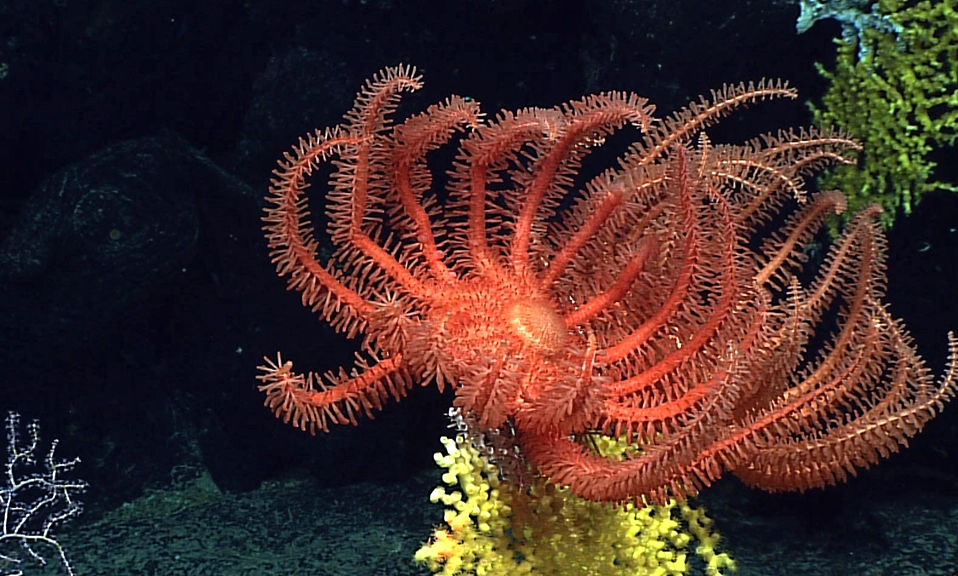
The most eye-catching discovery was “Loki the Sea Cucumber” (Peniagone sp.), named for its two horn-like appendages that resemble the headgear of the Norse trickster god. It lives 2,577 meters below the surface—nearly eight Eiffel Towers deep—and is one of up to 10 new sea cucumber species found during the workshop.
The Copepod Trove
The copepods tell an even more striking story. The team examined only 10% of the copepod samples collected. Every single specimen they looked at was new to science. That yielded 20 species and one new genus—with 90% of the samples still unexamined.
“We’ve only scratched the surface,” the researchers effectively said. And they meant it literally.
Patrick the Sea Star
The viral star of the expedition—the orange sea star that launched a thousand memes—was not a new species. But its fame helped draw attention to the canyon’s biodiversity, and the livestream became one of the most-watched deep-sea broadcasts in history.
The Science: Why This Matters
The Mar del Plata Canyon is not just a curiosity. It is a biodiversity hotspot at the intersection of two major ocean currents. The warm Brazil Current and the cold Malvinas Current create a dynamic mixing zone that supports an extraordinary range of life, from microscopic copepods to deep-sea corals and sea cucumbers.
But the canyon is also under threat. The expedition found plastic and fishing litter in the deep-sea environment—a sign that even this remote habitat is not immune to human pressure. Deep-sea mining, climate change, and bottom trawling are all potential threats to ecosystems we are only just beginning to understand.
“Discovering 57 new species and five new genera in just two weeks demonstrates the speed and power of collaborative taxonomy,” said Michelle Taylor, Ocean Census’s Head of Science. “The deep sea holds some of the least understood ecosystems on Earth”.
The Caveat: “Discovered” Is Not “Described”
There is an important distinction to make. These 57 species are “discovered” —meaning experts have judged them new to science and logged them in Ocean Census NOVA, an open-access database. But they are not yet “described” —a process that requires a peer-reviewed paper and a reference specimen in a museum. That process can take years.
So the 57 species are real, but their formal names and taxonomic descriptions are still to come. The discovery is the beginning, not the end.
What Comes Next
The samples from the Mar del Plata Canyon are far from exhausted. With 90% of the copepod collection still unexamined, and new genera awaiting genetic confirmation, the canyon will keep scientists busy for years. The workshop also served as a training ground for early-career taxonomists from Argentina and across Latin America, building capacity for future deep-sea research in the region.
“The deep sea holds some of the least understood ecosystems on Earth,” Taylor said. “By bringing Latin America’s scientific expertise and international experts together… we are drastically accelerating our understanding of marine biodiversity”.
In two weeks, in a converted
university lab in Buenos Aires, 20 scientists named 57 species that no one had ever seen before. They found a sea cucumber with horns, a canyon full of corals, and a copepod population so rich that every tenth of it they examined turned out to be new.
They also found plastic on the seafloor—a reminder that even the deepest, most remote places on Earth are not untouched.
The Mar del Plata Canyon is a hidden world. We’ve only just opened the door. And behind it, there is so much more.