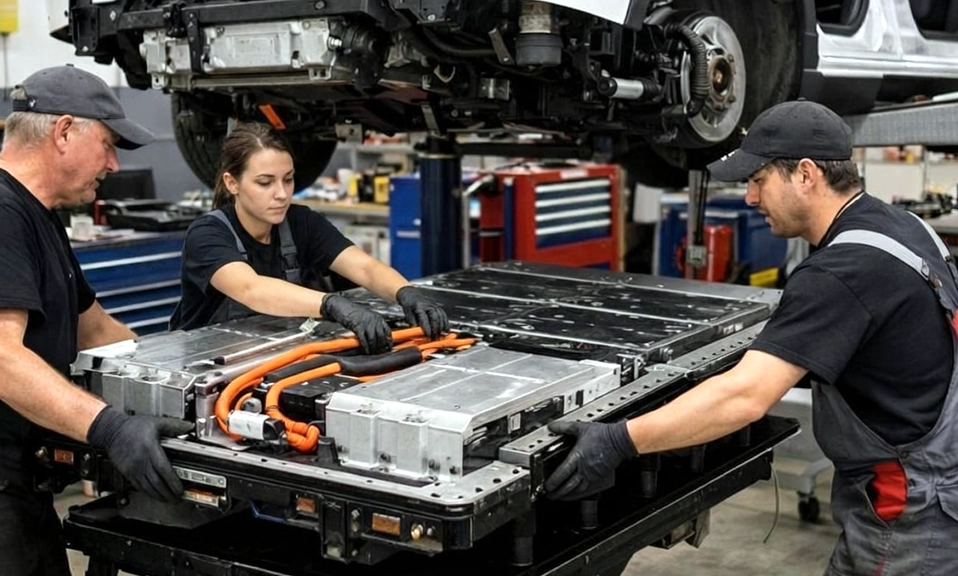
The single biggest fear for anyone considering an electric car is the battery. Will it die after a few years? Will a replacement cost more than the car is worth? Will the range shrink so much that the car becomes useless? The answers, based on the largest real-world studies ever conducted, are far more reassuring than the rumours suggest—but they come with important caveats that every buyer should understand.
The Headline: Batteries Are Outlasting the Skeptics
The most comprehensive data on EV battery health comes from AVILOO, an Austrian battery diagnostics company that analysed more than 500,000 state-of-health tests across 20 popular EV models between 2022 and 2026. The tests were conducted across North America, South America, Europe, Asia, and Australia—a genuinely global dataset.
The findings were striking. None of the 20 models tested showed a median drop in state of health of more than 10% in the first 50,000 km. After 100,000 km, most models retained at least 90% of their original capacity. And after 150,000 km—roughly 93,000 miles—the median values clustered between 90% and 94% for most models.
A separate analysis from Geotab, based on 22,700 EVs across 21 brands, found an average degradation rate of 2.3% per year—which equates to roughly 81.6% capacity after eight years. That is well above the 70% threshold that most manufacturers guarantee in their warranties.
The message from the data is clear: modern EV batteries are not failing. They are ageing slowly, gracefully, and in most cases, outlasting the cars they are installed in.
The Model-by-Model Picture: Some Age Better Than Others
Not all batteries are created equal. The AVILOO data revealed significant variation between models—and even between individual cars of the same model.
The top performers after 150,000 km:
| Model | Median State of Health (150,000 km) |
|---|---|
| Hyundai Ioniq 5 | 93.79% |
| Mercedes EQA | 93.97% |
| BMW i4 | 93.62% |
| Hyundai Kona Electric | 92.95% |
| Volvo XC40 Recharge | 92.79% |
Source: Aviloo, via InsideEVs and Auto Express
The lower end of the scale:
| Model | Median State of Health (150,000 km) |
|---|---|
| Nissan Leaf (ZE1) | 86.67% |
| Mini Cooper SE | 87.11% |
| Renault Zoe | 87.33% |
| Tesla Model 3 | 88.94% |
| Tesla Model Y | 90.3% |
Source: Aviloo, via InsideEVs and WhichCar
The pattern is instructive. The Hyundai Ioniq 5 and Mercedes EQA—both with large battery packs and liquid-cooled thermal management—performed best. The Nissan Leaf and Renault Zoe—both with smaller packs and air-cooled batteries—performed worst. Smaller batteries require more charging cycles to cover the same distance, and air cooling is less effective at managing heat, which accelerates degradation.
Tesla’s mid-table position is worth noting. The Model 3 and Model Y are not the longevity champions in this dataset, despite Tesla’s own claims that its batteries would take 20 years and 200,000 miles to lose 15% of capacity. They are still well above the warranty threshold, but they are not the best in class.
The critical caveat: The range of outcomes within a single model can be vast. For the Tesla Model Y at 150,000 km, the 99% confidence interval spans 82.9% to 94.9%. For the BMW i4, it spans 87.5% to 96.9%. The median tells you what to expect on average. The individual car you buy could be better or worse.
The Warranty: What You’re Actually Guaranteed
Every new EV sold in the US carries a federally mandated minimum battery warranty of 8 years or 100,000 miles, whichever comes first. Most manufacturers exceed this minimum.
The standard warranty covers the battery pack against defects and against capacity dropping below 70% of its original usable capacity. If your battery falls below that threshold within the warranty period, the manufacturer is obligated to repair or replace it.
Some manufacturers offer more. BYD has extended its Blade Battery warranty to 8 years or 250,000 km (155,000 miles) in Europe, with a guaranteed minimum state of health of 70%—and the extension applies retroactively to cars already on the road. Hyundai offers a 10-year or 100,000-mile high-voltage battery guarantee on some models, and will replace the whole battery if it degrades below 70% within eight years or 100,000 miles.
The warranty is your safety net. But the data suggests most owners will never need it. The average degradation rate of 2.3% per year means a typical EV will be at roughly 81.6% capacity after eight years—comfortably above the 70% threshold.
What Actually Affects Battery Lifespan?
The AVILOO and Geotab data, along with a growing body of academic research, have identified several factors that accelerate or slow battery degradation.
Charging Habits
Frequent DC fast charging is the most significant behavioural factor. Vehicles that rely primarily on DC fast charging at over 100 kW show degradation rates of up to 3% per year—roughly double those charged mainly on AC or low-power DC. However, the research is clear that fast charging is not a problem in itself if it is occasional. The damage accumulates when the battery spends a large proportion of its life at extreme states of charge—very close to 0% or 100%—and when fast charging is the default rather than the exception.
The widely recommended practice is to keep the battery between 20% and 80% for daily use, reserving full charges for long trips.
Temperature
Heat is the enemy of lithium-ion batteries. A 2026 study in Nature Climate Change found that under 2°C of warming, old batteries (2010–2018) would experience lifetime declines of 8% on average and 30% at worst, while new batteries (2019–2023) would experience declines of just 3% on average and 10% at worst—a sign that thermal management is improving. Vehicles in hot climates degrade about 0.4% per year faster than those in temperate regions.
Driving Style
Aggressive acceleration, frequent deep discharges, and irregular depth-of-discharge patterns all accelerate degradation. A 2026 SAE technical paper found that aggressive driving, frequent fast charging, and deep discharge habits materially accelerate capacity fade. Smoother driving, gentler acceleration, and avoiding running the battery to near-zero all help.
Battery Size and Chemistry
Larger battery packs degrade more slowly because they require fewer charging cycles to cover the same distance. Smaller packs—like those in the Mini Cooper SE and Nissan Leaf—cycle more frequently and therefore wear faster. The chemistry also matters: LFP (lithium iron phosphate) batteries, used in many Chinese EVs and some Tesla models, have a longer cycle life than NMC (nickel manganese cobalt) batteries, though they have lower energy density.
What About Replacement Cost?
If the worst happens and your battery fails outside the warranty, what does a replacement cost?
The typical out-of-pocket range is $5,000 to $22,000, depending on battery size and brand. Small electric cars can be at the lower end ($5,000–$8,000), while luxury models can reach up to $25,000.
But the context matters. According to Recurrent Auto’s dataset of more than 20,000 tracked EVs, the overall replacement rate is just 2.5%—and most of those were first-generation vehicles now 14+ years old. Modern battery management systems, thermal management, and chemistry improvements mean a 2022-or-newer EV battery may genuinely outlast the rest of the vehicle.
Battery costs are also falling. Pack prices have dropped 72% since 2012, from $400/kWh to $111/kWh by the end of 2024, and are projected to reach $80/kWh by 2026** and **$60/kWh by 2030. Third-party remanufactured packs now undercut OEM prices by 30–50%, with refurbished units available from $115/kWh.
The financial risk of battery replacement is real, but it is small—and shrinking every year.
The Second Life: What Happens When a Battery Retires?
Even when an EV battery reaches the end of its useful life in a car—typically defined as 70–80% of original capacity—it is not useless. Research published in 2026 confirms that end-of-life EV batteries can retain up to 80% of their capacity and are increasingly being repurposed for stationary energy storage, where the lower energy density is less of a limitation. They can also be remanufactured or recycled for material recovery, creating a circular economy for battery materials.
The battery in your EV is not a disposable item. It is a resource with a lifespan measured in decades, not years.
What Every Buyer Should Know
Electric car batteries last longer than most people fear. The largest real-world studies ever conducted show that after 150,000 km (93,000 miles), most EVs retain 90% or more of their original capacity. The average degradation rate is 2.3% per year, meaning a typical battery will still be at over 80% capacity after eight years—well above the 70% warranty threshold.
But the experience is not uniform. Some models age better than others. The Hyundai Ioniq 5 and Mercedes EQA lead the pack; the Nissan Leaf and Mini Cooper SE trail it. Individual driving and charging habits can shift the outcome significantly. And the range of outcomes within a single model can be wide.
The warranty is your protection. Every new EV comes with at least 8 years or 100,000 miles of coverage, and most manufacturers guarantee at least 70% capacity for that period. The data suggests you will almost certainly never need to use it.
The replacement risk is small and shrinking. Only about 2.5% of EVs have ever needed a battery replacement, and costs are falling rapidly as manufacturing scales and third-party remanufacturing expands.
Your habits matter. Keep the battery between 20% and 80% for daily use. Avoid frequent DC fast charging unless you need it. Park in the shade in hot climates. Drive smoothly. These small choices can add years to your battery’s life.
The era of fearing the EV battery is ending. The data is in, and the verdict is clear: the battery is not the weak point. It is one of the most durable, reliable components in the entire car.