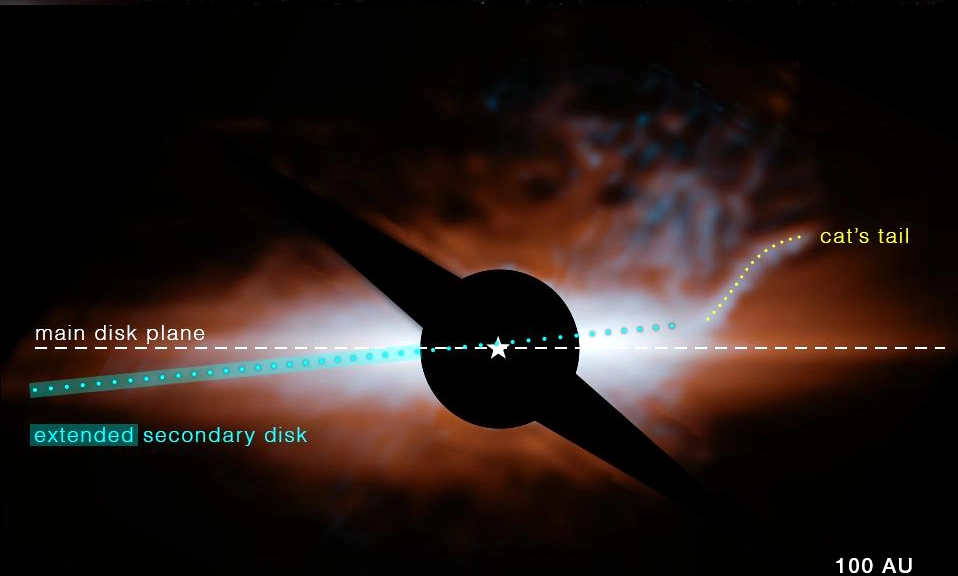
Astronomers have finally seen it in visible light: a vast, dark ribbon of dust stretching across the Beta Pictoris system, nicknamed the “Cat’s Tail.” It is thought to be the wreckage of a violent collision between Pluto-sized bodies, and its discovery is offering a rare glimpse into the chaotic infancy of planetary systems—including our own.
The structure sits about 63 light-years from Earth in the constellation Pictor, within the debris disk surrounding the young star Beta Pictoris. The system is only a few million years old and is considered a close analogue to our own solar system in its formative years. The Cat’s Tail was first spotted by the James Webb Space Telescope (JWST) in infrared light, but it remained invisible at shorter wavelengths—a puzzle that has now been solved.
The Discovery: Hubble’s Visible-Light Breakthrough
A team led by Arin Avsar, a doctoral student at the University of Arizona’s Lunar and Planetary Laboratory, used the Hubble Space Telescope to capture the Cat’s Tail in visible light for the first time. Their findings were published in The Astrophysical Journal Letters.
The observations combined new Hubble imaging with archival data spanning more than 14 years, allowing the team to track the structure’s location and nature over time. The Cat’s Tail stretches across an abyss of space about 1,000 astronomical units (AU) long—roughly 1,000 times the average distance between Earth and the Sun. In a more relatable unit, that is equivalent to about 200 trillion house cats lined up tail to snout.
Why Was It Invisible for So Long?
The Cat’s Tail eluded visible-light observations because of what it is made of. According to Avsar, the structure “consists almost entirely of what we call organic refractory material, which is heavily carbon-based. These long chains of carbon atoms absorb visible light, so they’re quite black”.
The dust grains themselves are also extraordinary. They are micron-sized and extremely porous or “fluffy.” “How you can get dust grains that small that are as porous as we see here, no one really understands, and that’s part of why we study this feature,” Avsar said. The darkness of the material, combined with its unusual texture, explains why it only stood out in the infrared glow captured by JWST.
The Violent Origin: A Pluto-Sized Collision
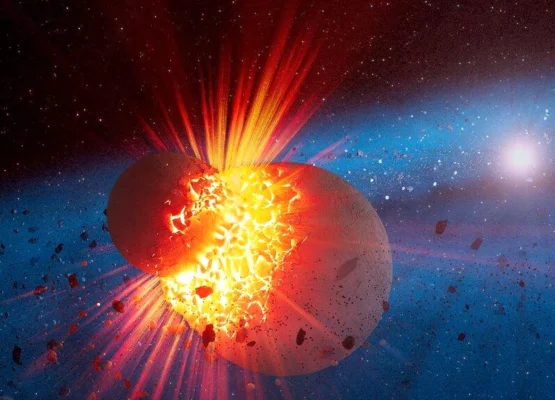
The Cat’s Tail is not a peaceful feature. Researchers believe it is the aftermath of a catastrophic collision between two or more large bodies—objects on the scale of Pluto—that were annihilated into microscopically small dust grains.
The evidence for this violent origin comes from the structure’s shape, its composition, and its location within the Beta Pictoris debris disk. The disk itself is a known site of ongoing planetary formation, with at least three directly imaged planets and evidence of exocomets. The Cat’s Tail’s curved, swept-back appearance suggests it was shaped by the gravitational influence of a massive planet. Computer modelling by the team indicates that a gas giant planet about 10 times the mass of Jupiter is likely responsible for a strange warp in the surrounding dust halo.
Why This Matters: A Window Into Our Own Past
The solar system we see today—with its neatly organized planets and stable asteroid belts—belies a chaotic and violent birth. Early on, it was a disk of gas and dust where space rocks smashed into each other, blew each other apart, and only a few survivors accreted enough mass to become planets.
Beta Pictoris, with its young age and its debris disk, offers a nearby laboratory for studying that process. The Cat’s Tail is a direct snapshot of the kind of collision that would have been common in the early solar system. By understanding how large bodies break apart and how their dust is distributed and shaped by planets, astronomers can refine their models of how our own planetary neighbourhood came to be.
“We think the Cat’s Tail has eluded our observations in visible light until now because of what it’s made of,” Avsar said. Now that it has been seen, it is providing “new insights on the location and nature of the substructure and further evidence for its likely violent origin”.
The Cat’s Tail is a dark,
fluffy ribbon of carbon-rich dust, 1,000 AU long, forged in a collision between worlds. It was invisible in visible light for years, hiding in the infrared glow of a young star system. Hubble has now revealed it, and in doing so, has given astronomers a clearer view of the violent processes that shape planetary systems.
It is a reminder that the cosmos is not a quiet place. It is a place where planets are born, where worlds collide, and where the debris of those collisions can stretch across a thousand times the distance from Earth to the Sun—and still be seen, 63 light-years away, by a telescope looking back in time.