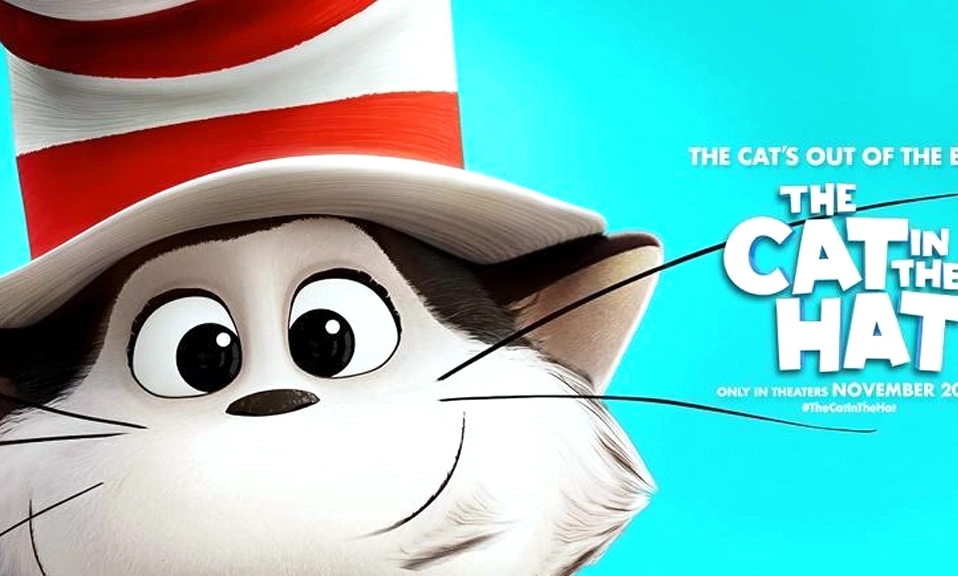
Dr. Seuss’s most chaotic character is back, but this time he’s not a live-action nightmare. The Cat in the Hat has returned as a fully animated feature from Warner Bros., and it’s already one of the most talked-about family films of the year—though not always for the reasons the studio might have hoped. The question isn’t whether the Cat is back. It’s whether this new version can finally become the family favourite that the 2003 film so spectacularly failed to be.
Directed by Erica Rivinoja and Alessandro Carloni, The Cat in the Hat arrives in theatres on November 6, 2026, marking the first full-length feature from Warner Bros. Pictures Animation. It’s an ambitious reimagining that tries to do something the previous adaptation never attempted: build a whole world around Dr. Seuss’s mischievous feline, rather than simply transplanting him into a live-action sitcom.
🎩 The Story: A Sequel, Not an Adaptation
The most important thing to understand about this Cat in the Hat is that it is not a faithful adaptation of the 1957 book. As The Hollywood Reporter noted, it is “more of a sequel to the original story than a true adaptation”.
The film introduces the I.I.I.I. (Institute for the Institution of Imagination and Inspiration, LLC) , a bureaucratic organization that employs the Cat as an “agent of chaos”. His mission: to cheer up two siblings, Gabby (Xochitl Gomez) and Sebastian (Tiago Martinez), who have just moved to a new town and are struggling to adjust. The stakes are high—if the Cat fails, he loses his magical hat and his job.
It’s a premise that gives the film a structure the original book never had, but it also fundamentally changes the character. As Variety put it, the Cat is presented “not as an independent operator but rather a beleaguered employee”—a shift that some critics found more corporate than chaotic.
🎙️ The Cast: Hader Shines, Berry Steals the Show
The voice cast is the film’s strongest asset. Bill Hader voices the Cat with what Variety described as “capital-F Friendly” energy—a performance that avoids the “black hole of misjudgment” that was Mike Myers’ 2003 turn, but also feels a little too safe for a character built on anarchy.
The real standout, however, is Matt Berry as Waffles, the family goldfish. Berry’s “grandly offended delivery” and “deadpan sophistication” have been singled out by nearly every reviewer, with The Hollywood Reporter calling him “the true star of the voice cast” who produces “the film’s biggest laughs”. The supporting cast—including Quinta Brunson, Giancarlo Esposito as the Cat’s exasperated boss, and America Ferrera as the children’s mother—is solid, if underused.
🎨 The Animation: A Kaleidoscope of Styles
Visually, the film is a genuine achievement. Animated by DNEG Animation (Nimona, The Garfield Movie), it uses stylised computer animation to explore Seuss’s “exaggerated shapes, bold colours and surreal transformations”. The film employs three distinct animation styles for different worlds, veering from CG realism to cel-shaded surrealism, a choice that reviewers have praised as one of its most imaginative elements.
It is, by any measure, a massive improvement on the 2003 film’s aesthetic. The question is whether the visual inventiveness is enough to compensate for the narrative shortcomings that critics have identified.
📉 The Reception: Mixed to Negative
The critical response has been decidedly lukewarm. As of early November, the film holds a 45% score on Rotten Tomatoes and a Metacritic score of 47, placing it in “mixed or average” territory. The Hollywood Reporter‘s bottom line was blunt: “Better than the live-action version, but not by much”.
The criticisms are consistent. Variety called it “overstuffed” and compared it to “a Marvel movie for tots,” arguing that it mimics blockbuster formulas rather than capturing the “innocent wildness of Dr. Seuss”. TheWrap delivered the sharpest takedown, writing that the film is “only competent at regurgitating a brand”. The most common complaints are frantic pacing, juvenile gags, and a tendency to explain and expand a story that was beloved precisely for its simplicity.
There are defenders, however. Deadline called it “a genuine treat for everyone in the family,” praising its music and colourful visuals. And even the negative reviews tend to agree that Hader and Berry make the film watchable, even when the script lets them down.
💰 The Box Office: An Uphill Battle
The film faces a challenging commercial landscape. Tracking suggests a domestic opening weekend of $20 million to $25 million from around 4,000 theatres—a figure that falls well below the 2003 film’s $38.3 million debut. It is also opening against *Godzilla Minus Zero*, which is expected to top the charts with around $30 million.
Against a reported production budget of **$92 million**, the film will need strong word-of-mouth and international performance to justify its cost. The comparison to *Garfield* (2024), which opened to $23 million and powered to $257 million globally, offers a hopeful template—but Garfield had a clearer identity and a more beloved lead character.
💎 Can It Become a Family Favourite?
The honest answer is: it’s possible, but unlikely to become a classic.
The Cat in the Hat is a better film than the 2003 version. It is visually inventive, well-voiced, and clearly made with affection for its source material. For young children who have never encountered the book, it may well be a diverting, colourful adventure—the kind of film that entertains for 107 minutes and is forgotten by the next rainy day. As The Hollywood Reporter noted, it “will eventually fulfill its role as streaming babysitter”.
But a family favourite? That requires something more. It requires the kind of timeless charm that makes a film rewatchable for parents as well as children—the quality that The Grinch (2018) and The Lorax (2012) possessed, and that this film, for all its energy, seems to lack. The critics have been nearly unanimous in their verdict: it captures the antic silliness of Dr. Seuss, but not the charm.
The Cat in the Hat will always be a beloved character. This film will not diminish that. But it will not elevate it either. It is a competent, occasionally charming, often exhausting adaptation that proves the Cat can survive without Mike Myers—but not yet that he can thrive without a better script.
The Cat in the Hat is in theatres now.