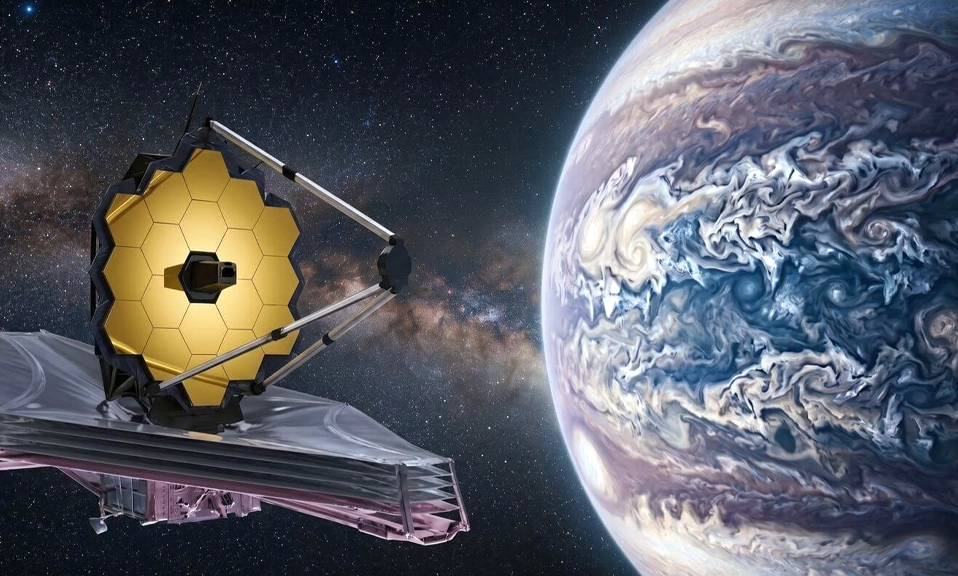
A gas giant nearly eleven times the mass of Jupiter has been hiding in plain sight in data from the James Webb Space Telescope—and it took a new kind of machine learning to finally see it.
The planet is 51 Eridani b, a world orbiting a star roughly 97 light-years away in the constellation Eridanus. It was first discovered in 2015 by ground-based telescopes, but when JWST turned its mirrors toward the system, the planet was nowhere to be found. The star’s blinding glare had swallowed it whole. Now, a team of astronomers has developed a physics-based machine learning framework called FLIP—Physics-based Learning for Imaging Planets—that can strip away that glare, revealing the hidden world in archival JWST data and opening a new chapter in the hunt for distant planets.
The findings were published on November 4, 2026, in the journal Nature.
The Problem: A Firefly Next to a Lighthouse
Finding a planet around another star is not simply a matter of pointing a telescope and looking. The brightest planets are about 100,000 times fainter than their host stars, meaning spotting one is like trying to see a firefly hovering next to a lighthouse. JWST carries a coronagraph—a device designed to block a star’s light—but even that is not enough. Starlight leaks around the edges, creating a haze of scattered light that drowns out faint companions.
For the past two decades, astronomers have tackled this problem by observing a different star and using it as a reference to subtract the glare. But that approach has limits. It assumes the telescope’s optics behave identically from one observation to the next, and it struggles with the subtle, time-varying imperfections that make each image unique. 51 Eridani b, despite being a massive and well-known planet, simply could not be recovered from the JWST data using standard techniques.
The Solution: A Digital Twin of JWST
FLIP takes a different approach. Instead of relying on a reference star, it builds a physics-based “digital twin” of the telescope itself—a software model that simulates exactly how JWST’s optics, coronagraph, and detectors transform incoming light into an image. By understanding the instrument’s behaviour at a fundamental level, FLIP can predict and subtract the starlight with far greater precision than conventional methods.
The result is a dramatic improvement in sensitivity. In tests, FLIP improved the ability to detect faint planets by roughly two to fifteen times compared with standard processing. When applied to JWST’s observations of 51 Eridani, the planet emerged at a wavelength of 4.3 micrometres—a region of the infrared spectrum where carbon dioxide absorbs light—with a signal-to-noise ratio of about 6.3, making it a robust detection.
The team tested FLIP on data from three stars, including 51 Eridani, and in each case the method either recovered known planets or improved the sensitivity of the search.
Why 51 Eridani b Matters
51 Eridani b is not just any planet. It is a young gas giant—the system is estimated to be only about 20 million years old—and it orbits at a distance that makes it a valuable laboratory for understanding how giant planets form and evolve. At roughly 11 Jupiter masses, it sits near the boundary between planets and brown dwarfs, making it a fascinating case study in the grey zone between the two categories.
The planet’s atmosphere is also a target of intense interest. Previous observations have detected water and methane in its spectrum, and the new 4.3-micrometre detection adds carbon dioxide to the list of molecules that can be probed. By studying the composition of young giant planets like 51 Eridani b, astronomers can test models of how planets assemble from the discs of gas and dust that surround newborn stars.
A New Tool for a New Era
The significance of FLIP extends far beyond a single planet. JWST has already observed dozens of stars with known or suspected planetary companions, and many of those observations may contain hidden worlds that standard processing has missed. FLIP offers a way to go back through the archive and recover planets that were previously invisible—data that has already been paid for, already collected, and is just waiting to be re-examined.
The method is also a sign of things to come. As telescopes grow more powerful and the planets we seek grow smaller and fainter, the ability to model and subtract instrumental noise will become ever more important. FLIP is not just a clever trick for one detection. It is a template for how astronomers will extract meaning from the next generation of exoplanet images.
51 Eridani b was never
truly lost. It was there all along, buried in the glare of its star, waiting for a better way to look. The FLIP method—part physics, part machine learning, part digital twin—has finally brought it into the light, and in doing so has given astronomers a powerful new tool for finding the hidden planets that are surely waiting in the JWST archive.
The universe is full of worlds we cannot yet see. With tools like FLIP, we are learning how to see them.