Two faint companions of the Milky Way have been hiding in plain sight—and their discovery, made with just a fraction of the data from a brand-new telescope, suggests that hundreds more may be waiting to be found. The finds offer a tantalizing first glimpse of what astronomers hope will become a complete census of our galaxy’s hidden neighbours.
The discoveries were made by the Vera C. Rubin Observatory, a powerful new facility perched on Cerro Pachón in the Chilean Andes. Using preliminary observations that covered only 7% of the night sky, astronomers identified two previously unknown satellites of the Milky Way: an ultra-faint dwarf galaxy called Aquarius IV and a star cluster named Rubin-GC1.
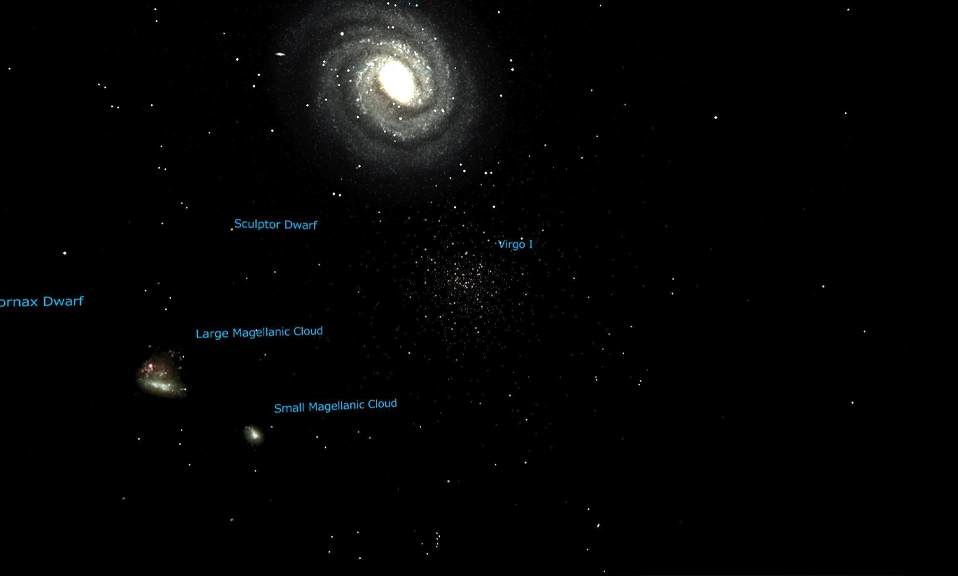
The implications are immediate. Astronomers currently know of about 65 satellite galaxies orbiting the Milky Way. But theoretical models and simulations have long suggested that hundreds more should exist, lurking just beyond the limit of our detection capabilities. These two new objects are the first evidence that Rubin has the power to find them.
The Two Hidden Companions
Aquarius IV is the more distant and intriguing of the pair. It lies approximately 355,000 light-years from Earth, placing it in the far outskirts of the Milky Way’s halo. It is a tiny, low-luminosity system with an ancient, metal-poor stellar population—characteristics that closely resemble the smallest and faintest known ultra-faint dwarf galaxies. Whether it is truly a dwarf galaxy or a globular cluster is not yet certain; the key distinction is the presence of dark matter, which dwarf galaxies possess and globular clusters generally do not. Deeper imaging and spectroscopy will be needed to settle the question.
Rubin-GC1 is a different kind of find. It is a star cluster located on the far side of the Milky Way, hidden within a dense, dusty region of the sky where observations are notoriously difficult. The fact that Rubin detected it through the Milky Way’s bulge—a crowded and obscured part of the sky—is a testament to the observatory’s sensitivity and its ability to pierce through cosmic dust.
Both objects were identified in data collected during the observatory’s commissioning period, before its official survey began. The discoveries were confirmed with follow-up images from the Dark Energy Camera.
A Telescope Built to Find the Invisible
The Vera C. Rubin Observatory is not just another telescope. It houses the 8.4-meter Simonyi Survey Telescope, equipped with the largest digital camera ever built—a 3.2-gigapixel instrument capable of capturing enormous swaths of the sky in extraordinary detail. Its primary mission is the Legacy Survey of Space and Time (LSST) , a 10-year project that will repeatedly image the entire Southern Hemisphere sky, creating an ultra-wide, time-lapse record of the cosmos.
One of LSST’s key scientific goals is to map the Milky Way’s halo—the vast, roughly spherical region of gas, stars, and dark matter that surrounds the galaxy’s main disk. This halo is where the faintest satellite galaxies and star clusters reside, preserving clues about the Milky Way’s formation and assembly history. Rubin’s combination of wide-field imaging and exceptional depth makes it uniquely suited to finding these elusive objects.
The fact that it found two satellites in just 7% of the sky, using preliminary data, is a strong signal of what is to come. As William Cerny, the lead author of the Aquarius IV study, put it: “If the observatory can find systems this faint and difficult with only its preview data, its full 10-year survey will undoubtedly provide us with many more Milky Way satellite discoveries”.
Why Hundreds More Might Be Waiting
The discrepancy between the 65 known satellite galaxies and the hundreds predicted by theory is one of the most persistent puzzles in near-field cosmology. The standard model of cosmology, which successfully explains the large-scale structure of the universe, predicts that a galaxy like the Milky Way should be surrounded by a vast swarm of smaller dwarf galaxies. Yet most of them have never been seen.
There are several reasons for this. Many of these satellites are simply too faint—they contain so few stars, and those stars are so dim, that they are lost in the glare of the Milky Way or in the noise of background objects. Others may be hidden behind thick clouds of interstellar dust, particularly on the far side of the galactic disk, as is the case with Rubin-GC1. And some may be dark galaxies, objects dominated by dark matter with so few stars that they are nearly invisible.
Rubin is designed to overcome all three obstacles. Its large mirror and sensitive camera can detect incredibly faint objects. Its wide field of view allows it to survey large areas of sky quickly. And its repeated observations will help distinguish genuine satellites from background noise and transient events.
The discovery of Aquarius IV and Rubin-GC1 is the first step in closing the gap between theory and observation. If hundreds more satellites are indeed waiting, Rubin is the telescope that will find them.
What the Discoveries Could Reveal
Finding more satellite galaxies is not just about completing a census. These objects are powerful laboratories for testing our understanding of the universe.
Dark matter. Ultra-faint dwarf galaxies are among the most dark-matter-dominated objects known. By studying their structure and dynamics, astronomers can probe the nature of dark matter—the mysterious substance that makes up most of the mass of the cosmos. The discovery of more satellites will provide more data points for testing models of how dark matter behaves on small scales.
Galaxy formation. The smallest dwarf galaxies are relics of the early universe. Their stars are ancient and metal-poor, preserving a record of the conditions that prevailed shortly after the Big Bang. Studying them helps astronomers understand how the first galaxies formed and how the Milky Way assembled its mass over billions of years.
The Milky Way’s history. The halo of the Milky Way is a graveyard of shredded galaxies. When a satellite galaxy falls into the Milky Way, it is torn apart by tidal forces, leaving behind a stream of stars that traces its orbit. By mapping these streams, astronomers can reconstruct the Milky Way’s merger history—a record of the collisions and accretions that built our galaxy.
The discovery of Aquarius IV
and Rubin-GC1 is a milestone, but it is only the beginning. The Vera C. Rubin Observatory has barely started its survey, and already it has found two objects that had eluded detection for decades. The implications are clear: the Milky Way’s neighbourhood is far more crowded than we knew, and the tools to find its hidden inhabitants are finally here.
Hundreds of faint galaxies may be waiting in the dark, and Rubin is the telescope that can see them. The next decade of discoveries will reshape our understanding of the Milky Way, of dark matter, and of the universe itself. The census of our galactic neighbourhood has begun.