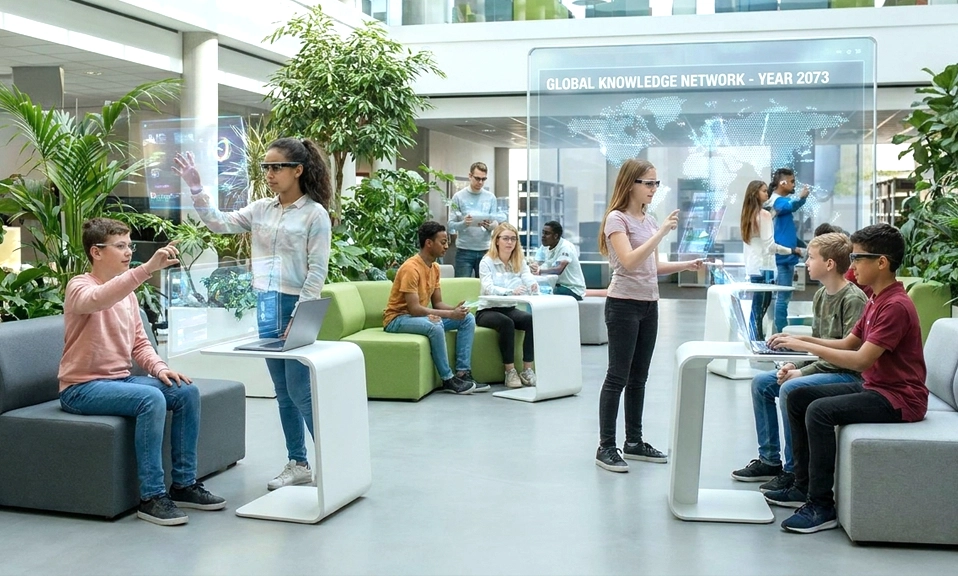
Imagine walking past a high school in the year 2073.
You won’t see a fleet of yellow idling buses. You won’t hear a shrill bell ringing to signal the end of a 45-minute period. And if you peek through the windows, you certainly won’t see 30 teenagers sitting in silent, straight rows, staring at the back of a teacher’s head while taking notes.
If you define “school” as a 19th-century factory model designed to produce obedient industrial workers, then yes: School is dead.
But if you define school as the place where human beings acquire knowledge, build skills, and prepare for life, then education in 2073 is more vibrant, personalized, and effective than at any point in human history.
Nearly 50 years from now, the way we learn will be unrecognizable to anyone educated in the 2020s. Here is what the educational landscape looks like in 2073, and why the traditional classroom had to die so that true learning could live.
🤖 1. The End of “Teaching to the Middle” (The 1-to-1 AI Mentor)
In the early 2020s, a single human teacher was responsible for 25 to 30 students, forcing them to teach to the “middle” of the pack. The fast learners got bored; the struggling learners got left behind.
In 2073, every student is assigned a Lifelong AI Learning Companion from the day they start speaking. This isn’t a clunky chatbot; it is a hyper-intelligent, emotionally aware AI that knows exactly how the student’s brain works.
- If a student learns best through visual storytelling, the AI generates a custom historical narrative.
- If they struggle with calculus, the AI instantly pivots to explain it using the physics of their favorite virtual sport.
- The AI tracks their cognitive load, adjusting the difficulty in real-time to keep them in the perfect “flow state.”
The result? The concept of “falling behind” or “failing a class” is practically obsolete. Students master subjects at their own unique pace.
🌍 2. “Field Dives” Replace Textbooks (Immersive Experiential Learning)
Why read a 40-page chapter about the construction of the Pyramids or the biology of a coral reef when you can be there?
By 2073, lightweight, haptic-feedback neural wearables have replaced the textbook and the flat-screen monitor. When students study the Roman Empire, they don’t memorize dates; they put on their rigs and walk through a 1:1 scale, historically accurate simulation of the Forum, interacting with AI-driven historical figures.
Biology students don’t just look at diagrams of cells; they shrink down to the microscopic level and “swim” through a human bloodstream to watch white blood cells fight off a pathogen in real-time. Education has shifted from memorization to experience.
🏢 3. The Physical School Becomes a “Collaboration Hub”
So, if the AI does the teaching and the VR does the experiencing, do physical school buildings still exist? Yes, but their purpose has completely changed.
Students no longer go to a building to sit and listen to lectures. They go to Collaboration Hubs. These spaces look less like classrooms and more like a cross between a modern tech startup, a maker-space, and a community center.
Students go to these physical hubs to:
- Build physical robots and engineer projects with their hands.
- Play sports, run, and engage in physical socialization.
- Collaborate on complex, multi-disciplinary group projects that require human empathy, debate, and teamwork.
- Receive emotional support and mentorship from human guides.
The physical school is no longer a place of passive consumption; it is a place of active creation and human connection.
🎓 4. The Death of the “Grade” and the 4-Year Degree
In 2073, the concept of being “in 10th grade” is laughable. Why should a 15-year-old who is a genius at coding but struggles with reading be forced to learn at the exact same pace as their peers in both subjects?
Education is entirely mastery-based. You don’t move on because the semester ended; you move on because you proved you mastered the skill.
Furthermore, the traditional four-year university degree has been replaced by a Continuous Skill Wallet. Instead of spending four years and hundreds of thousands of dollars to get a piece of paper, young adults engage in continuous, modular micro-learning. Every time they master a new skill, pass a rigorous simulation, or complete a real-world project, a verified credential is added to their blockchain-backed digital portfolio. Employers don’t hire based on a college name; they hire based on a verified, real-time map of the candidate’s actual abilities.
🧑🏫 5. The Human Teacher’s Renaissance
If AI handles the lecturing, the grading, and the curriculum mapping, what happens to human teachers? They become the most important people in the room.
Freed from the exhausting administrative burden of grading papers and writing lesson plans, the human educator’s role evolves into that of a Learning Architect and Mentor.
- They teach philosophy, ethics, and emotional intelligence—things AI cannot authentically model.
- They facilitate complex group dynamics and help students resolve interpersonal conflicts.
- They provide the crucial human empathy, encouragement, and psychological safety that a machine cannot replicate.
Teaching in 2073 is no longer a underpaid, high-burnout job. It is a highly respected, elite profession focused entirely on human development and mentorship.
We Finally Fixed the Factory
For over a century, we tried to force the beautiful, chaotic, diverse spectrum of human intelligence into a standardized, industrial box. We judged fish by their ability to climb trees, and we bored the birds by making them swim.
Education in 2073 isn’t about abandoning structure; it’s about replacing a rigid, outdated structure with a fluid, responsive one. By leveraging AI for personalization, immersive tech for experience, and human mentors for connection, we haven’t destroyed school.
We have finally allowed it to become what it was always meant to be: a place where every single human being can discover exactly what they are capable of.