You’ve seen the influencers on social media gliding effortlessly across reformer machines, looking like graceful, elongated gazelles. It looks beautiful, but it can also look incredibly intimidating.
Because of this, many people write Pilates off, thinking, “I’m not flexible enough,” or “I don’t have the core strength for that.”
Here is the secret the fitness industry doesn’t always tell you: You don’t do Pilates because you’re already strong and flexible; you do Pilates to become strong and flexible.
Pilates is the ultimate equalizer. It’s not about how many reps you can crush or how much weight you can lift. It’s about control, precision, and connecting your mind to your “powerhouse” (your deep core muscles).
You don’t need a fancy studio or a $5,000 reformer machine. All you need is a mat, 30 minutes, and a willingness to move with intention. Here is your complete, beginner-friendly, 10-exercise Pilates flow to build a bulletproof core.
🧘♀️ Before You Begin: The 3 Golden Rules of Pilates
Before we get to the moves, you need to understand how to do them. Pilates is entirely different from traditional cardio or weightlifting.
- The Breath is the Boss: In Pilates, we use “lateral rib breathing.” Inhale deeply through your nose, expanding your ribs out to the sides (like an accordion). Exhale fully through pursed lips (like you’re blowing out a candle), actively pulling your navel in and up toward your spine. Rule of thumb: Exhale on the effort.
- Control Over Speed: Slow and controlled beats fast and sloppy every time. If you are swinging your limbs, you are using momentum, not your core. Slow it down.
- Find Your “Powerhouse”: Before every movement, gently draw your lower belly in and up, as if you are zipping up a tight pair of jeans. This engages the transverse abdominis (your body’s natural corset).
🧱 The 30-Minute Beginner Mat Flow
Instructions: Perform each exercise for 45 seconds, followed by 15 seconds of rest and transition. That gives you exactly 30 minutes for the full circuit. Do 1 to 2 rounds depending on your fitness level.
1. Pelvic Curls (The Warm-Up)
Target: Lower back mobility, glutes, and deep core connection.
- How to do it: Lie on your back, knees bent, feet hip-width apart. Inhale to prepare. Exhale, engage your core, and peel your spine off the mat one vertebra at a time until you are in a straight line from knees to shoulders. Inhale at the top. Exhale and slowly roll back down, imprinting each vertebra into the mat.
- Beginner Mod: If you feel pinching in your lower back at the top, don’t push your hips as high. Just find a comfortable mid-range and roll down.
2. Dead Bugs (The Core Stabilizer)
Target: Transverse abdominis (the deep core) and coordination.
- How to do it: Lie on your back, arms reaching straight up to the ceiling, knees bent at 90 degrees (tabletop position). Exhale, press your lower back firmly into the mat, and slowly extend your right leg straight out and lower your right arm overhead. Inhale to return to the start. Exhale and switch sides.
- Beginner Mod: Keep your lower back glued to the floor. If it arches, don’t lower your leg as far. Or, keep both feet on the floor and just practice the arm movements.
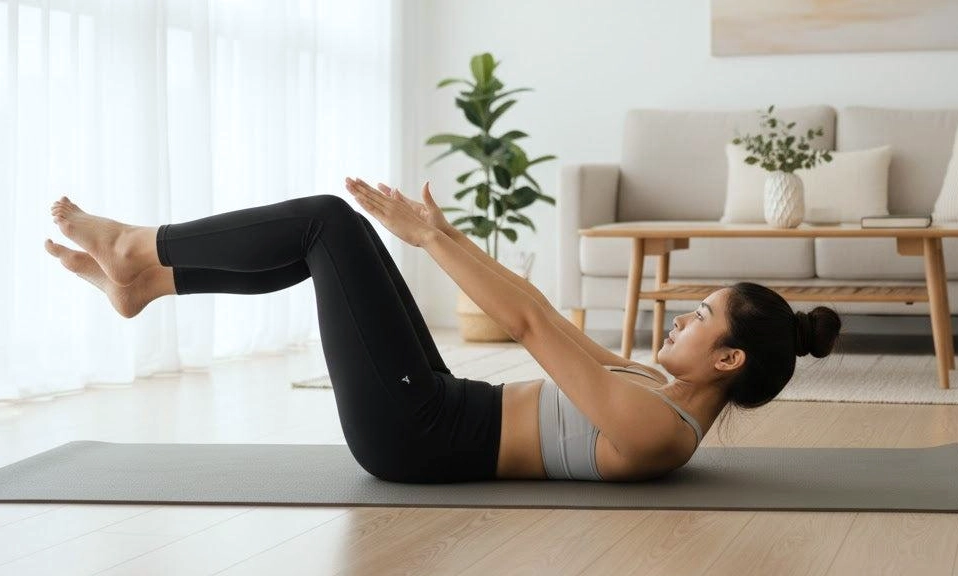
3. The Hundred (Beginner Version)
Target: Core endurance, circulation, and breath control.
- How to do it: Lie on your back, bring your knees to your chest, then extend your legs out at a 45-degree angle (or keep them in tabletop if that’s too hard). Lift your head, neck, and shoulders off the mat. Reach your arms straight out by your hips. Pump your arms up and down in a small, controlled motion. Inhale for 5 pumps, exhale for 5 pumps. Goal: 100 pumps total.
- Beginner Mod: Keep your feet flat on the floor and your head/neck resting on the mat if your neck gets tired. Just focus on the arm pumps and the breath.
4. Single Leg Circles
Target: Hip flexor mobility and core stability (keeping the pelvis still).
- How to do it: Lie on your back, arms by your sides. Extend one leg straight up to the ceiling. Keep the other leg glued to the mat. Draw a small circle with your raised leg, leading with the inner thigh. Do 5 circles one way, then 5 circles the other way. Switch legs.
- Beginner Mod: Make the circles tiny. The goal is not to let your hips wiggle or your lower back arch. If your hips move, shrink the circle.
5. Half Roll-Back (The Teaser Prep)
Target: Upper and lower abdominals, spinal articulation.
- How to do it: Sit tall with your knees bent, feet flat on the floor. Hold the backs of your thighs. Inhale to sit tall and lengthen your spine. Exhale, scoop your belly in, and roll your spine back just until your elbows hover over your mat (your back should be rounded like a “C”). Inhale here. Exhale and use your core to roll back up to sitting tall.
- Beginner Mod: Only roll back an inch or two. The moment you feel your lower back rounding or your neck straining, roll back up.
6. Single Leg Stretch
Target: Lower abs, hip flexors, and coordination.
- How to do it: Lie on your back, head and shoulders lifted. Hug your right knee into your chest while extending your left leg straight out at a 45-degree angle. Switch legs in a controlled, rhythmic motion: switch, switch, switch, switch. Keep your core engaged and your lower back heavy on the mat.
- Beginner Mod: Keep both knees bent and just alternate tapping your toes lightly on the floor, or hold onto the backs of both thighs and gently pull them in and extend them out.
7. Glute Bridge with Marching
Target: Posterior core, glutes, and pelvic stability.
- How to do it: Lie on your back, knees bent, feet flat. Exhale and lift your hips into a high bridge. Keep your hips elevated and stable. Inhale as you lift your right foot an inch off the floor. Exhale as you place it down and lift the left foot. Continue “marching” in the air without letting your hips drop or wiggle.
- Beginner Mod: Just hold the static bridge at the top, focusing on squeezing your glutes and keeping your core tight, without the marching.
8. Modified Side Plank
Target: Obliques (side abs) and shoulder stability.
- How to do it: Start on your right side, legs bent at 90 degrees behind you. Prop yourself up on your right forearm. Exhale, engage your core, and lift your hips off the mat so your body forms a straight line from your head to your knees. Hold for 3 breaths, then lower. Switch sides.
- Beginner Mod: Keep your bottom knee bent and your hips resting on the mat, just focus on lifting your top arm to the ceiling and rotating your ribcage open.
9. Bird-Dog
Target: Back extensors, deep core, and balance.
- How to do it: Come onto your hands and knees (tabletop position). Keep your spine neutral (like a flat table). Exhale and extend your right arm forward and your left leg straight back. Hold for one breath, keeping your hips perfectly square to the floor. Inhale to return to the start. Exhale and switch sides.
- Beginner Mod: Only extend the arms, or only extend the legs. If doing both, don’t worry about how high the leg goes; focus entirely on keeping your back flat and not rocking side to side.
10. Seated Spine Twist (The Cool Down)
Target: Obliques, spinal mobility, and chest opening.
- How to do it: Sit tall with your legs extended straight out in front of you (or cross-legged if that’s more comfortable). Inhale and reach both arms out to the sides, lengthening your spine. Exhale and twist your torso to the right, placing your right hand behind your hip and your left hand on your right knee. Inhale to center, exhale and twist to the left.
- Beginner Mod: Bend your knees slightly, or keep your hands resting on your thighs for support. Focus on twisting from your ribs, not just yanking your neck around.
🧘♀️ The Aftermath: How You Should Feel
When you finish that final spine twist, take a moment to just lie flat on your back in “Savasana” (resting pose). Close your eyes, let your breath return to normal, and notice how your body feels.
You should feel a deep, satisfying fatigue in your core, a sense of length in your spine, and a calm, centered mind. That is the “Pilates effect.”
Consistency is the Magic Pill
Pilates is not a workout you do once and see massive changes. It is a practice. It’s about retraining your nervous system to move with control, align your posture, and protect your joints.
If you commit to doing this 30-minute flow just 2 or 3 times a week, you will be shocked at the changes you see in just four weeks. Your posture will improve, your lower back pain will likely decrease, and you’ll develop a core strength that supports you in every other area of your life.
Roll out your mat, find your breath, and start building your powerhouse today.