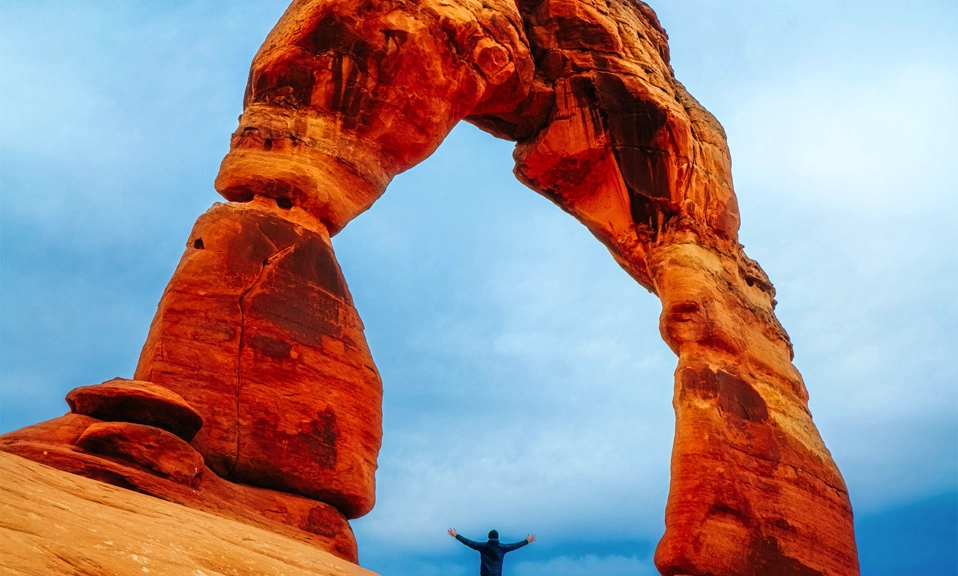
If you’ve ever seen a Utah license plate, a National Park Service poster, or a classic Western film, you know the silhouette.
Standing 45 feet tall and spanning 33 feet, Delicate Arch is arguably the most famous natural arch in the world. To a casual observer scrolling through Instagram, it might just look like a spectacular, if slightly precarious, rock formation.
But to stand beneath it, to feel the desert wind whip through its opening, and to watch the sandstone ignite in fiery hues of red and orange at sunset, is to realize a profound truth: Delicate Arch is not just a rock. It is a monument to time, a testament to human endurance, and a fragile symbol of the wild American West.
Here is why this iconic formation is so much more than geology.
1. A Masterpiece of “Deep Time” ⏳
Yes, it’s made of Entrada Sandstone. But calling Delicate Arch “just a rock” is like calling the Mona Lisa “just paint.”
This arch is the surviving fragment of a massive sandstone fin that began forming over 100 million years ago. It was shaped by an agonizingly slow, relentless process: water seeped into microscopic cracks, froze, expanded, and shattered the rock from the inside out (a process called frost wedging). Wind and rain then swept away the debris, slowly carving out the iconic shape we see today.
When you look at Delicate Arch, you aren’t just looking at a landscape; you are looking at a clock. It is a physical manifestation of deep time, reminding us of nature’s patient, unstoppable power to create beauty through destruction.
2. A Sacred Landmark with Deep Human Roots 🪶
Long before it was a tourist destination, this landscape was home.
For thousands of years, Indigenous peoples, including the Ute and Paiute tribes, traversed this region. While the arch itself wasn’t necessarily a site of permanent settlement due to the lack of water, it served as a vital landmark in a vast, unforgiving desert.
Later, in the 19th century, it guided cowboys, explorers, and pioneers along the treacherous routes of the Old Spanish Trail. In the 1920s, it was a prospector named Alexander Ringhoffer who, upon seeing the arch, was so moved that he lobbied the railroad and the government to protect the area, directly leading to the creation of Arches National Park.
The arch is a silent witness to millennia of human history, survival, and reverence.
3. The Pilgrimage: A Rite of Passage 🥾
Part of what makes Delicate Arch so special is that it doesn’t give itself up easily. You can’t drive right up to it.
The 3-mile round-trip hike is a moderate but demanding climb. You traverse exposed slickrock, navigate steep switchbacks, and feel the relentless sun of the high desert. Your legs burn, your water bottle empties, and your breath shortens.
But then, you round the final sandstone fin, and there it is.
The physical effort required to reach the arch transforms the experience from simple sightseeing into a pilgrimage. The sweat and exertion make the payoff profoundly earned. It teaches a quiet lesson: the most beautiful things in life often require a little struggle to reach.
4. A Paradox of Strength and Fragility 🍃
The name “Delicate” isn’t just a poetic flourish; it’s a warning.
While the arch has survived for millennia, it is geologically temporary. The same forces of erosion that carved it are actively working to destroy it. One day, gravity will win, and the arch will collapse, returning to the desert floor as a pile of rubble.
This inherent fragility makes it a powerful metaphor. It reminds us that beauty is fleeting and that the natural world, while majestic, is vulnerable. In an era of climate change and overcrowded national parks, Delicate Arch stands as a silent plea for conservation. Every footstep on cryptobiotic soil, every carved initial, and every drop of wasted water chips away at the very environment that sustains it.
5. A Mirror for the Human Spirit 🌅
Why do millions of people make the journey to stand beneath this arch?
Because in a world that is increasingly digital, noisy, and artificial, Delicate Arch offers something rare: absolute, grounding reality.
When the sun dips below the horizon and the arch glows like a neon ember against a deep purple sky, people don’t just take photos. They go quiet. They hug their loved ones. They sit in the dirt and just breathe.
The arch acts as a frame. When you look through it, you see the La Sal Mountains in the distance, a reminder of the vastness of the world. But when people take photos of the arch, they are often really capturing their own small, awe-struck place within that vastness. It puts our daily stresses, our inbox notifications, and our modern anxieties into a humbling, beautiful perspective.
Delicate Arch
is a geological accident, yes. But it is also a cultural touchstone, a historical landmark, a physical challenge, and a spiritual anchor.
It is more than just a rock. It is a reminder that we are part of a much larger, older, and more magnificent story. And it is our responsibility to ensure that this delicate masterpiece remains standing for the generations of pilgrims yet to come.
Have you made the hike to Delicate Arch? What did you feel when you finally rounded that last corner and saw it?