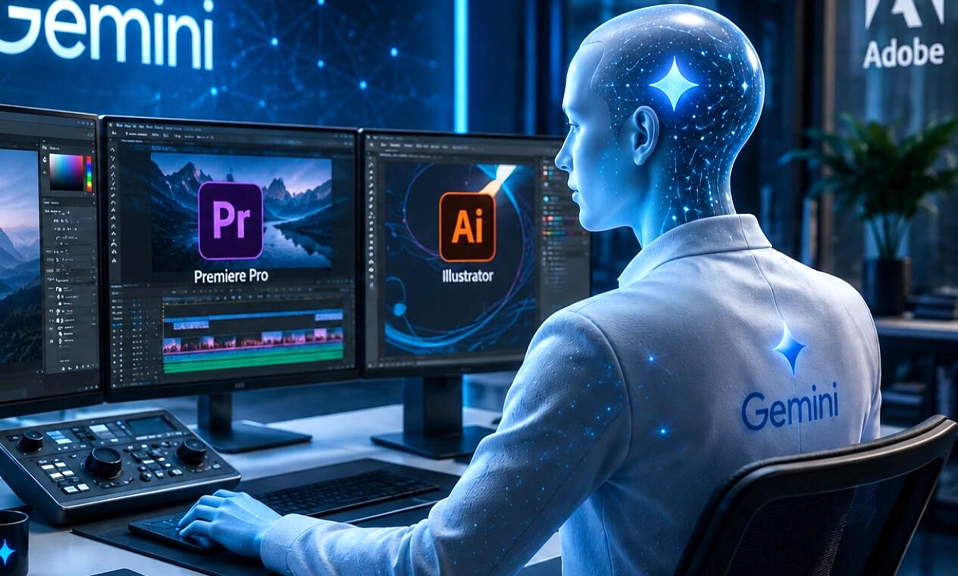
Adobe has just made its most significant move yet into the era of agentic AI. At Adobe MAX on November 10, 2026, the company announced that it is opening up Photoshop, Illustrator, Premiere, and After Effects to third-party AI assistants through a new local Model Context Protocol (MCP) integration . In plain terms, the AI assistants you already use—like ChatGPT, Claude, or Gemini—will soon be able to directly open your native project files and make changes to them on your computer, with every layer, vector, and sequence remaining fully editable .
This is not a subtle feature update; it is a philosophical pivot. Adobe is moving from a world where AI is a tool inside its software to a world where its software is a tool for external AI agents.
🤖 What Adobe Actually Announced
The headline is the MCP integration. The Model Context Protocol is an open standard that allows AI agents to use other software, and Adobe’s implementation is local, meaning the agent works on your machine rather than sending your files to a third-party cloud . The integrations are currently in preview, with a private beta slated for early 2027 .
But the MCP announcement is only one part of a broader agentic strategy.
Adobe’s Own Creative Agent. Adobe is not just opening the door to outside agents; it is also expanding its own. The Adobe Creative Agent is being rolled out across Creative Cloud, powering an AI Assistant in Photoshop, Illustrator, Premiere, InDesign, After Effects, and Frame.io . This agent is designed to handle the “countless production tasks” that consume creative time—organizing assets, batch-renaming layers, resizing for different formats, and running preflight checks—so that designers can focus on craft . In Photoshop, for example, you can describe a desired outcome like “batch background removal” or “asset resizing,” and the agent executes it across the entire composition .
“Always-On” Agents. Perhaps the most ambitious preview is the concept of “always-on” agents that can perform recurring tasks continuously in the background . You could assign an agent to automatically turn incoming images into promotional graphics for different social channels, check in daily to review its work, and select the best results to publish . Adobe has not specified a launch date for this feature, but it says it will come to the Firefly AI Assistant first .
Firefly Design (Beta). Adobe also introduced Firefly Design, an all-in-one workspace that brings illustration, image editing, animation, 3D, and print onto a single canvas . The goal is to reduce the friction of switching between different tools and to keep live-linked Photoshop and Illustrator files connected within a unified environment .
🎨 The Demo: Nine Artboards in Nine Minutes
To illustrate what this looks like in practice, Adobe showed a demo of ChatGPT working inside the Photoshop beta app . A user asked it to create versions of a DJ party poster for two additional DJs, each requiring a new photo, name, city background, and date. ChatGPT opened the Photoshop file, used the photos and backgrounds already in the layers, translated the São Paulo poster into Portuguese, and resized all three posters into two more formats. The result was nine editable artboards in the same file, after 9 minutes and 11 seconds of work .
The key detail is that the output remained fully editable. At any point, the user could step in and manually refine the work . This is not a “generate and done” workflow; it is a supervised automation model where the agent handles the production labor and the human handles the creative judgment.
⚖️ Could AI Soon Do All Your Graphic Design Work?
This is the question that matters most, and the answer is more nuanced than a simple yes or no. The evidence suggests that AI is not replacing designers wholesale, but it is redistributing the work .
The Case for Concern. Adobe’s own research paints a picture of a profession in transition. US creative professional job postings rose 8% between September 2025 and April 2026, which is a positive signal for demand . However, the nature of that demand is shifting. The research found that “clients are expecting faster work for some deliverables,” with pitch deadlines shrinking from weeks to days, and “a growing tier of acceptable-but-unremarkable AI work overtaking smaller projects like social media posts” . This suggests that the entry-level production work that has traditionally been the training ground for junior designers is being automated away. As one analysis put it, “the bottom is compressing fast” .
The Case for Optimism. The same Adobe research found that 84.8% of US creative professionals feel positively about AI, particularly for brainstorming . The technology is being used to check originality, to handle repetitive tasks, and to free up time for the work that requires taste, judgment, and vision . Adobe’s framing is consistent: the Creative Agent is designed to “reduce production complexity so you can focus on the work that requires your craft, taste, judgment and direction” . The agent is a collaborator, not a replacement.
The Skills Shift. The skills that will matter most in this new landscape are not the ones that can be easily automated. Clear written instructions, design systems thinking, and the ability to direct and evaluate AI output are becoming more valuable . The career ladder is changing: the traditional path from production designer to art director is still viable, but the rungs are different . Designers who can orchestrate agents, define brand rules, and exercise creative judgment will thrive. Those who can only execute production tasks will struggle.
💎 A New Medium, Not a Replacement
Adobe’s move to open Creative Cloud to AI assistants is a bet that the future of design is not a single, all-knowing AI that does everything for you. It is a future of interoperability, where you use the AI tools you prefer, and those tools work seamlessly within the professional software you rely on.
The honest answer to “could AI soon do all your graphic design work?” is: it could do the production work, but it cannot do the design work. It can resize a poster, translate text, and organize layers. It cannot decide what the poster should say, why it matters, or how it should make someone feel. The agents are powerful, but they are only as good as the creative direction they are given.
The designers who will succeed in this new era are not the ones who resist the agents. They are the ones who learn to direct them—who use the time freed up by automation to think more deeply, experiment more boldly, and apply the kind of taste and judgment that no model can replicate. Adobe has built a powerful new set of tools. What matters now is what designers choose to do with them.