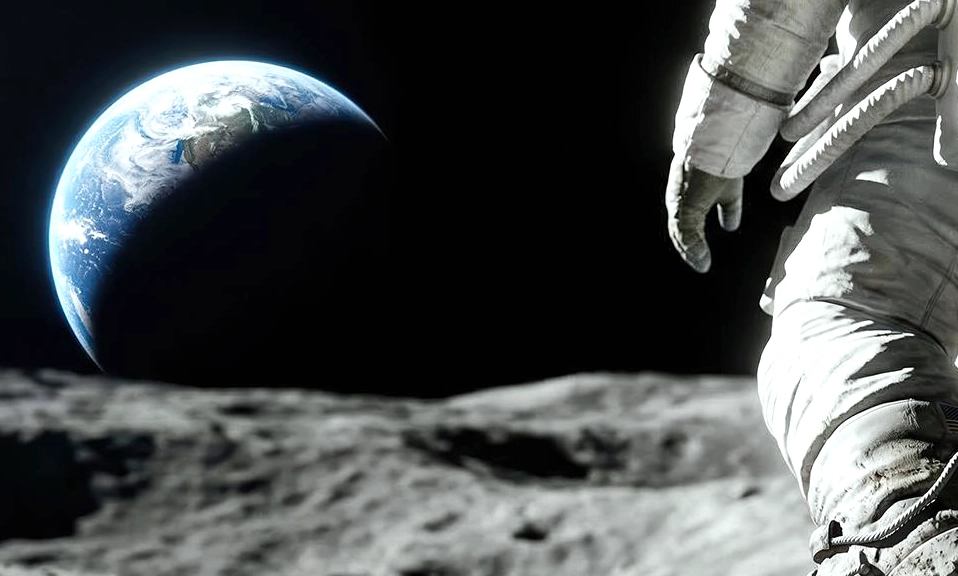
The search for extraterrestrial intelligence has spent sixty years listening to the sky. Now, a team of scientists is proposing something radically different: stop listening, and start sifting. Their target is not a distant star or a radio signal from deep space. It is the fine, grey dust beneath our feet—or rather, beneath the boots of future astronauts. The Moon, they argue, may be the galaxy’s most patient collector of alien debris, and the evidence of civilizations long gone could be hiding in plain sight, in particles smaller than a grain of sand.
The idea comes from a study led by Lewis Pinault, an affiliate scientist at the SETI Institute and a researcher at Birkbeck College, University of London. The paper, published on the arXiv preprint server in August 2026 and currently undergoing peer review for the International Journal of Astrobiology, does not claim to have found anything. What it does claim is that the search for “microscopic technosignatures” in lunar soil is no longer a thought experiment. It is a testable scientific hypothesis.
Why the Moon?
The logic rests on a simple geological fact: the Moon is a terrible place to be a rock, and a wonderful place to be a fossil. Unlike Earth, it has no atmosphere to burn incoming objects to vapor, no flowing water to wash them away, and no plate tectonics to bury them under mountains or recycle them into the mantle. For roughly four billion years, it has been quietly accumulating material from the solar system and interstellar space, layer by layer, like a natural archive.
If an advanced civilization ever existed elsewhere in the galaxy, the argument goes, it would have produced debris. Some of that debris—whether intentionally engineered or simply the waste of large-scale space infrastructure—could have drifted through interstellar space and eventually settled on the lunar surface. “The moon has been quietly accumulating material from space for billions of years, much of it likely billions of years older than the moon itself,” Pinault said. “We’re asking whether that ancient collection might contain microscopic traces of technologies that existed long before humans ever looked up at the sky”.
Two Kinds of “Smart Dust”
The paper distinguishes between two types of particles.
The first is the Arkhipov Particle, named after Ukrainian astronomer Alexei Arkhipov, who proposed in the 1990s that the Moon could collect interstellar dust of artificial origin. These are fragments of unintentional industrial debris—the worn-down remnants of a Dyson swarm, a planet-wide mining operation, or some other megastructure that eroded over millions of years. As the civilization collapsed or its infrastructure degraded, clouds of particles would have been released into the galaxy, “akin to the microplastics in Earth’s oceans,” as the New York Times put it.
The second is the Bracewell Particle, named after physicist Ronald Bracewell. These are not debris but intentionally sent probes—”smart dust” designed to travel to other star systems and perhaps observe or communicate. If such particles exist, the Moon would be a natural destination, a place where they could sit undisturbed for eons.
One Cubic Meter
The most striking claim in the paper is quantitative. Using computer models, the team estimated that a single cubic meter of lunar regolith could be enough to find at least one such fragment. That is a volume roughly the size of a small refrigerator. It is a sample size that future missions could plausibly collect and return.
The detection method would combine microscopy, industrial materials analysis, and AI-assisted imaging. The particles would be tiny—models suggest fragments up to three micrometres across could survive the journey through interstellar space for up to a billion years before reaching our solar system. They would need to be made of durable materials like advanced ceramics, graphene, or titanium-tungsten to withstand the radiation and dust impacts of deep space. Finding them would require looking for materials and structures that do not occur naturally—a signature of engineering, not geology.
The Caveats
It is important to be clear about what this study is not. It is not evidence of aliens. The SETI Institute’s own statement is explicit: “The study reports no evidence of extraterrestrial technology. Instead, it demonstrates that searching for these microscopic technosignatures is now scientifically testable”.
The paper is also not yet peer-reviewed, and the detection scenario is theoretical. No existing lunar samples have been examined for this kind of material, and the authors note that previous samples were likely too small to yield meaningful results. The upcoming Artemis missions and China’s Chang’e-7 will collect fresh samples, but in volumes far smaller than the cubic meter the study recommends. A permanent lunar base—planned by both the US and China within the next decade—may ultimately be needed to gather enough material.
There is also the question of survival. The journey from another star system to our Moon is a gauntlet of cosmic rays and high-velocity dust impacts. Most materials would be destroyed. Only the most refractory, durable substances could survive the trip—which is precisely why finding one would be so significant.
A New Direction for SETI
The study represents a philosophical shift in the search for extraterrestrial intelligence. Traditional SETI listens for radio signals from civilizations that are alive now, in a galaxy that is 13 billion years old. The odds of overlapping in time with a broadcasting civilization are, as Universe Today put it, “a huge leap of faith”.
Searching for physical debris, by contrast, opens a window onto all of galactic history. A civilization that existed a billion years ago and vanished without a trace could still have left particles that drifted across the galaxy and settled on the Moon. “If any other technological civilization has ever existed in our galaxy,” Pinault said, “it’s not an unreasonable hypothesis to think that particles of them are on the moon in some quantity”.
Sofia Sheikh, a SETI Institute scientist who studies technosignatures, called the idea “a creative and worthwhile avenue,” particularly given the renewed interest in the Moon from the Artemis program. And the SETI Institute itself described the concept as “extraordinarily original and eminently reasonable”.
Could alien technology
be hiding in Moon dust? The honest answer is: we don’t know, and no one has looked. But for the first time, there is a concrete, testable way to find out. The Moon has been collecting the galaxy’s debris for four billion years. If any of that debris was engineered by another intelligence, a cubic meter of regolith might be enough to prove it.
The search would not be easy. It would require new missions, new instruments, and a willingness to sift through the mundane in the hope of finding the extraordinary. But the payoff—the first physical evidence of a civilization beyond Earth—would be incalculable. The sky has been silent for sixty years. Perhaps it is time to look down.