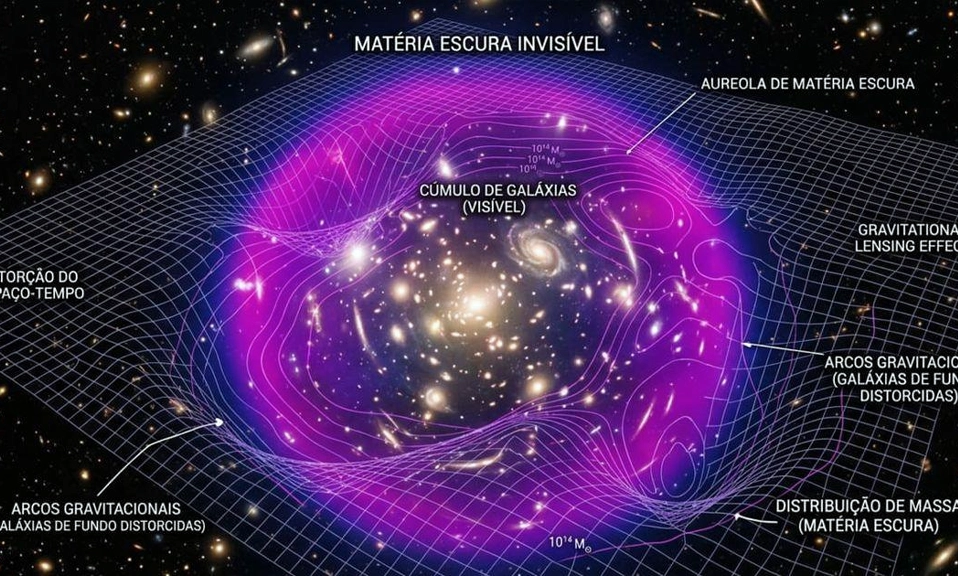
You cannot see it. You cannot touch it. It does not emit, absorb, or reflect light. And yet, without it, the universe as we know it would not exist. Dark matter is the invisible scaffolding that holds galaxies together, shapes the cosmic web, and dictates the fate of the cosmos. It makes up roughly 27% of everything in the universe—five times more than all the ordinary matter that makes up stars, planets, and people. And after decades of searching, we still do not know what it is.
This is the story of the greatest unsolved problem in modern physics: the mystery of the missing mass.
What Is Dark Matter?
Dark matter is a form of matter that does not interact with light or the electromagnetic force. It is completely transparent—light passes through it as if it were not there. It does not form atoms. It does not clump into stars or planets. It does not produce any radiation we can detect.
But it does have mass. And that mass exerts gravity. That is the only way we know it exists—through its gravitational pull on the visible universe.
The concept dates back to the 1930s, when Swiss astronomer Fritz Zwicky noticed that galaxies in the Coma Cluster were moving far too fast for the amount of visible mass they contained. The cluster should have flown apart. Something invisible was holding it together. Zwicky called it dunkle Materie—dark matter. His colleagues largely ignored him.
Four decades later, astronomer Vera Rubin made the discovery that changed everything. She measured the rotation speeds of stars in spiral galaxies and found that the outer stars were moving just as fast as the inner ones. According to Newtonian physics, they should have slowed down. The only explanation was a vast halo of invisible mass surrounding each galaxy—dark matter. Her work transformed the field and made dark matter an accepted part of cosmology.
The Evidence: How We Know It’s There
We cannot see dark matter directly, but its gravitational effects are everywhere. Here are the four pillars of evidence.
Galaxy rotation curves. Stars in the outer regions of spiral galaxies orbit at roughly the same speed as stars near the center. This is only possible if the galaxy sits inside a massive, invisible halo of dark matter. Visible matter alone would produce a rotation curve that drops off at the edges. The observed flat curves are one of the most robust pieces of evidence for dark matter.
Gravitational lensing. Massive objects bend light. When a galaxy cluster lies between Earth and a distant background galaxy, its gravity distorts the background galaxy’s image into arcs, rings, or multiple copies. The amount of lensing tells astronomers how much mass is in the cluster—and it consistently shows that the total mass is five to six times greater than the visible mass. In 2026, the Euclid space telescope released a catalog of over 15,000 strong gravitational lensing candidates, the largest ever assembled, giving scientists an unprecedented tool for weighing dark matter in galaxies across the sky.
The cosmic microwave background. The afterglow of the Big Bang is not perfectly uniform. It has tiny temperature fluctuations that encode the ratio of ordinary matter to dark matter in the early universe. Those fluctuations match the predictions of a universe with about five times more dark matter than ordinary matter.
Structure formation. Computer simulations of the universe that include dark matter produce a cosmic web of filaments, clusters, and voids that looks remarkably like the real universe. Simulations without dark matter produce a universe that is far too smooth. Without dark matter’s gravitational scaffolding, galaxies could never have formed in the time available since the Big Bang.
What Could Dark Matter Be?
The search for the nature of dark matter has produced a long list of candidates. None has been confirmed. Here are the leading contenders.
Weakly Interacting Massive Particles (WIMPs). For decades, WIMPs were the leading candidate. These hypothetical particles would have mass similar to a heavy atomic nucleus but interact only through gravity and the weak nuclear force. They would be produced in the early universe and still be around today. But decades of increasingly sensitive experiments—underground detectors, particle colliders, and space-based observatories—have found no sign of them. The WIMP window is narrowing, and many physicists are looking elsewhere.
Axions. Axions are extremely light particles that were originally proposed to solve a different problem in particle physics. They are now a leading dark matter candidate. Experiments like ADMX are searching for axions by converting them into detectable microwave photons in strong magnetic fields. No detection yet, but the search is expanding.
Sterile neutrinos. A hypothetical fourth type of neutrino that does not interact via the weak force. It could be dark matter if its mass is in the right range. Experiments are looking for the subtle X-ray signature that a decaying sterile neutrino would produce.
Primordial black holes. Instead of a new particle, dark matter could be made of black holes formed in the first fraction of a second after the Big Bang. These would be small—much smaller than stellar-mass black holes—but they would still exert gravity. Observations of gravitational waves and microlensing are testing this idea, but the mass range allowed by current data is narrowing.
Modified gravity. A small but persistent minority of physicists argue that dark matter is not a substance at all, but a sign that our theory of gravity is incomplete. Modified Newtonian Dynamics (MOND) and its relativistic extensions can explain galaxy rotation curves without dark matter. But they struggle to explain galaxy clusters, the cosmic microwave background, and the large-scale structure of the universe. Most cosmologists accept that dark matter is real, but the debate has not been settled entirely.
The Search: Where We Stand in 2026
The search for dark matter is one of the largest and most expensive endeavours in modern physics. It involves underground detectors in abandoned mines, particle accelerators, space telescopes, and observatories buried in Antarctic ice.
Direct detection experiments, like LZ and XENONnT, sit deep underground and wait for a dark matter particle to collide with a nucleus in a tank of liquid xenon. They have not seen anything yet, but they have ruled out large swaths of the WIMP parameter space.
Indirect detection looks for the products of dark matter annihilation or decay in space—excess gamma rays from the galactic center, or unusual X-ray emissions from galaxy clusters.
Collider searches at the Large Hadron Collider look for missing energy that would indicate dark matter particles being produced in high-energy collisions.
Astronomical surveys like Euclid are mapping the distribution of dark matter on the largest scales, using lensing and galaxy clustering to infer its properties.
The null results are frustrating, but they are also informative. They are telling us what dark matter is not, and in doing so, they are narrowing the search.
A Mystery Worth Solving
Dark matter is not a minor anomaly. It is the dominant form of matter in the universe. It shaped the cosmic web, it holds galaxies together, and it will determine the ultimate fate of the cosmos. We do not know what it is, but we know it is there.
The search for dark matter is one of the most compelling stories in modern science—a story of invisible mass, of galaxies that should fly apart, of particles that might be passing through you right now by the billions every second. It is a reminder that the universe is not only stranger than we imagine, but stranger than we can imagine.
And it is a reminder that the most important discoveries are often the ones we cannot see.