Let’s be honest: when you hear the name “Dead Bug,” you probably don’t picture a hardcore, results-driven fitness move. It sounds like something you’d do while lying in bed on a lazy Sunday.
But don’t let the silly name fool you. The Dead Bug is arguably the most effective, spine-safe, and functional core exercise you can do.
While flashy exercises like sit-ups and crunches often lead to neck strain and lower back pain, the Dead Bug does the exact opposite. It teaches your core to do its actual job: stabilizing your spine while your limbs move.
Whether you are dealing with lower back pain, trying to improve your squat, or just want to build a stronger, more functional midsection, the Dead Bug is your new best friend. Here is your complete guide to mastering it.
🐞 Why the Dead Bug is a Core Game-Changer
Before we get to the “how,” let’s talk about the “why.” Why do physical therapists and elite strength coaches love this exercise so much?
1. It Targets the “Internal Corset” Most ab exercises target the rectus abdominis (the superficial “six-pack” muscles). The Dead Bug targets the transverse abdominis (TVA). The TVA wraps around your midsection like a natural weightlifting belt. Strengthening it pulls your waist in tight and provides a solid foundation for all other movements.
2. It Bulletproofs Your Lower Back The primary goal of the Dead Bug is “anti-extension.” It trains you to resist arching your lower back when your arms and legs move. If you can master keeping your spine neutral while your limbs are in the air, you will drastically reduce your risk of lower back pain during daily life and heavy lifting.
3. It Improves Mind-Muscle Coordination It forces your left and right hemispheres to communicate. Moving your right arm and left leg simultaneously while keeping your core locked requires immense neurological control, which translates to better balance and athletic performance.
📝 How to Do the Perfect Dead Bug (Step-by-Step)
The magic of the Dead Bug isn’t in how far you can stretch your limbs; it’s in how perfectly you can keep your torso still.
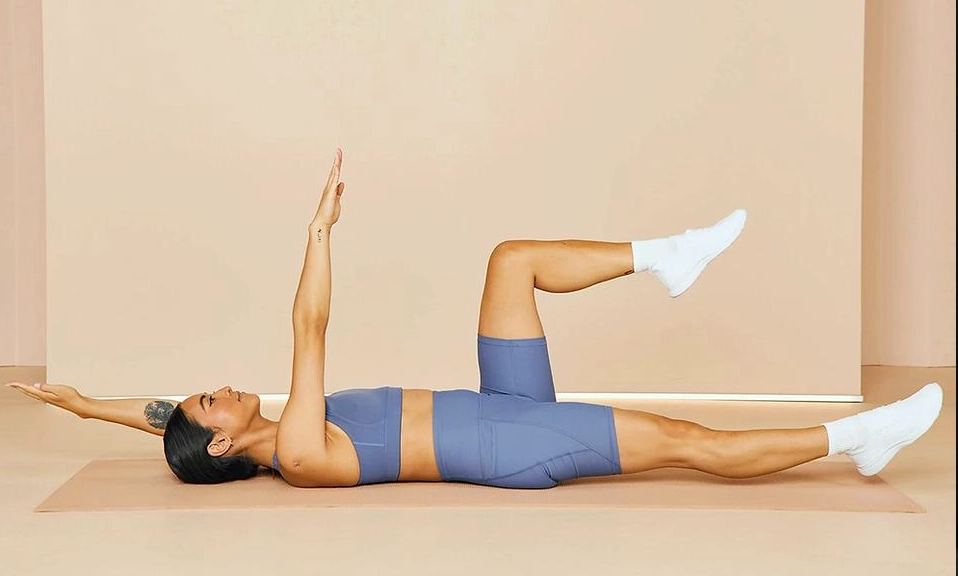
Step 1: The Setup Lie flat on your back on a yoga mat. Raise your arms straight up toward the ceiling, directly over your shoulders. Lift your legs and bend your knees to 90 degrees, so your shins are parallel to the floor (tabletop position).
Step 2: The Crucial First Move (The Imprint) Do not skip this step. Exhale deeply and use your core to press your lower back firmly into the floor. Imagine there is a grape under your lower back, and you are trying to crush it. Your pelvis should tilt slightly backward (posterior pelvic tilt).
Step 3: The Movement Keeping your lower back glued to the floor, slowly lower your right arm overhead and extend your left leg straight out. Inhale as you lower them. Go only as far as you can without letting your lower back arch off the mat.
Step 4: The Return Exhale, engage your core, and slowly pull your right arm and left leg back to the starting position.
Step 5: Alternate Repeat on the other side (left arm, right leg). That is one rep.
🚫 3 Common Mistakes That Ruin the Exercise
If your lower back hurts after doing Dead Bugs, you are doing them wrong. Here is how to fix the most common errors:
Mistake 1: The “Hammock” Back
- The Error: As you lower your leg, your lower back arches up off the floor, creating a “hammock” shape. This means your deep core has disengaged and your lumbar spine is taking the load.
- The Fix: Limit your range of motion. Only lower your leg an inch or two. Or, place your hand under your lower back; if you feel your spine lift away from your hand, you’ve gone too far.
Mistake 2: Rushing the Reps
- The Error: Dropping the arm and leg quickly and snapping them back. This uses momentum, completely bypassing the core.
- The Fix: Slow down. Take 3 full seconds to lower your limbs, pause for 1 second, and take 3 seconds to pull them back. If you are shaking, you are doing it right.
Mistake 3: Holding Your Breath
- The Error: Clenching your jaw and holding your breath while trying to stabilize. This spikes your blood pressure and actually disengages the deep core.
- The Fix: Breathe continuously. Exhale forcefully through pursed lips as you pull your limbs back to the center.
📈 How to Scale It: Modifications and Progressions
The Dead Bug is highly scalable. If the standard version is too hard (or too easy), use these tweaks.
🟢 Make it Easier (Beginner)
- Heel Taps: Keep your arms at your sides. Just keep your lower back flat and slowly tap one heel down to the floor, then bring it back.
- Arms Only: Keep your legs locked in the 90-degree tabletop position and only move your arms overhead.
- Wall Press: Lie with your head near a wall. Press your hands flat against the wall behind you to create leverage and help you feel your core engage.
🟡 The Standard (Intermediate)
- Full Extension: Arms and legs moving as described in the step-by-step guide above.
🔴 Make it Harder (Advanced)
- Add a Resistance Band: Loop a light resistance band around your wrists and around your feet. The band will try to pull your limbs out of alignment, forcing your core to work overtime to resist it.
- The Stability Ball Squeeze: Hold a small stability ball or a pillow between your right hand and left knee. As you extend your left arm and right leg, you must squeeze the ball with your remaining hand and knee to keep it from dropping.
- Add Weight: Hold light dumbbells in your hands or wear light ankle weights.
Boring is Beautiful
In a fitness world obsessed with high-intensity, sweat-drenched, gravity-defying movements, the Dead Bug feels almost… boring. You are literally lying on the floor, moving an inch at a time.
But that is exactly why it works.
It strips away the momentum, the ego, and the flashy mechanics, leaving only the raw, unfiltered function of your core. It teaches your body how to brace, how to breathe, and how to protect your spine under pressure.
Add 3 sets of 10 slow, controlled Dead Bugs to the beginning of your next workout as a warm-up, or to the end as a core finisher. Your lower back will thank you, and your core will finally wake up.