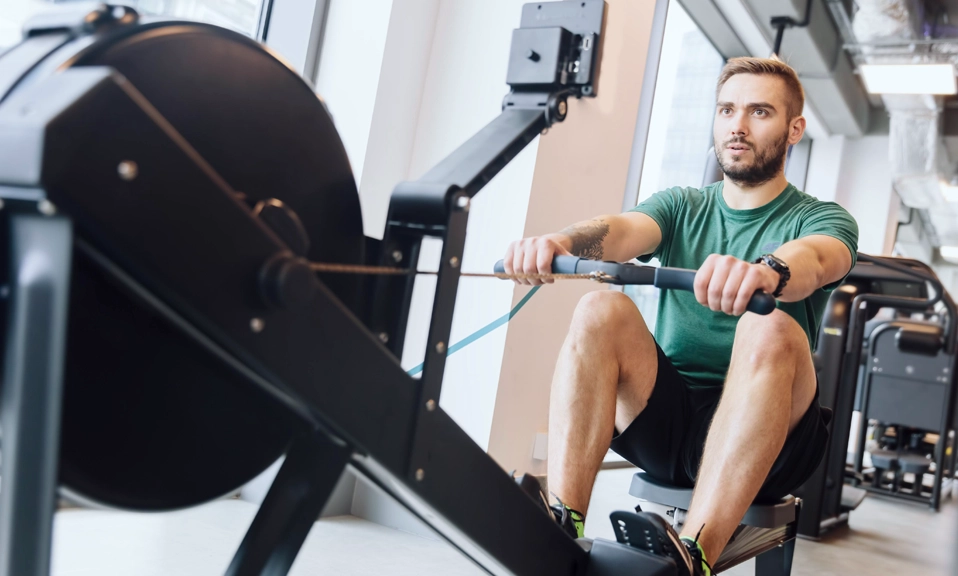
Walk into any gym, and you’ll likely find the rowing machines tucked away in a corner. Some are gathering dust. Others are being ridden by people who look like they are fighting the handle for their life, hunching their backs and pulling with their arms like they’re starting a lawnmower.
It’s no wonder the rowing machine (or “ergometer”) intimidates people. It looks complicated, it requires coordination, and if you do it wrong, it feels incredibly awkward.
But here is the secret that elite athletes and fitness pros know: The rowing machine is the most efficient, full-body, low-impact fitness tool in the gym.
It builds cardiovascular endurance, builds muscle, burns massive calories, and saves your joints—all at the same time. If you are willing to spend a little time learning the technique, it will completely transform your fitness.
Here is your complete, jargon-free guide to mastering the indoor rower, from setting the damper to executing the perfect stroke.
🚣♂️ Why You Should Start Rowing
Before we get to the “how,” let’s talk about the “why.” Why choose the rower over the treadmill or the elliptical?
- The 86% Rule: Rowing engages roughly 86% of the muscles in your body. Every single stroke works your quads, glutes, hamstrings, core, back, shoulders, and arms. It’s cardio and strength training rolled into one.
- Zero Impact: Unlike running, there is no pounding on your joints. The smooth, gliding motion makes it the perfect exercise for people with knee, hip, or ankle issues.
- The Calorie Torch: Because you are using so much muscle mass, your heart has to work incredibly hard to pump blood. A vigorous rowing session can burn 400 to 600+ calories an hour.
🧠 The Golden Rule: It’s NOT an Arm Exercise
If you take only one thing away from this guide, let it be this: Rowing is primarily a leg exercise.
A common beginner mistake is grabbing the handle and immediately yanking it with their biceps. If you do this, your arms will burn out in 60 seconds, and you’ll miss out on the real power of the machine.
The power distribution of a perfect rowing stroke is: 60% Legs | 30% Core/Body | 10% Arms
Your legs are the engine. Your core is the transmission. Your arms are just the steering wheel.
⚙️ Demystifying the “Damper” Setting (The 1-10 Lever)
On the side of the flywheel, there is a lever with numbers from 1 to 10. Most beginners immediately crank it to 10, thinking it’s a “resistance” dial. It is not.
The damper controls how much air gets into the flywheel.
- A setting of 10 feels like rowing a heavy, clunky wooden boat.
- A setting of 1 feels like rowing a sleek, fast racing shell.
The Fix: For 90% of your workouts, keep the damper between 3 and 5. This provides the perfect balance of resistance and speed, mimicking real water dynamics and allowing you to focus on your form rather than fighting the machine.
📝 The 4 Phases of the Perfect Stroke
The rowing stroke is a sequence. You must execute it in the exact right order to be efficient and protect your lower back. Remember the mantra: Legs, Body, Arms on the way back; Arms, Body, Legs on the way forward.
1. The Catch (The Setup)
- Slide forward. Your shins should be vertical (don’t let your knees go past your toes).
- Keep your arms completely straight, reaching for the handle.
- Lean your torso slightly forward (about the 1 o’clock position on a clock face).
- Keep your back flat and your core braced.
2. The Drive (The Power)
- LEGS FIRST: Push explosively through your heels to extend your legs. Keep your arms straight and your back angle exactly the same. The handle should move only because your legs are pushing.
- BODY SECOND: Once your legs are almost flat, swing your hips open, leaning your torso back to the 11 o’clock position.
- ARMS THIRD: Finally, pull the handle into your lower chest/ribcage, keeping your elbows high and wide (not flared out like chicken wings).
3. The Finish (The End Position)
- Your legs are flat.
- Your torso is leaning back slightly (11 o’clock).
- Your arms are bent, and the handle is lightly touching your lower ribs.
- Your shoulders should be down and relaxed, not hunched up by your ears.
4. The Recovery (The Active Rest)
- ARMS FIRST: Straighten your arms out completely, leaning your torso forward over your hips (back to 1 o’clock).
- BODY SECOND: Keep your arms straight as your body continues to pivot forward.
- LEGS THIRD: Once the handle has cleared your knees, bend your knees and slide the seat forward back to “The Catch” position.
🚫 3 Rookie Mistakes That Ruin Your Row
Mistake 1: “Shooting the Slide”
- The Error: You push with your legs, but your back is open (leaning back) and your arms are bent. The seat slides back, but the handle doesn’t move. You’re just doing a leg press.
- The Fix: Keep your core tight and your back angle locked until your legs are almost flat.
Mistakeake 2: Rushing the Recovery
- The Error: You finish the drive and immediately slam your body forward and shoot your knees open to get back to the catch. This kills your momentum and exhausts you.
- The Fix: The recovery should be relaxed and take twice as long as the drive. Think: Drive fast, recover slow.
Mistake 3: Hunching the Shoulders
- The Error: Pulling the handle up to your chin or neck, and shrugging your shoulders up to your ears. This leads to neck and shoulder pain.
- The Fix: Keep your shoulders depressed (pushed down). The handle should travel in a perfectly flat, horizontal line to your lower sternum.
🏋️♂️ The 20-Minute Beginner Workout
Now that you know the mechanics, let’s get on the water. This workout focuses on form and consistency, not raw speed.
Note: Look at the monitor for “spm” (strokes per minute). Beginners always row too fast. Keep your spm low to focus on powerful, clean strokes.
Phase 1: The Warm-Up (5 Minutes)
- Minutes 0-2: Row at a very light pressure. Focus entirely on the sequence: Legs, Body, Arms.
- Minutes 2-5: Add a little power. Pause for 1 second at the “Catch” (the setup) before every stroke to ensure your shins are vertical and your back is flat.
- Target Stroke Rate: 16–18 spm.
Phase 2: The Main Set (12 Minutes) We are doing 3 rounds of 3 minutes of rowing, followed by 1 minute of complete rest.
- Round 1 (3 mins): Row at a moderate, steady pace. Focus on a strong leg push. Target: 18–20 spm.
- Rest (1 min): Sit on the edge of the seat, shake out your arms, and breathe.
- Round 2 (3 mins): Pick up the power slightly. Focus on a long, slow recovery. Target: 20–22 spm.
- Rest (1 min): Stand up, stretch your hips, and reset.
- Round 3 (3 mins): Empty the tank. Row with strong, deliberate power, but keep your form perfect. Target: 22–24 spm.
Phase 3: The Cool-Down (3 Minutes)
- Minutes 0-3: Extremely light paddling. Let your heart rate come down. Focus on long, reaching strokes at the catch.
- Finish: Unstrap your feet, stand up, and do a quick standing hamstring and hip flexor stretch.
Form First, Speed Second
The indoor rower is a machine that rewards patience. If you try to muscle through it with bad form, you will just get tired and frustrated. But if you take two weeks to just practice the sequence—Legs, Body, Arms—at a slow stroke rate, something magical happens.
Suddenly, the handle feels light. The seat glides effortlessly. Your heart rate skyrockets, but your muscles don’t burn out. You’ve unlocked the rhythm of the row.
Stop avoiding the corner of the gym. Drag that chair up to the monitor, set the damper to 4, and start building your engine.