The transcript is not a byproduct. It is the foundation on which every downstream task is built—the meeting summary, the customer support ticket, the clinical note, the voice agent’s response. Every error at the transcription stage travels downstream, where it costs far more to fix. This is the quiet truth that makes ElevenLabs’ Scribe v3, launched on November 10, 2026, more significant than a routine model update. It is an attempt to get the foundation right the first time.
Scribe v3 is not a consumer app. It is a speech-to-text model for recorded audio, available through ElevenAPI and the ElevenLabs app, where it is now the default transcription layer. Its sibling, Scribe v3 Live, handles realtime audio for voice agents and live calls. Together, they represent ElevenLabs’ most accurate speech-to-text models to date—and the numbers behind that claim are worth examining closely.
🎯 The Accuracy Story: 27% Fewer Errors Across 102 Languages
The headline claim is straightforward: Scribe v3 makes 27% fewer word errors than Scribe v2 across 102 languages, measured on the FLEURS benchmark. The improvement is not uniform—it is largest in German (42%), followed by Spanish (35%), Swahili (34%), Tamil (29%), Thai (28%), and English (23%)—which suggests the model has made genuine gains in languages that have historically been harder for transcription systems.
Independent testing has put the claim in context. On the Artificial Analysis leaderboard for recorded audio, read on November 12, 2026, Scribe v3 ranked second among 64 models at 1.9% word error rate, behind Alibaba Cloud’s Fun-Realtime-ASR-preview at 1.7%. One analysis noted that Scribe v3 is “among the most accurate transcription models, but lags competitors in speed and price”. That is a fair characterization: Scribe v3 is not the fastest or the cheapest, but it is among the best at getting the words right.
🗣️ Diarization and Turn Detection: The Real-World Wins
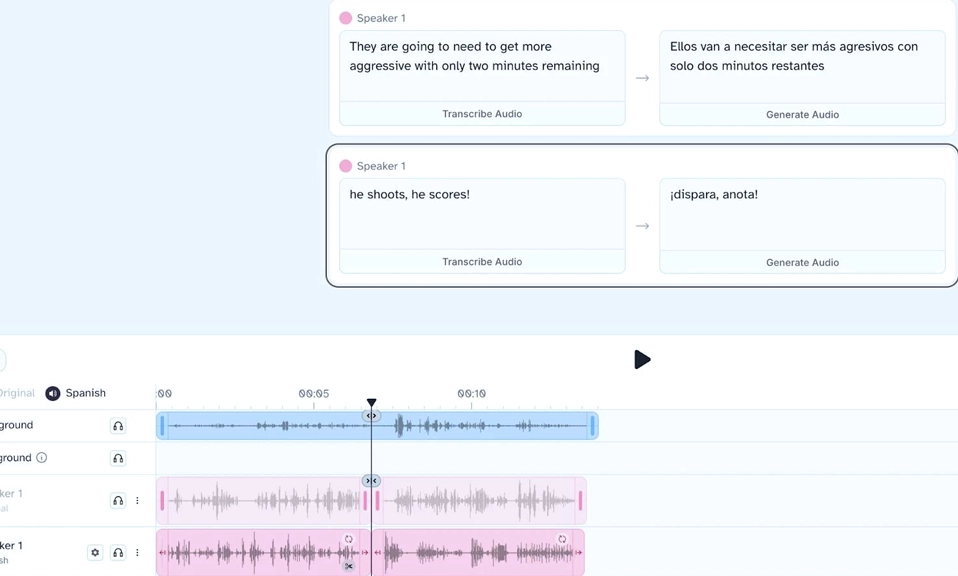
Raw word accuracy matters, but the feature that will change the most workflows is speaker diarization—the ability to label who said what. Scribe v3 makes 17% fewer diarization errors than Scribe v2 on recordings with three or more speakers, which are precisely the recordings where most models fail. The realtime variant, Scribe v3 Live, brings diarization to live transcription for the first time, with 39% fewer diarization errors than the next-best realtime model tested.
The Live model also introduces a smarter form of turn detection. Traditional voice agents rely on silence thresholds to decide when a speaker has finished—a short threshold interrupts people who pause mid-sentence, and a long one makes the agent feel sluggish. Scribe v3 Live uses the context of the conversation as well as the audio, so a caller who pauses halfway through reading out a number is not cut off. This is the same turn detection already used inside ElevenAgents, now available in the API.
🌐 Languages, Terminology, and Control
Scribe v3 supports 102 languages, and it can infer hints about which languages a recording contains—useful for mixed-language audio, where callers switch mid-sentence. Developers can choose whether numbers are returned as digits or words, attach a keyterm prompt of up to 10,000 terms (enough for a full legal or medical vocabulary), and define transcript edits through formatting rules written in plain English. For multilingual workflows, a secondary_language_codes parameter handles mid-sentence language changes.
The Live model’s keyterm library supports up to 10,000 domain-specific terms, and the batch model supports 1,000 terms. These are the kinds of controls that separate a demo from a dependable production step: the ability to tell the model that “Himax” is not “high max,” or that “Nguyen” is a surname, not a misheard English word.
💰 Pricing: Competitive, But Not the Cheapest
Scribe v3 is priced at $0.20 per hour of audio** for batch transcription, and Scribe v3 Live is **$0.22 per hour—unchanged from the previous generation. A ten-minute file costs about four cents.
The comparison with rivals is instructive. AssemblyAI lists at $0.15 per audio hour** and **OpenAI’s mini model at $0.18—both cheaper than Scribe v3. Deepgram Nova-3 is $0.258**, **Google Chirp 2 is $0.96, and AWS Transcribe is $1.44, making Scribe v3 competitive against the more expensive options but not the value leader against AssemblyAI or OpenAI. For teams already inside the ElevenLabs ecosystem—using ElevenAgents for voice automation, or the ElevenLabs app for dubbing—the integration and the accuracy gains may justify the premium. For teams purely optimizing on cost, AssemblyAI and OpenAI are worth benchmarking against the same audio.
🛡️ Deployment and Compliance: Built for Enterprise Pipelines
Scribe v3 is available in US, EU, India, and Singapore environments, serving enterprise data residency requirements. A Zero Retention Mode deletes audio and text once a request completes, and the stack carries SOC 2, ISO 27001, and PCI DSS Level 1 certifications. It is HIPAA-eligible with a BAA, and a version of Scribe v3 Live optimized for medical conversations is available in ElevenAgents. For teams in healthcare, legal, or financial services—industries where transcription accuracy is not a convenience but a compliance requirement—these are not minor features. They are the difference between a tool that can be deployed and one that cannot.
⚠️ The Caveats: What Scribe v3 Does Not Solve
No model is perfect, and Scribe v3 has documented weaknesses that matter for real-world deployment.
Speed is not its strength. Independent analysis notes that Scribe v3 “lags competitors in speed,” and some Microsoft and xAI products offer faster processing and lower costs. For high-volume, latency-sensitive batch pipelines, this is a meaningful trade-off.
The accuracy claim is vendor-benchmarked. The 27% figure comes from ElevenLabs’ own testing on FLEURS. Independent testing confirms Scribe v3 is among the best, but the specific percentage will vary with audio quality, accents, background noise, and domain-specific terminology. As one analysis put it: “test it on your own audio before you rely on it”.
The realtime model is not a drop-in replacement for every use case. Scribe v3 Live is optimized for voice agents and live calls, not for transcribing a podcast or a recorded lecture. Choosing the wrong model for the job will produce results that are technically functional but practically suboptimal.
💎 A Foundation Worth Building On
Scribe v3 is not the cheapest transcription model, and it is not the fastest. But it is among the most accurate, and it brings features—diarization in realtime, context-aware turn detection, a 10,000-term keyterm library, plain-English transcript edits—that directly address the pain points of the teams that depend on transcription most: meeting-notes apps, contact centers, clinical documentation, and voice agents.
The strategic logic is sound. Transcription is the first stage of a pipeline. Every later step—the summary, the CRM note, the support ticket, the agent’s response—can only be as good as the text it receives. Getting that text right the first time is worth paying a small premium for, especially when the alternative is a downstream error that costs far more to fix. Scribe v3 is not a revolution in speech recognition. It is a deliberate, well-engineered improvement to the foundation—and for teams building on that foundation, it is a model worth testing against their own audio.