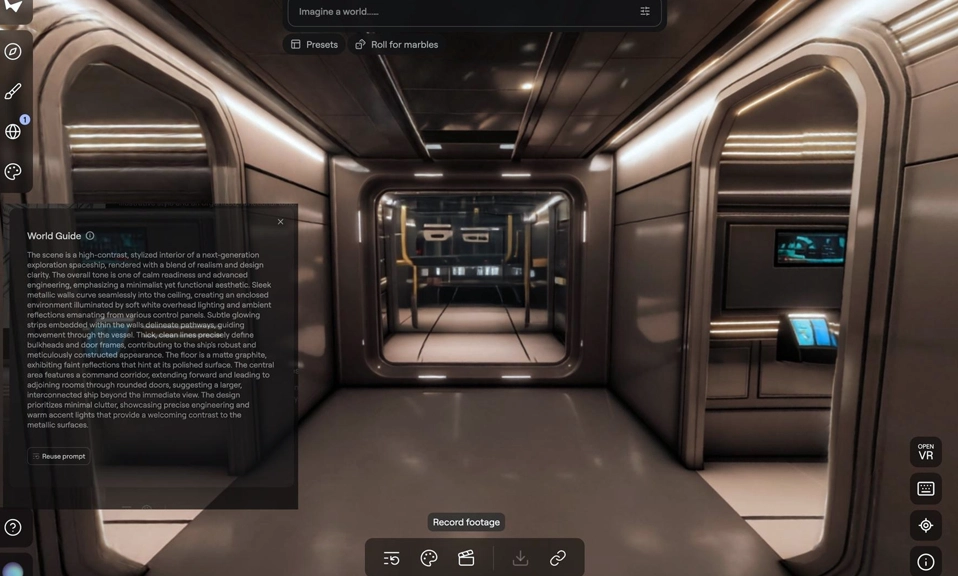
The image is flat. A photograph of a room, a painting of a landscape, a single frame from a video game. For most AI tools, that image is the end of the story—a static picture to be captioned, edited, or admired. For World Labs’ Atlas, it is the beginning of a world. Atlas takes a single image and does something that feels genuinely magical: it turns it into an explorable 3D environment, a space you can fly a camera through, look around inside, and export as a video, a set of keyframes, or a 3D Gaussian splat ready for a game engine. It is not a filter or a clever trick. It is a world model—a new kind of AI built to understand and reconstruct the spatial fabric of reality.
Atlas, unveiled by Fei-Fei Li’s World Labs on September 1, 2026, and opened to the public on November 12, 2026, represents a significant shift in what generative AI can do. The first wave of AI image tools learned to describe the world. The second wave learned to generate images of it. Atlas is part of a third wave: AI that attempts to understand the world in three dimensions, with geometry, depth, and spatial consistency. And for creators, developers, and anyone who has ever wanted to step inside a picture, it is a tool worth understanding.
What Atlas Actually Is: An Omni World Model
The technical description is dense, but the core idea is simple. Atlas is an omni model—a single, unified system that was pretrained from scratch to natively operate on text, images, video, and 3D data simultaneously. Unlike earlier video generators that rely on imprecise text prompts to guess at camera angles, Atlas ingests camera trajectories and geometry as native inputs. That means you can specify exactly where the camera should be, what angle it should face, and how it should move, and Atlas generates views that are consistent with the 3D structure of the scene.
The architecture is a multimodal autoregressive diffusion transformer. In plain terms, Atlas encodes everything it is given—an image, a video, a set of camera poses—into a shared spatial context. It then generates what comes next by staying consistent with the 3D world it has inferred, imagining what lies beyond the edges of the input image. This is why it can generate the back of an object it has only seen from the front, or invent a plausible continuation of a room that was only partially photographed. It is not simply stitching images together. It is building a world in its latent space and rendering views of that world.
From a Single Image to an Explorable Space
The headline capability—and the one that has captured the most attention—is image-to-3D generation. Give Atlas a single photograph, and it will reconstruct a scene you can explore from new viewpoints. The output is not a flat panorama. It is an explicit 3D representation, typically a point cloud or a 3D Gaussian splat, which can be rendered in real time and imported into tools like Blender, Unity, or Unreal Engine.
The system can also work from multiple overlapping photos of a real place, producing a more detailed and accurate reconstruction. It can generate up to one minute of video at 1440p resolution with pixel-perfect camera control, and it can simulate space and time from input videos, enabling “real-to-sim” workflows for robotics. In human evaluations, Atlas’s camera control was preferred over Google’s Gemini Omni Flash 81% of the time, and over MiniMax’s H3 75% of the time—a strong signal that its spatial understanding is not just technically impressive but perceptually convincing.
The Tools: Four Ways to Build a World
When World Labs opened Atlas to the public on November 12, it did so with four distinct tools, each serving a different kind of creator.
Viewfinder is the purest expression of the image-to-world promise. You give it a photo or a set of photos, and it reconstructs the scene as a 3D space you can fly a camera through. It can generate new camera angles, render camera paths, and export the result as a video or a splat. If you have ever wanted to see what is around the corner in a photograph, Viewfinder is the tool that shows you.
Chisel takes a different approach. Instead of starting from a photo, you start with simple shapes—planes, blocks, basic geometry—and block out a scene. Then you describe the aesthetic you want in text or provide a reference image, and Atlas styles the blockout into a finished set. Every camera view updates as objects move, making it a kind of spatial sketching tool for set design and previsualization.
Splats to Mesh converts a Gaussian splat into a polygon mesh with real geometry, ready for games and interactive environments. This is a crucial bridge between the world of neural rendering and the world of traditional 3D pipelines.
Relight allows you to change the lighting on an existing splat scene—a small but powerful tool for compositing and look development.
Alongside these, World Labs offers Frameboy, a real-time viewer that streams a world from cloud GPUs to your browser at up to 15 frames per second while you steer the camera. It is still labeled a research preview, but it hints at a future where explorable AI-generated worlds are as easy to open as a web page.
What It Costs (and the Licence Catch)
Atlas is not free, but the pricing is transparent and credit-based. A finished 3D splat scene costs $5**. A **minute of real-time exploration** costs **$0.50. Chisel captions cost $0.02 each. Credits convert at 1,000 per US dollar and do not expire.
There is one important catch for anyone using the free tier: anything you make on a free account belongs to World Labs, not to you〔7†L13-L14〕. If you intend to use your creations commercially, you need to pay. For hobbyists and experimenters, the free tier is a generous way to try the technology. For professionals, the $5-per-splat price is a modest entry point for a tool that can generate a usable 3D asset from a single image.
The Context: Fei-Fei Li and Spatial Intelligence
Atlas is not an isolated product. It is the culmination of an idea that Fei-Fei Li has been advocating for years: spatial intelligence. Li, the computer vision pioneer who co-founded World Labs in 2024, has argued that true artificial general intelligence is impossible without an AI that can reason natively about the 3D world—objects, environments, and the spatial consequences of actions within them. World Labs has raised $1.2 billion from backers including Nvidia, AMD, and Autodesk to pursue this vision.
Atlas is the clearest expression of that vision yet. It is not just a creative tool, although it is a powerful one. It is a step toward AI that can simulate the physical world in high fidelity, helping robots plan actions, enabling creators to build immersive environments, and giving anyone the ability to step inside an image and look around.
A New Kind of Creative Primitive
Atlas is not a toy, and it is not a finished product. It is a world model—a new kind of AI primitive that turns flat images into explorable spaces. The tools are accessible, the pricing is reasonable, and the technology is genuinely impressive. For 3D artists, game developers, filmmakers, and anyone who works with spatial content, it is a tool worth trying today. For everyone else, it is a glimpse of where AI is heading: from generating pictures to generating places.
The image is no longer the end. It is the doorway. And Atlas is the key.