In June 2026, something happened that would have been unthinkable 10 years ago.
The United States — the country that invented pop music as a global business — officially became the biggest overseas market for K-pop for the first time, overtaking China.
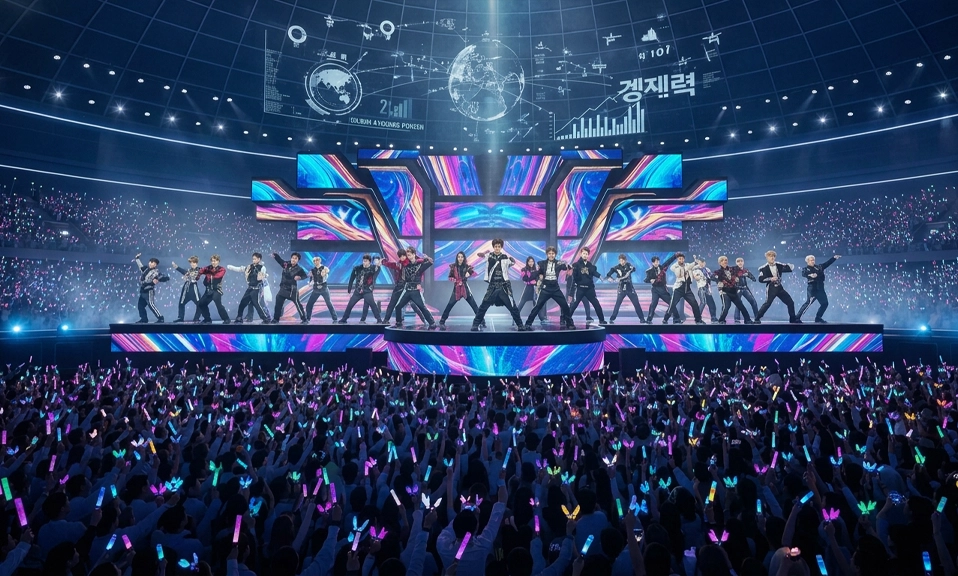
K-pop conquers Billboard as US leapfrogs China to emerge as its biggest export market. The US has become the largest overseas market for K-pop for the first time, marking a symbolic shift for an industry that for decades relied primarily on Asian consumers.
At the American Music Awards the same month, K-pop acts collectively secured 11 wins across categories.
It represented a symbolic shift in global music power, where K-pop was embedded into the structure of global mainstream entertainment.
The biggest moment of the night belonged to BTS. Returning to the AMAs for the first time in four years following military service hiatuses.
How did a country of 52 million people, speaking a language most of the world doesn’t speak, build an entertainment system that beat Hollywood at its own game?
It didn’t happen by accident. Korea engineered it.
1. It Started With a Government Plan, Not a Song
In 1998, after the Asian Financial Crisis, South Korea’s president Kim Dae-jung made a decision: We have no oil, no big land, but we have people and internet. Let’s export culture.
The government funded:
- Broadband everywhere (Korea was first country with nationwide high-speed internet in 2000)
- KOCCA — Korea Creative Content Agency — to fund music, drama, games
- Tax breaks for entertainment companies
While America was fighting Napster, Korea was building studios designed to create groups for export from day one. Lyrics had English hooks, choreography was made to be mirrored on YouTube, training systems were 7 years long.
Hollywood said: Make product, then find audience.
K-pop inverted this entirely. One thing that immediately stands out is how K-pop flipped the traditional entertainment model. Instead of creating content and then finding an audience, K-pop groups like BTS built their audience first.
2. The BTS Blueprint: Fans Are Not Fans, They Are Owners
American entertainment traditionally worked one way: make the product, find the audience. K-pop inverted this entirely.
BTS didn’t get big because BigHit spent millions on radio. They got big because in 2013-2015, when no one watched them, they went on Twitter (now X) and VLive for 3 hours a day, talking to 200 fans directly. They learned names. They made inside jokes. They let fans vote on everything.
By the time “Dynamite” hit #1 in America in 2020, BTS had 40 million ARMY who felt like they raised them.
This emotional honesty resonates deeply, especially in a world tired of superhero clichés.
Today, Spotify‘s 2026 data shows the scale clearly: K-Pop became the first non-English genre to account for over 15% of global top 50 streams. It’s not a niche. It’s infrastructure.
The fan engagement model proved equally revolutionary.
3. K-Pop Is Not Just Music — It’s a Gateway Drug to All of Korea
The real economic value of K-Pop is not solely measured by concert ticket sales, but by its incredible ability to establish an infrastructure of cultural familiarity that continuously drives the demand for Korean lifestyle goods worldwide.
Cultural Gateway: K-Pop serves as a powerful entry point, with 64.8% of global fans influenced to buy Korean products in 2026.
Think about what happened to you:
- You liked BLACKPINK → You watched a Blackpink vlog eating tteokbokki → You tried Korean fried chicken
- You liked BTS → You watched them do skincare → You bought CeraVe? No, you bought Laneige and Cosrx → K-beauty now $13B export industry
- You liked NewJeans → You watched their drama → You got Netflix to watch Squid Game, The Glory, K-Pop Demon Hunters
The success of the 2025 animated film K-Pop Demon Hunters, which quickly became the most watched original title in Netflix’s history with more than 300 million views worldwide, may be seen not only as evidence of the global dominance of the Korean wave but also as a declaration.
In March 2026 the animated film ” KPop Demon Hunters”, the most-watched film in the history of Netflix, won two Academy Awards, and BTS returned after a break of almost four years with an album named after the Korean folk song “Arirang”. Yet the film was made by a Hollywood studio for an American platform, and the BTS comeback concert in central Seoul was streamed to the world by that same platform.
Hallyu has become a global industry.
A kid in São Paulo who stans Stray Kids now uses 10 Korean words a day, eats kimchi, and does a 10-step skincare routine. That’s not just music dominance. That’s cultural software installation.
4. The System Is Brutal — And Perfected
Let’s be honest: K-pop’s takeover wasn’t all cute lightsticks.
The trainee system: Kids audition at 11, train 12 hours a day for 5-7 years in singing, dancing, languages, media training, no dating. 90% never debut.
The business system: Companies like HYBE (12% market share), Kakao + SM (8% market share but largest IP portfolio in existence spanning idol group, webtoon, drama) control everything — music, merch, webtoons, games, Weverse fan platform where you pay $30/month to message your idol.
Its acquisition of majority control over SM Entertainment, one of the original architects of the K-pop global expansion, created a combined entity with unmatched IP depth.
Unlike Hollywood’s endless ‘development hell,’ Korean projects are built for completion, with room for last-minute creative shifts.
Result: While Hollywood takes 5 years to make a movie that flops, Korea can produce a 16-episode drama, a 12-song album, a webtoon, and a game in 6 months — all connected.
5. Why 2026 Is The Tipping Point
Streaming platforms reported record viewership for newly released Korean shows during May 2026, while global concert demand for leading K-pop groups remained exceptionally high.
Three things happened in 2026:
1. US became #1 market. K-pop doesn’t need Asia to survive anymore. It now makes more money from American stadium tours than Japanese domes.
2. Language barrier died. Gen Z grew up watching subtitled anime and K-dramas. They don’t need English lyrics to feel something. Spotify shows Korean lyrics searches up 200% in 2026.
3. Hollywood started copying Korea, not other way around. KPop Demon Hunters was made by Sony Pictures Animation for Netflix — an American movie about K-pop, using Korean storytelling beats. BTS comeback album named after Korean folk song “Arirang” went #1 in 87 countries singing mostly in Korean.
It demonstrated that a carefully developed local entertainment industry can become a global cultural system without abandoning its language or identity.
Korea didn’t win by becoming more American. It won by becoming more Korean — and making the world learn Korean.
What Comes Next?
It will be measured by packed stadiums in Madrid, fan festivals in São Paulo, sold-out arenas in Mexico City, and streaming records set by listeners from every corner of the world. If 2026 has shown us anything, it’s that K-pop has officially become a truly global genre.
World tours will grow even larger, international collaborations will become more common, and fans everywhere will continue shaping the future of the industry.
The old model: America exports culture, world imports.
The new model: Korea exports a system — music + drama + beauty + food + fandom tech — and world lives in it.
You don’t have to like BTS. But if you have a 10-step skincare routine, ate Korean corn dogs last week, and watched a subtitled show on Netflix — you already live in the world K-pop built.
Who converted you — BTS, BLACKPINK, NewJeans, or a K-drama? Be honest, what was your gateway?